
Diagnose the trial before adding more reminders
David A · Founder, 1212 Agency
Published November 16, 2026

Review a SaaS trial using a defined cohort, real activation evidence and a complete outcome window. Separate product friction, buyer fit and lifecycle problems.
A weak trial-to-paid rate does not tell you which part of the product journey needs work. The audience may be unsuitable, the first useful action may be hard to reach, the trial may require a sales decision, or the measurement may combine incompatible users.
Before adding another reminder, define the cohort and inspect the actual path. This guide uses a fictional software trial to show how to build a diagnosis. The numbers are illustrative arithmetic, not SaaS benchmarks or 1212 client performance.
Define the trial population
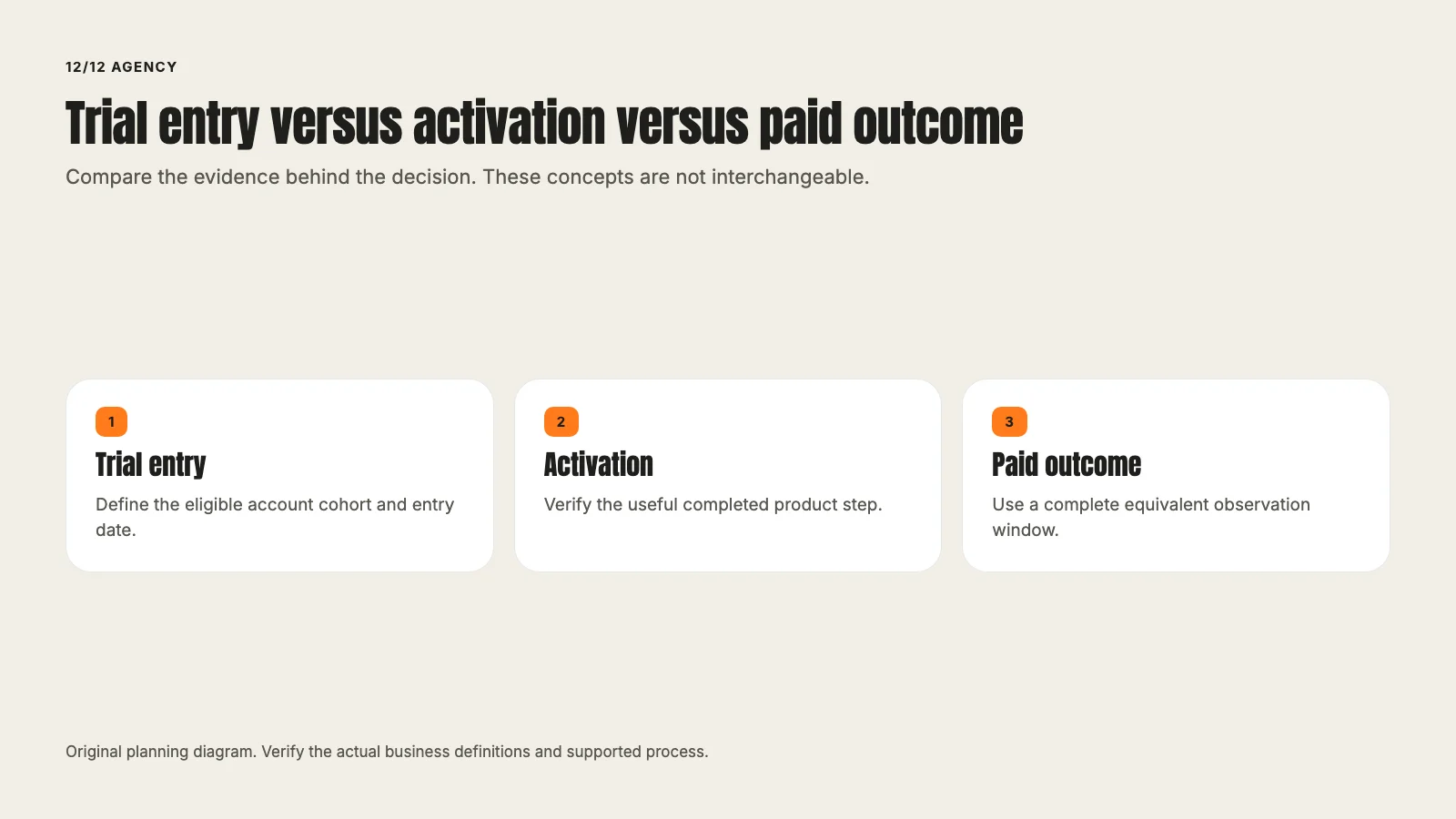
Specify who enters the denominator. An account created, an eligible trial started and a person invited to an existing account are not the same thing. If one company can create several users, decide whether the analysis follows accounts or people.
Use one entry period and record the trial start time. Keep internal tests, duplicates and ineligible records separate. If a user can restart a trial, define how that behavior affects the cohort rather than allowing each restart to look like a new prospect.
The fictional product has 200 eligible account trials starting in a calendar month. That figure excludes employee accounts and invitations to existing customers. It does not say that all 200 accounts have completed their evaluation window.
Choose an activation event with product
Activation should describe a useful completed step, not merely convenient tracking. A project-management product might need a project used by the team. A scheduling product might need a published schedule. The precise event belongs to the product's value proposition.
Document the evidence behind the event. A click on Save does not prove that the object persisted. An empty project may not prove meaningful use. A product team can decide on a practical proxy, but the report should name it accurately.
In the example, 80 of the 200 trials publish a first usable schedule within the defined activation window. The descriptive activation rate is 40%. That does not establish what rate another product should achieve.
Give outcomes time to occur
A trial that started yesterday cannot be judged against one that began several weeks ago. Compare cohorts with equivalent observation windows, and distinguish completed from still-open evaluations.
Suppose the fictional business records 20 paid accounts after every account has had the same agreed window. The trial-to-paid rate is 20 divided by 200, or 10%. If 16 of those paid accounts came from the 80 activated trials, their descriptive activation-to-paid rate is 20%. These related ratios answer different questions.
Do not conclude that activation caused payment from this comparison alone. Buyers who were already more motivated may be more likely to both activate and purchase. The association is useful for investigation, not proof of a causal effect.
Inspect where suitable users stop
Walk through the product on the supported devices and roles. Look for reproducible failures, unclear instructions, missing prerequisites and permissions. Ask support which tasks repeatedly require help.
A failed invitation, an unclear import requirement or an unsupported integration may be the reason a suitable buyer cannot proceed. Email cannot repair those conditions. A product defect needs a verified fix; an unsupported capability needs an accurate explanation.
Also examine whether the acquisition message created the wrong expectation. A campaign promising a capability the product lacks can generate enthusiastic signups that never had a chance to convert. The appropriate response may be a message correction, not a longer trial.
Separate buyer-fit and product-use questions
Review suitable and unsuitable accounts using criteria the team can actually verify. A tiny team testing an enterprise workflow may differ from a qualified buyer waiting for security approval. Avoid treating every incomplete trial as one generic inactive segment.
For each meaningful group, ask what information or action would allow progress. A suitable administrator may need a setup explanation. A buyer conducting a team evaluation may need current security documentation. Someone outside the product's supported use case needs an honest boundary.
Do not infer sensitive personal traits or invent a lead score from sparse behavior. The purpose is to understand the operational journey and improve accurate guidance.
Use lifecycle messages for the gap they can address
A useful reminder names an unfinished, supported action and leads to the right destination. It stops when the action is complete. It respects role, preferences and account state.
Our proposed onboarding email framework uses a fictional state map rather than a fixed sequence sent to everyone. The same principle applies to trials: define eligibility and exit rules before scheduling messages.
If the trial requires a real deadline, price or plan boundary, verify those facts for the current account. Do not create false urgency. A promotional offer also needs appropriate approval and cannot be invented to improve the model.
Write one change hypothesis
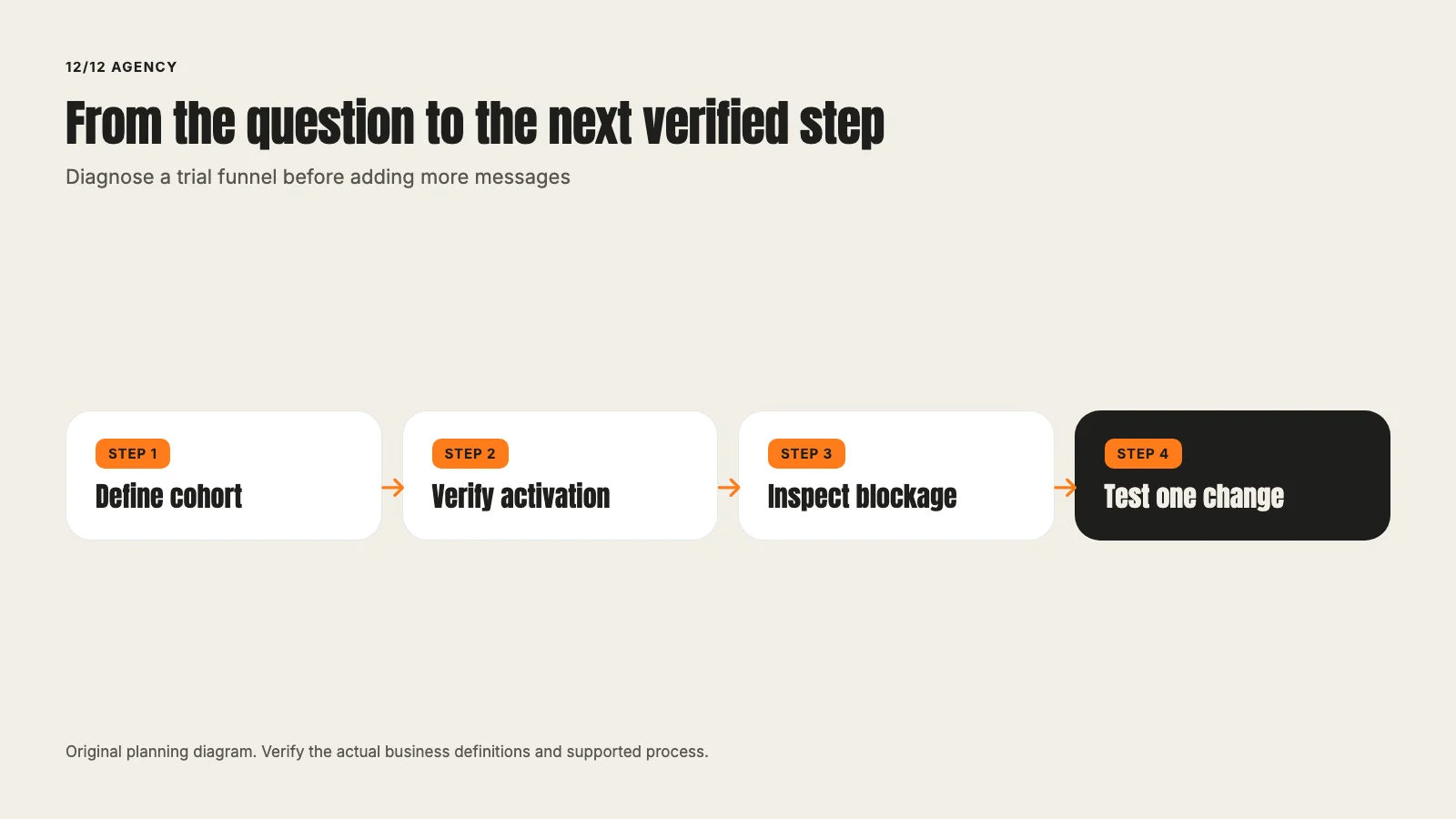
After the diagnosis, choose the next question the evidence can answer. For example: suitable administrators appear to stop because the first-schedule instructions omit a required timezone step. A proposed change could clarify that step in the product and the relevant help resource.
Decide whether this is a correction or an experiment. A reproducible defect can be repaired and checked. An uncertain alternative may require a planned comparison, with traffic and statistical limitations made explicit.
Keep other changes visible. Revising the audience, trial length, price and onboarding at once makes it difficult to interpret why outcomes changed. Business urgency may still require several changes, but the report should not pretend to isolate one cause.
Review a complete cohort again
Use the same definitions and observation windows where possible. Report entry, activation, purchase, missing evidence and still-open evaluations separately. Record product releases, acquisition shifts and operational changes that affect comparability.
Look beyond the headline rate. A higher trial-to-paid percentage can accompany fewer total suitable trials. A change that removes unsuitable signups may improve fit even if signup volume falls. A new paid account is not proof of retention or collected lifetime value.
Bring the cohort definition and one observed blockage to a review. Start with the evidence behind the rate.
Turn the diagnosis into a cohort worksheet
Use one row per entry cohort, with account definition, entry dates, activation rule, complete outcome window, paid outcome and missing evidence. Keep the underlying counts beside every percentage. This makes it possible to see whether an apparent improvement reflects a changed denominator or a genuine difference in the recorded journey.
The SaaS overview provides the commercial context. The B2B SaaS guide, general lead-generation guide and tracking guide help preserve the stage definitions. The SaaS demand-generation article addresses distribution rather than replacing product diagnosis.
If acquisition campaigns use these events, review Google's conversion-goal documentation against the actual account. If the team wants to infer an effect from a comparison, the NIST two-proportion reference illustrates that a statistical method has assumptions beyond a visible rate difference.
The worksheet's final column should name the next product or lifecycle question. One example is whether eligible administrators can complete the required timezone step. That is a more useful task than improve activation without identifying the observed blockage or how the next change will be checked.
Keep the product release in the cohort record
A changed setup flow can alter what activation means. Record the relevant release and any event-definition change alongside the cohort. If an older version reports a different step, do not compare its rate as if the definitions were identical.
The same applies to trial eligibility and plan boundaries. A smaller denominator after a policy change can improve the percentage without improving the experience of an equivalent user. The diagnosis should preserve that operational context before proposing more messages.
Frequently asked questions
Want this run for your business?
Tell us where to send it and we'll follow up with the strategies that fit your market.