
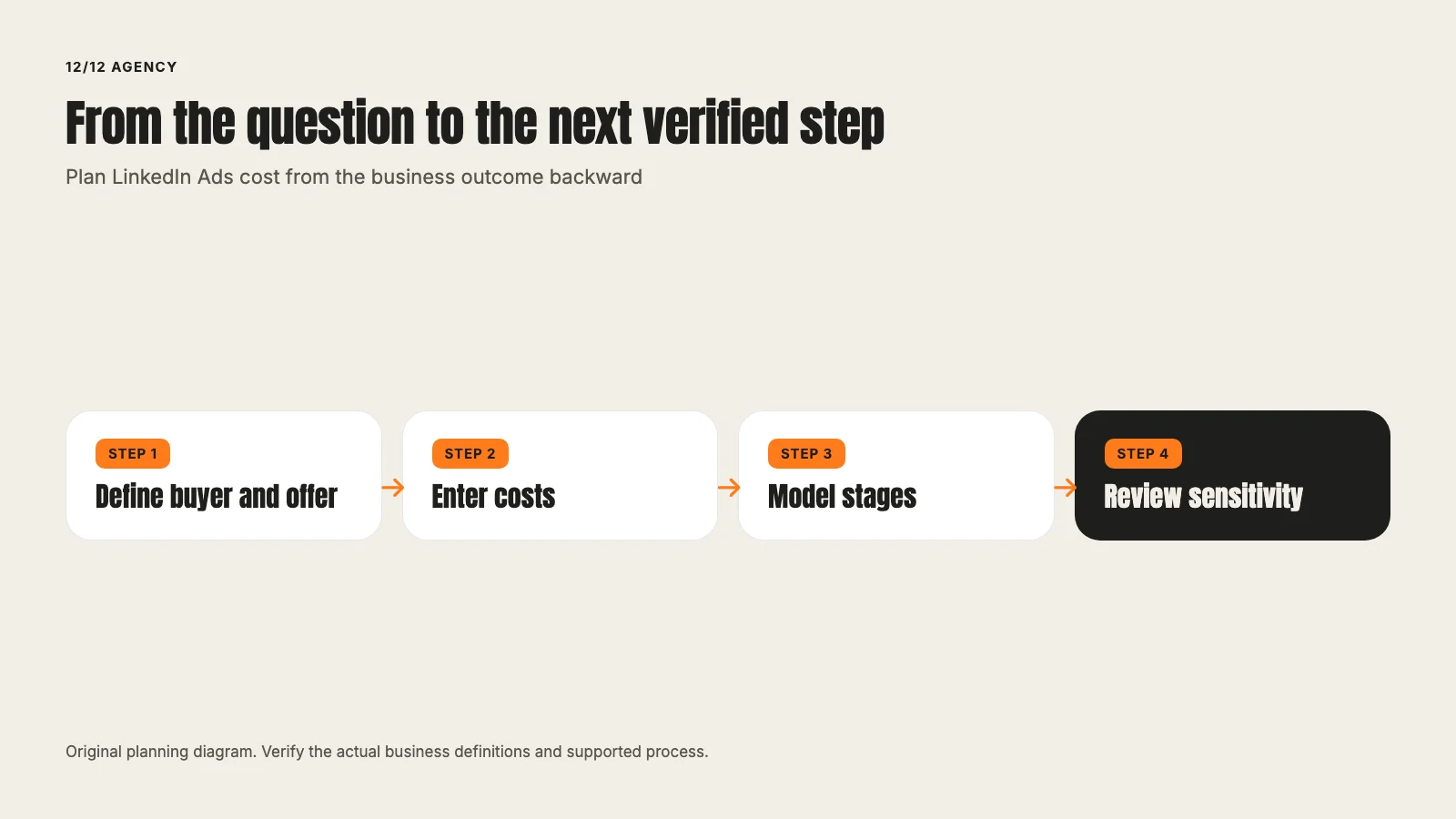
Plan LinkedIn Ads cost from the business outcome
David A · Founder, 1212 Agency
Published November 16, 2026

Model LinkedIn Ads using your own cost, conversion and qualification assumptions. Separate auction charges, media, management and the verified business result.
A LinkedIn click price does not tell you what a suitable sales conversation will cost. The audience, offer, charging event, page and later qualification all affect the comparison. A useful budget starts with the business outcome and makes each assumption visible.
This guide builds an input-led cost model rather than publishing a universal LinkedIn benchmark. Its numerical examples are fictional. They explain the calculation and should be replaced with the business's own observed evidence or clearly labeled planning assumptions.
Identify what the platform charges for
LinkedIn's current pricing overview explains that costs depend on the auction and the selected objective's billable event. Do not assume every campaign is charged for the same kind of click or impression.
The bidding guidance is the primary reference for the supported choices. Verify the actual account setup before interpreting a result or proposing a change. A glossary definition is not a substitute for the campaign's current configuration.
The LinkedIn service page supplies the commercial context. This article does not authorize a bid, budget or objective change. It helps the team understand the cost boundary of a proposed test.
Define the action the business needs
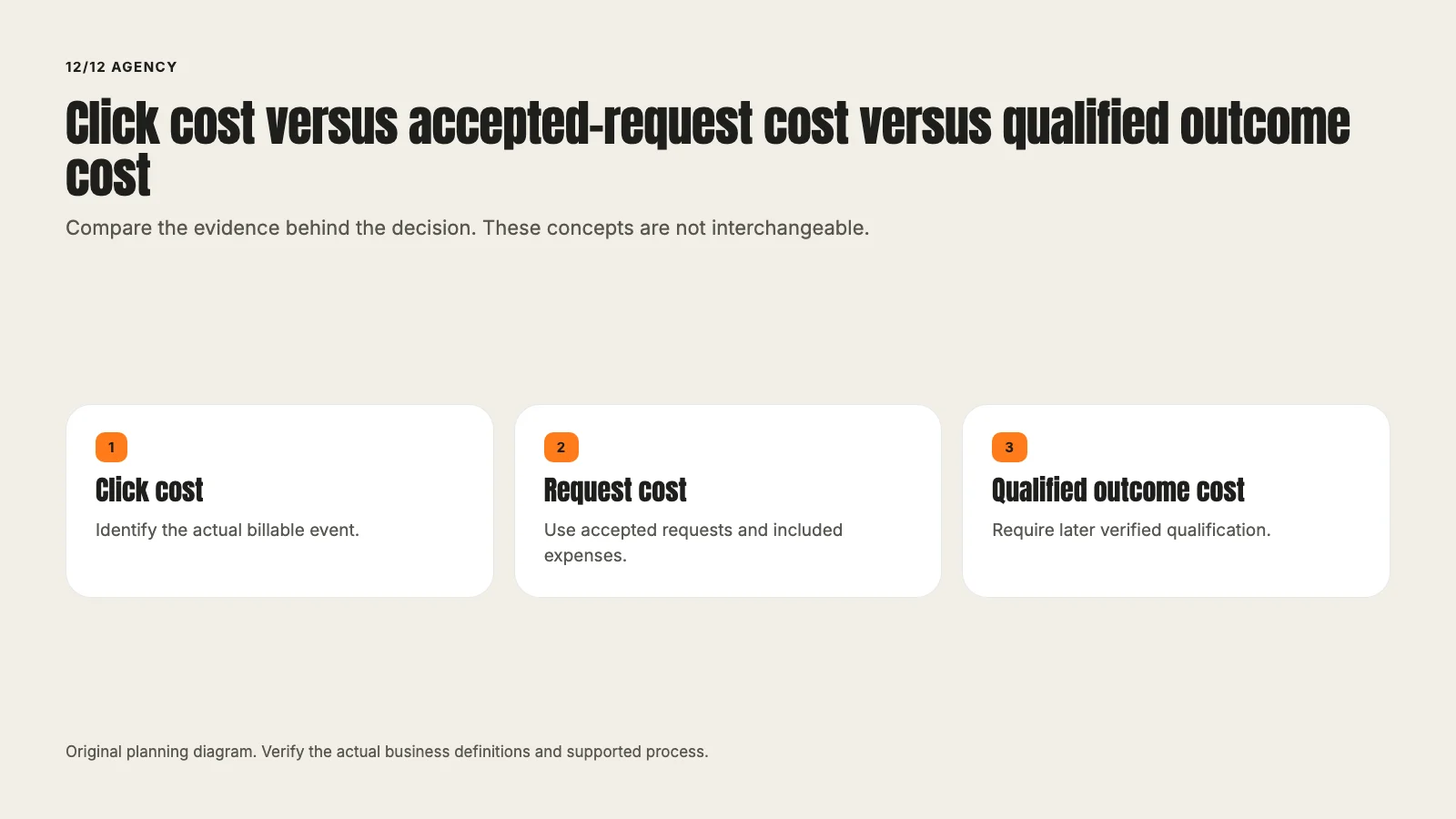
A resource download, accepted demo request, booked meeting, held meeting and qualified opportunity are different stages. Choose the intended outcome and identify its source of truth before using a cost-per-result figure.
For a fictional software company, the first campaign may offer an evaluation guide. A download can be useful, but it should not be called a sales-qualified lead merely because professional profile data is available. Qualification needs the business's actual criteria and evidence.
The B2B SaaS guide explains later-stage distinctions. Preserve those definitions when comparing a form campaign with a website campaign or another platform.
Separate media and the work around it
Media is the amount spent on the platform. Management, creative, page work, tools and sales handling may also belong in the acquisition cost definition. Decide which costs are included and over what period.
Do not add a production expense twice because it appears in a fee and a separate line item. If a reusable asset supports several campaigns, allocate its cost explicitly rather than charging the full amount to each one without explanation.
The paid media overview can help scope that work. Current pricing and commercial terms remain those actually agreed with the business; a fictional worksheet is not a new 1212 quote.
Build the click-to-outcome scenario
For a website-visit model, let media spend be M, assumed cost per click be C, click-to-accepted-request rate be r and request-to-qualified-opportunity rate be q. Modeled clicks equal M divided by C. Requests equal clicks times r. Qualified opportunities equal requests times q.
Suppose the fictional inputs are $6,000 of media, a $12 click cost, a 4% accepted-request rate and a 20% qualification rate. The model gives 500 clicks, 20 accepted requests and four qualified opportunities.
Media cost per accepted request is $300. Media cost per modeled qualified opportunity is $1,500. If $2,000 of other eligible acquisition work is included, the total is $8,000 and the corresponding fully included cost per qualified opportunity is $2,000.
These are assumptions multiplied together, not a forecast. Fractional modeled outcomes can be valid in a scenario, but they are not partial observed customers. A zero outcome denominator should show an unavailable cost, not a zero-dollar success.
Compare conservative and optimistic assumptions
Change one assumption at a time to understand sensitivity. If click cost rises while every other input stays the same, fewer clicks fit within the media plan. If the request rate falls, the cost of each accepted action rises. If sales qualification changes, the early CPL may stay stable while the business outcome cost changes materially.
Use the business's own range where available. Do not label arbitrary inputs industry averages. Show why each scenario was chosen and which variable the next test is meant to clarify.
A broad range may be the honest result when evidence is sparse. That does not make the worksheet useless. It identifies the assumption carrying the decision and the evidence needed before a larger commitment.
Match the audience and offer
A professional role or company attribute can help define reach, but it does not prove immediate buying intent. The offer should answer a useful question for that audience at the intended stage.
A SaaS service page may support a product evaluation. A manufacturing context may require a technical resource or RFQ preparation. Do not use the same download and qualification standard everywhere simply because both are B2B.
Review audience size, supported targeting, policy and actual account controls before launch. This guide deliberately avoids a universal minimum audience, fixed campaign duration or recommended bid. Those decisions need the current configuration and test question.
Verify the form or page handoff
An expensive click that reaches a broken form is not evidence that the audience is too costly. Check the destination, accepted action, confirmation, source persistence and receiving business record.
The conversion-tracking guide explains why a technical event and a qualified outcome need separate verification. A native form submission may require a different retrieval and routing process from a website form.
Do not promise a CRM connection from a vendor's feature list. Verify the actual supported fields, permissions and delivery receipt. Use one approved labeled test if a real request is needed, and keep QA out of business totals.
Review a completed cohort
Use an entry period and a consistent opportunity window for later outcomes. Keep downloads, accepted requests, meetings and qualification separate. Record still-open and missing evidence rather than assigning a guessed final status.
Compare source definitions before adding totals. A platform may attribute an outcome under its rules while the CRM records a different period or stage. Attributed opportunity value is not collected revenue and should not be summed across platforms that can claim the same business.
Cost should be read with fit and capacity. A channel can produce a smaller number of useful conversations at a higher click cost. It can also generate expensive activity with no verified later outcome. The report needs the evidence to distinguish those cases.
Turn the model into a test decision
A concrete plan states the audience, offer, destination, included costs, primary action, later outcome window and review rule. It also identifies the assumption the test is meant to improve.
The next decision might be a clearer offer, a handoff repair or a bounded paid test. It should not be an automatic budget increase because the spreadsheet looks profitable. Scenario value and observed performance remain separate.
Bring the outcome definition and current assumptions to a planning review.
Keep the model attached to the decision
When sharing the result, include the assumed click cost, request rate, qualification rate, included expenses and period. A copied acquisition-cost figure without those inputs can become an unintended forecast.
At review, replace only the assumptions supported by a matched observed cohort. Do not mix a current click cost with an old qualification rate from a different offer without explaining the limitation. If the source population changes, keep that change visible.
The model's useful output is the next question: which rate or cost needs better evidence before the business approves a larger test? It should not automatically select a bid or recommend spending the entire available budget.
Frequently asked questions
Want this run for your business?
Tell us where to send it and we'll follow up with the strategies that fit your market.