
SaaS Demand Generation: Turn a Live Integration Into a Partner Launch
David A · Founder, 1212 Agency
Published October 29, 2026

A working integration needs more than a listing. Build the explanation, joint launch, distribution and sales handoff around one shared buyer problem.
Your integration works. The partner has a listing. If the buyer still cannot see what changes in their day, the sales teams need a shared explanation.
That is a useful starting point for SaaS demand generation. SaaS means software as a service. Instead of inventing a new campaign theme, take a working connection and explain the buyer problem it solves, how it works and what to do next.
We recently prepared a partner-launch plan for a business-to-business (B2B) software company serving cultural organizations and one of its integration partners. The plan covered a joint announcement, practical product content, newsletter timing, internal sales materials and a customer-proof question. The integration was live. The coordinated campaign was still planned, with no measured pipeline result to report.
This is the playbook from that planning work. It helps a small marketing team turn a product fact into a launch both partners can deliver. It is not a claim that a launch checklist creates demand on its own. Buyers still need a reason to care, and the results still need measuring.
What SaaS demand generation does before a buyer requests a demo
Demand generation gives relevant people a reason to understand the problem and consider a solution. Lead generation gives that interest a way to become an identifiable request. The distinction changes what content you make and how you judge it.
LinkedIn's demand generation guide separates building product interest from collecting contact information for follow-up. That is a useful boundary for a partner campaign. Someone reading how two products connect may be learning, evaluating or checking an existing setup. The page visit alone does not tell you which.
Start by deciding what the buyer should understand after seeing the campaign. For an integration, that might be which information moves between the products, what work remains manual and who can use the connection. Give the reader a direct answer before asking for contact details.
Then make the next step fit the question. A person checking compatibility may need product documentation. A team evaluating a change may need a demonstration. An existing customer may need support rather than a sales form. Clear paths help each audience without pretending they all represent new pipeline.
Our SaaS marketing work connects that education with acquisition and follow-up. The campaign's job is to make the product easier to understand and evaluate. The form and booking mechanics belong to the later path covered in our B2B lead generation guide.
Start with one shared buyer problem and a working integration
Write the buyer problem in ordinary language. An illustrative example would be a team maintaining the same records in two systems and wanting a supported way to keep them aligned. That is easier to evaluate than a promise of seamless transformation. It also gives both partners a concrete claim to check.
Now describe what the integration actually does. Which records move? In which direction? What starts the transfer? What does the user need to set up? Which accounts or product plans qualify? What happens when data is missing or an action fails? These questions belong in the brief before public copy.
Keep intended benefits separate from demonstrated outcomes. A connection that transfers a record can support a claim about that transfer. It does not, by itself, prove hours saved, better retention or higher revenue. Those require their own evidence. Use a product demonstration to show behavior while leaving unmeasured outcomes unclaimed.
In our recent planning work, the connection was already live, so the missing piece was a coordinated explanation and launch. That distinction matters. A technical release and a marketing launch have different owners, evidence and completion criteria. Do not report the second as finished because the first happened.
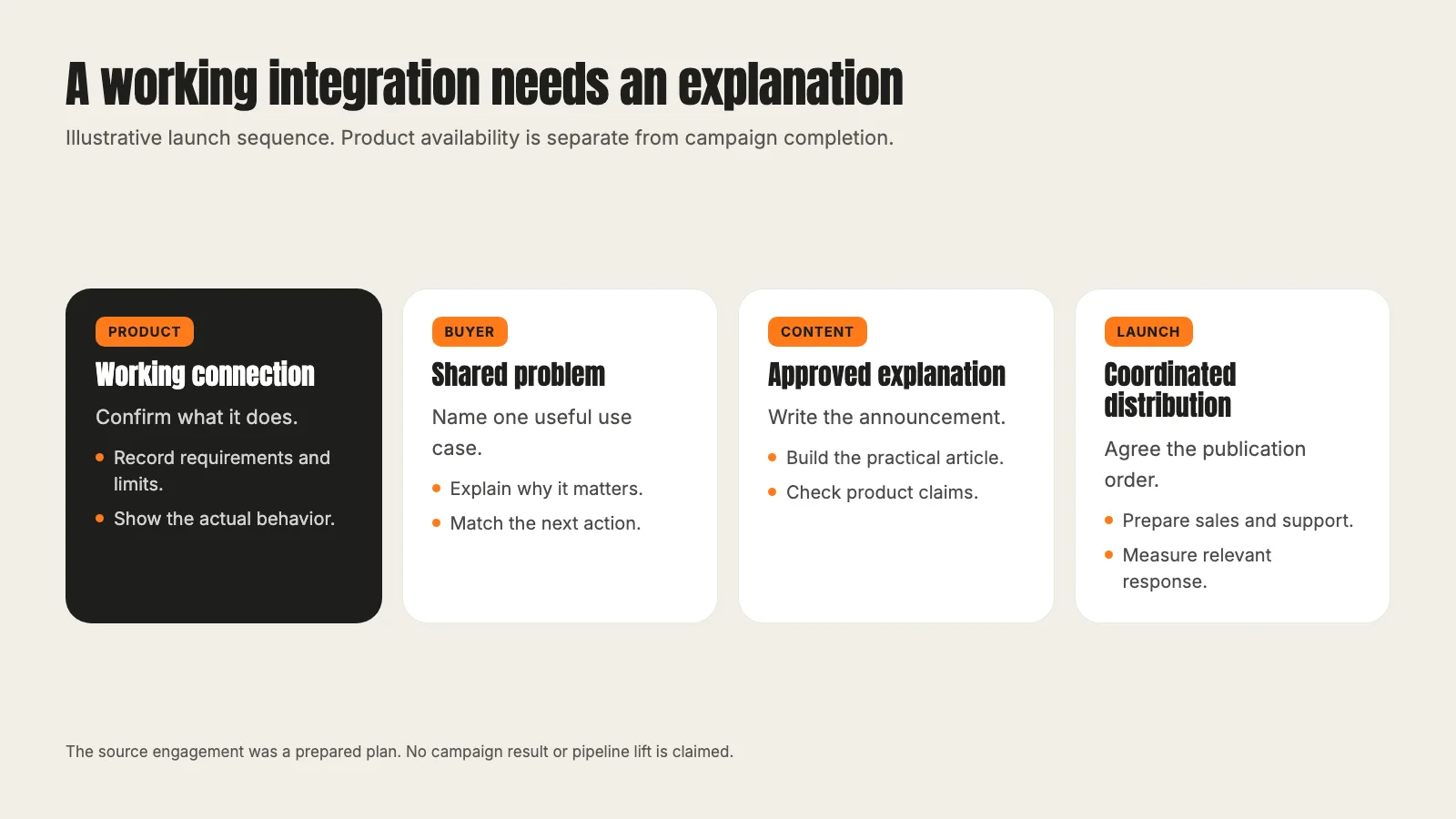
Choose one primary use case for the initial package. Additional capabilities can have their own sections or follow-up content. One clear buyer problem gives the announcement, article and sales conversation a common purpose. It also makes factual disagreements easier to catch before each partner writes a different story.
Agree the product facts and who can approve them
Create a shared fact sheet before drafting. Keep it short enough for product and marketing reviewers to check together. Include availability, requirements, supported behavior, limitations, setup path and the person who can answer unresolved questions.
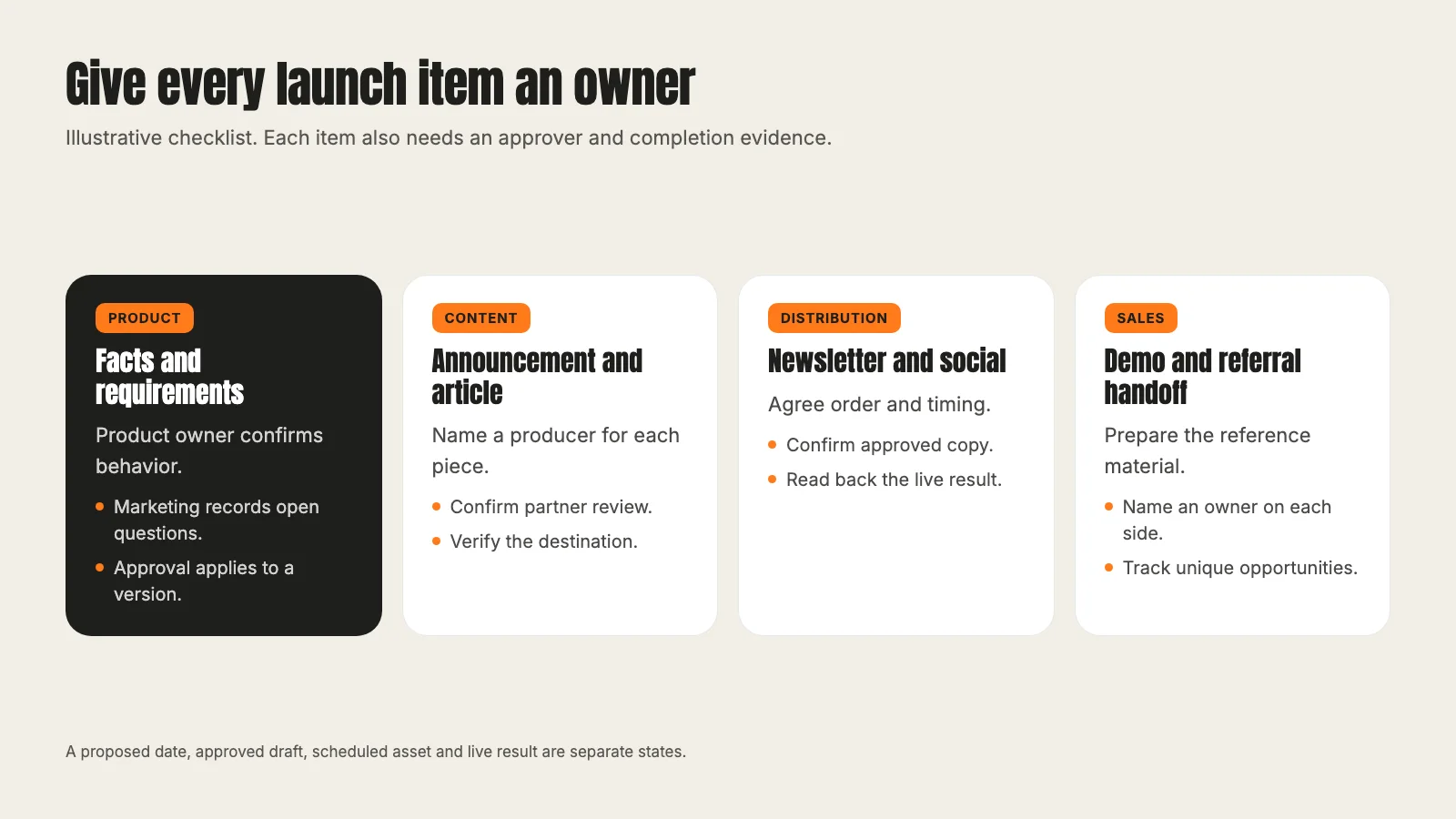
Assign an owner and approver to each deliverable. The owner produces it. The approver confirms the parts their team is responsible for. A jointly branded page may need separate product, marketing and brand approval. Make those boundaries explicit instead of waiting for a late review to reveal them.
Record open questions as questions. If a partner has not confirmed a capability or customer permission, leave that point out of approved public copy. A proposed quote is not an approved quote. A suggested launch date is not a confirmed schedule. The brief should preserve those differences as decisions change.
In the plan we prepared, the teams needed product facts and collateral before finishing the public materials. They also divided the writing work between a joint announcement and a practical explanation. That reduced ambiguity about who would produce each piece without claiming either was already published.
Use one current review copy for each asset. Capture requested changes and decisions there, with a named final owner. When someone approves wording, preserve the version they saw. Later edits that change a product claim need another factual check rather than inheriting approval from an older draft.
Build the announcement and how-it-works pair
The announcement answers what is available, who it is for and why that audience should pay attention. The practical article answers what the integration does and how a buyer can evaluate it. They can link to each other without repeating the same introduction at different lengths.
For the announcement, lead with the buyer's job. Explain the supported connection in concrete terms, add approved partner context and give one next action. Avoid filling the opening with both companies' histories. The reader needs to understand the change before the corporate background becomes useful.
For the how-it-works piece, follow a real use case from starting condition to result. Show which product handles each step, what must be configured and what happens afterward. Use approved screenshots or a labelled illustration. Do not let a diagram imply automation that the actual product still requires a person to perform.
Prepare a short version for each partner's integration directory as well. Check the description, destination and setup route against the same fact sheet. If a listing exists, review whether it still describes the supported connection accurately. A directory entry is part of the buyer's path, not just a box on the launch checklist.
Give the content an obvious destination. That may be an integration page with technical information and a relevant demo request, rather than a general homepage. Before distribution, ask somebody outside the writing team to read it and explain what the connection does. Their uncertainty identifies questions the next draft needs to answer.
Coordinate partner newsletters and social distribution
A joint launch needs a sequence both teams can follow. Confirm which page goes live first, when the other partner can link to it and when newsletters and social posts may begin. Distribution that precedes the approved explanation can send interested people to incomplete information.
Our recent plan proposed coordinating newsletter mentions with the announcement rather than letting each team publish independently. That was a timing proposal, not a record of a send. Keep the same distinction in your launch tracker: drafted, approved, scheduled and live are separate states.
Write channel-specific copy from the same product facts. An email needs a clear reason to open and a useful destination. A social post needs enough context to make sense on its own. A sales representative needs a short explanation they can adapt to a relevant conversation. Copying the full announcement into each channel does not address those different jobs.
Paid distribution is optional. LinkedIn's Sponsored Content overview describes feed advertising formats for product content, education and events. That gives you distribution options; it does not establish that paid promotion will be profitable for this launch. Plan the audience, asset and outcome before proposing spend.
If professional audience targeting fits the use case, our LinkedIn Ads service can support that distribution plan. If you are considering search or social instead, use our Google Ads and Facebook Ads comparison to frame the buying situation. The channel should serve the explanation you need to deliver.
Give sales a demo, talk track and referral owner
Prepare the internal explanation alongside the public content. A recorded demonstration can show the working connection. A short sales guide can explain who it fits, the questions to ask, limitations and the right person to involve. Give support access too if existing users will need help after reading the announcement.
In our plan, an internal demo and sales reference material were agreed as part of the proposed package. That is useful preparation before anyone promotes a demonstration request. It does not prove every representative has watched the recording or can deliver the product walkthrough. Verify readiness separately.
Keep the talk track concrete. Start with the buyer problem, explain the supported behavior, ask about the customer's current systems and offer the appropriate next step. Add the questions a representative should send to product or the partner instead of answering from memory.
Choose a referral owner on each side. Define how a relevant request is introduced, what context travels with it and who confirms the next action. A warm introduction still needs an owner. Avoid passing a spreadsheet of names between teams as a substitute for an agreed request and follow-up process.
Handle customer proof with the same care. In the recent planning exchange, a full case study was premature because the integration was new. A short customer quote was considered separately. A factual quote, if approved, can describe experience within its evidence. It should not be expanded into a performance story the customer has not substantiated.
Measure partner-sourced interest and opportunities without double counting
Separate launch completion from market response. A published page and a sent newsletter prove that work shipped. They do not prove buyers understood the offer or that the campaign produced qualified demand. Track those outcomes on their own terms.
Start with distribution and engaged visits, then relevant requests, conversations and qualified opportunities. Agree the definition at each stage. A support question from an existing customer may be valuable without being a new sales opportunity. A newsletter click is interest in a link, not proof of a buying project.
Define partner-sourced and partner-influenced records before reporting them. A direct referral might qualify as sourced. An existing opportunity that later engages with the launch may be influenced. Your team needs a written rule and evidence for each classification, especially when both partners already know the account.
Keep a unique opportunity record in combined totals. The same opportunity can have several useful touchpoints without becoming several opportunities. Report source and influence as different views when needed, and do not add them together as if they were separate pipeline.
Use campaign-tagged links consistently and check where they land. Our conversion tracking guide covers the handoffs that preserve campaign information. Then ask sales what the interested teams needed, whether the connection fit and what happened next. Our paid ads management approach ties acquisition to those downstream decisions. Attribution fields help organize the evidence; they do not replace the conversation or prove causality by themselves.
Allow the launch time to produce the outcome you are measuring. Mark recent requests as still developing rather than forecasting a deal from an early click. For this playbook's source engagement, the campaign was still planned. There is no launch result to substitute for that future read.
A reusable launch checklist
Use this list to decide whether your integration is ready for a coordinated marketing launch:
- One shared buyer problem is written in plain language.
- Product owners confirmed availability, behavior, requirements and limitations.
- Every asset has a producer, approver and completion criterion.
- The announcement and practical article answer different buyer questions.
- Directory descriptions and destination pages use the approved facts.
- Both partners agreed the order of publication and distribution.
- Sales and support have a usable demo and reference material.
- A referral owner is named on each side.
- Customer claims have evidence and publication permission.
- Source, influence and unique-opportunity counting rules are documented.
Begin with the first unanswered product question. Resolve it with the partner, then build the explanation around the answer. A clear, supportable launch gives buyers something useful to evaluate and gives your team a result it can measure honestly.
Frequently asked questions
Want this run for your business?
Tell us where to send it and we'll follow up with the strategies that fit your market.