
B2B SaaS Lead Generation: Count Booked Demos, Not Form Fills
David A · Founder, 1212 Agency
Published November 4, 2026
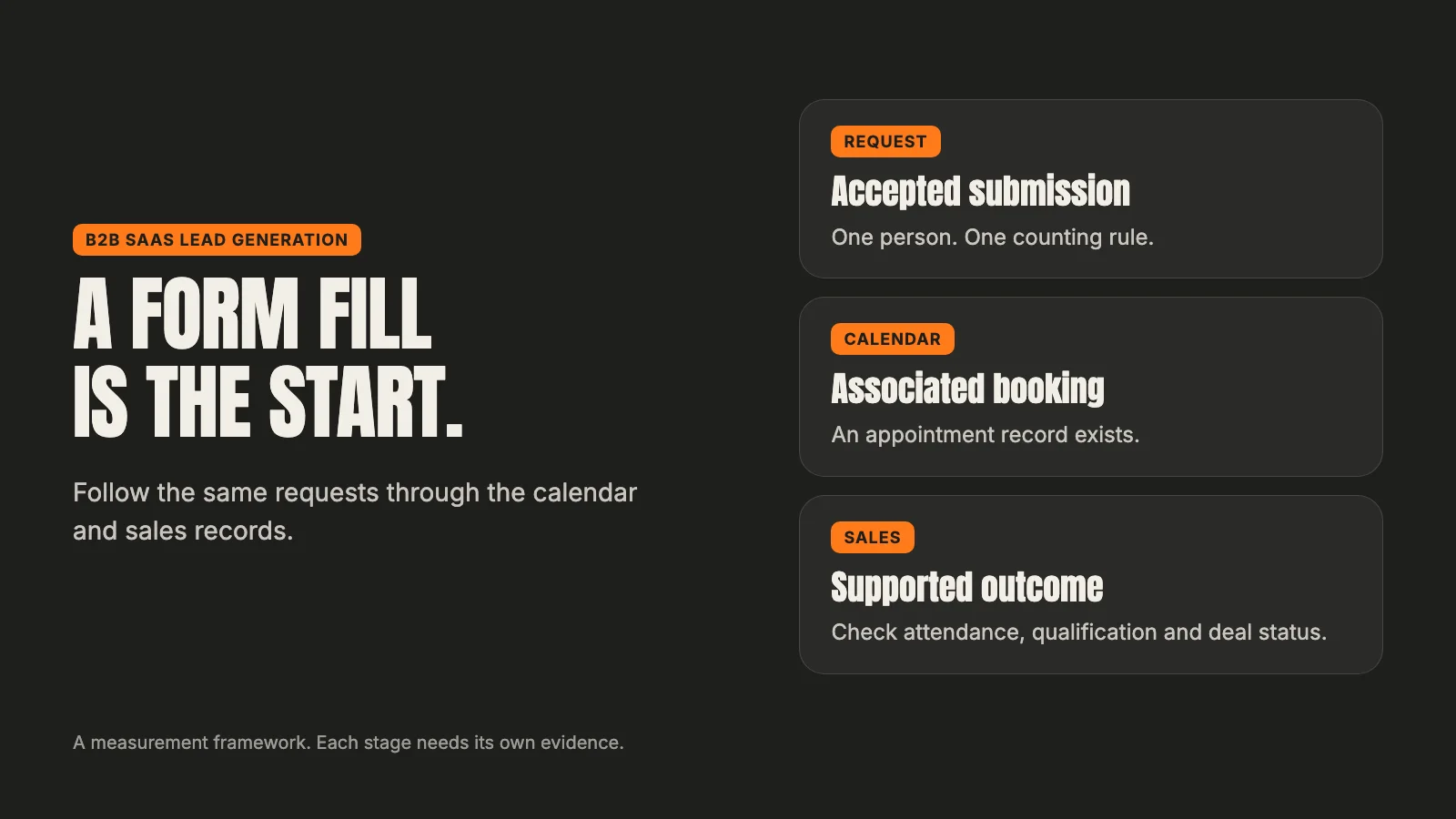
We followed 29 pricing requests to 10 associated bookings and 2 meetings marked qualified. Here is how to measure the steps between a form and a sales opportunity.
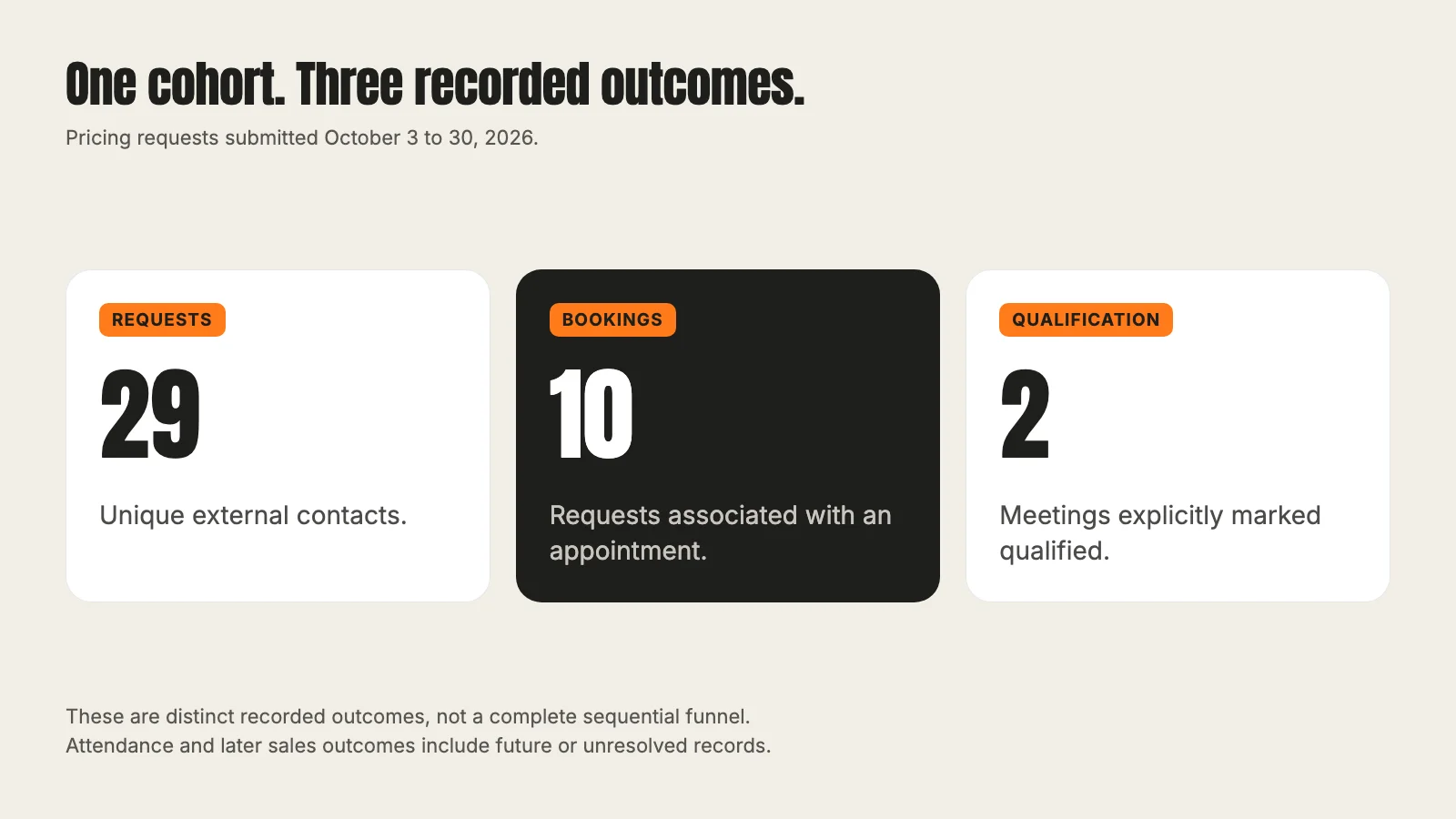
29 people requested a pricing conversation. 10 requests had an associated meeting booked. 2 meetings were explicitly marked qualified.
Those were three different answers to the question, “How is lead generation going?”
We found them while auditing four weeks of pricing requests for a business-to-business (B2B) software-as-a-service (SaaS) company serving cultural organizations. A form report could show demand. It could not show whether someone reached the calendar, attended a conversation or became a qualified opportunity.
For B2B SaaS lead generation, keep the form count. Then follow the same people through the next steps. That is how you find the work marketing and sales need to do together.
Follow one cohort from request to meeting
Start with people who submitted during a defined period. In this audit, that period was October 3 to 30, 2026. Exclude internal tests and count repeat submissions from the same person once.
That left 29 unique external contacts. We checked their associated meetings, logged sales activity and recorded outcomes. Bookings counted only when created before October 31 at 00:00 Eastern, even if the appointment itself was later. Meeting and deal outcomes reflect the separate October 31 audit snapshot.
10 of the 29 requests had an associated booking, a rate of 34.5%. 19 had no associated meeting found by the cutoff. One request led to a colleague's associated booking, so the figure measures requests connected to meetings, rather than proving every original submitter personally booked.
This matters when you design a report. A second form submission should not become a second new prospect. A rescheduled appointment should not become another converted person. A colleague joining the buying process needs an explicit association rule.
Keep those rules beside the numbers. Your SaaS marketing plan needs a denominator that sales can inspect and marketing can reproduce.
Separate booking, attendance and qualification
Of the 10 first meetings, 7 were due by the cutoff. Evidence supported at least 4 held conversations. 1 was marked no-show. 2 had unresolved attendance or outcomes. The other 3 appointments were still in the future.
Calling all 10 meetings “completed demos” would have overstated the evidence. Calling all 19 unbooked requests “bad leads” would also have gone beyond it.
2 meetings were explicitly marked qualified. That does not mean the remaining requests were definitively disqualified. Some outcomes were unresolved, some appointments were future, and a qualification label was not the same as an active opportunity. One historically qualified meeting was associated with a deal later closed lost.
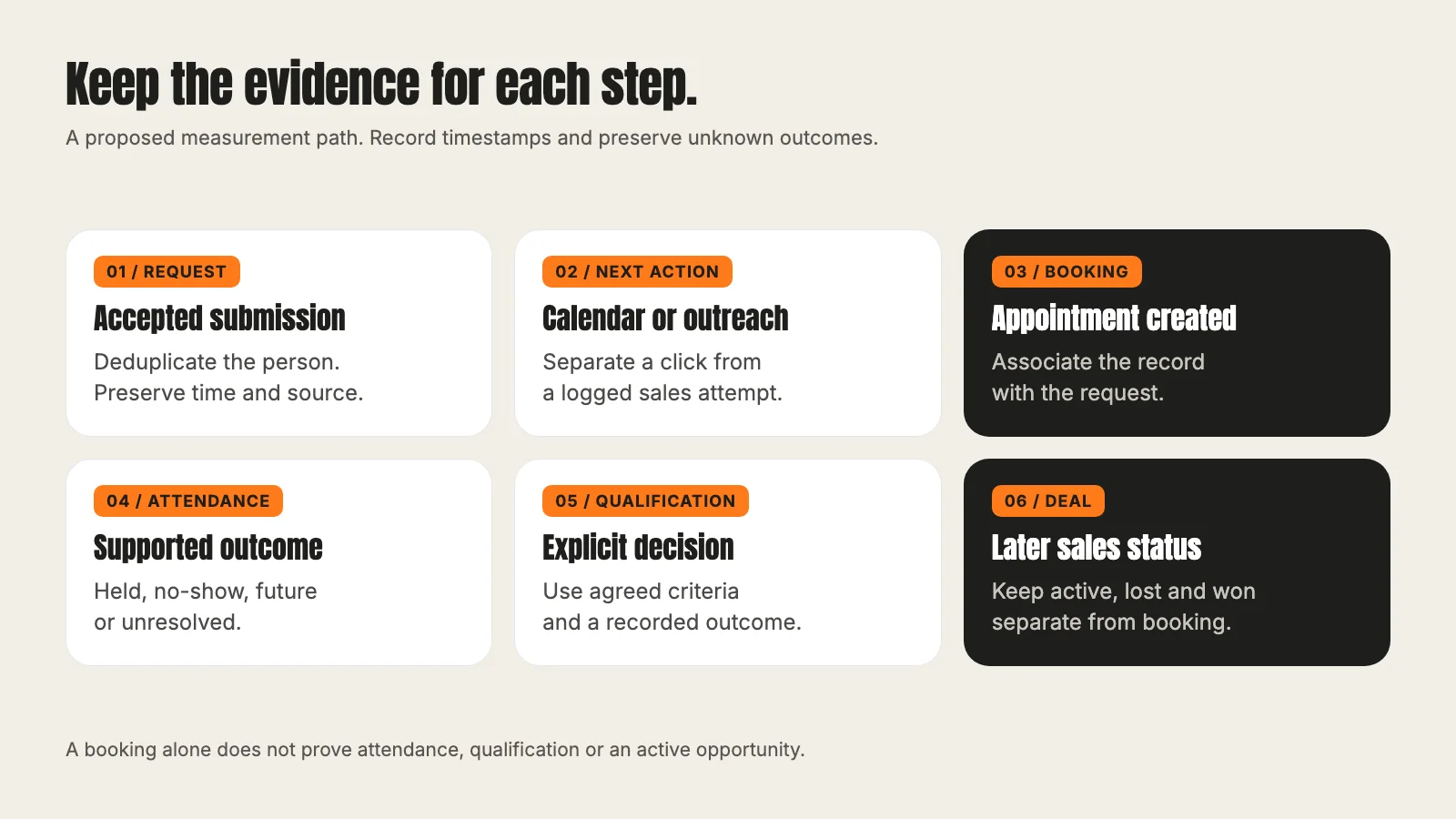
Define each stage before you count it. A booking needs an appointment record. Attendance needs a supported outcome. Qualification needs the sales team's criteria and an explicit decision. An opportunity needs its own record and status.
Our B2B lead-generation guide explains how to build the request path. This audit asks what happened to a specific group after they used it.
Give ready buyers a direct calendar path
4 bookings were created between 37 seconds and 2 minutes 49 seconds after submission. All used the scheduling page available from the thank-you experience.
The timing is consistent with people booking through that calendar. We did not have a person-level page-event connection proving that the thank-you page caused each booking. This was observational evidence, not a controlled experiment or a measured conversion lift.
The practical check is still useful: after an accepted demo request, can a ready buyer choose a time? Open the path on a phone and a desktop. Check the redirect, calendar availability, timezone and confirmation. Make sure a failed request cannot show a false success message.
Measure the calendar steps separately. A button that scrolls to a calendar is a click. An appointment created by the scheduling system is a booking. Neither proves attendance.
Keep the experience connected to the promise in your paid advertising. A buyer who requested pricing should understand what the next conversation covers and how to arrange it.
Measure speed to lead with the right clock
The 4 rapid self-bookers booked before outreach. We excluded them when measuring the sales response to the remaining 25 requests.
22 had a logged sales email that had not bounced or an outbound call attempt. 2 had no qualifying outreach found. 1 had only a bounced email.
Among those 22 people with logged qualifying outreach, median elapsed time to first outreach was 4 hours 11 minutes. That is clock time, including time outside working hours. It is not a business-hours response benchmark.
Using a provisional Monday to Friday, 9 AM to 5 PM Eastern calendar, 9 of the 25 initially unbooked contacts received outreach within one business hour. The actual service calendar was unavailable, so that calculation was an audit assumption rather than a settled service-level judgment.
When you measure lead response time, record both clocks. Confirm working hours, holidays and coverage. Separate an attempted call from a connected conversation, and a sent email from a reply. Missing activity may mean missing logging, so verify before judging a person or a process.
6 further bookings were created after logged outreach. That order alone does not prove causation. 2 people explicitly replied that they booked after receiving the email. We did not assign the same causal credit to the other 4.
Use channel data to ask better questions
A source field can change as someone returns to your site. For this audit, we used the source on each person's first qualifying submission URL, rather than treating a later source field as the acquisition history.
18 requests came from a nonbrand Google Search campaign, with 5 associated bookings. 4 came from brand search, with 2 bookings. A competitor-search request had 1 booking. Microsoft paid search produced 4 requests and 1 booking. 2 requests had untagged submission URLs, with 1 booking.
These are small groups. A booking from the sole request in one group does not establish a repeatable 100% conversion rate. The split describes this cohort and gives the team records to inspect. It does not justify shifting budget by itself.
Preserve the submission source, submission time and later outcome together. Our conversion-tracking guide covers those measurement handoffs. Keep unknown sources visible rather than assigning them to a channel without evidence.
Build a report that keeps missing evidence visible
Use one row per unique request, with the accepted submission time, source, first outreach, booking creation time, appointment date, attendance, qualification and deal outcome.
Store the evidence for each stage separately. The thank-you view and calendar click help explain the path. The appointment record establishes a booking. Sales records establish attendance and qualification. A missing value should stay unresolved until someone checks it.
Give each cohort the same time to book. In this audit, 18 contacts had a full seven days available before cutoff; 6 booked within that window. The 11 more recent contacts had incomplete seven-day observation periods. Comparing their final rates would have mixed different amounts of follow-up time.
Keep a later sales-outcome snapshot as well. A booking within seven days and a qualification decision several weeks later answer different questions. Do not rewrite the original booking window when an outcome changes.
Google Ads distinguishes qualified leads from converted leads, with stages defined around your lead process. Its offline conversion documentation explains measuring later outcomes after an ad interaction. That supports separating stages; it does not turn an unverified sales label into a reliable signal.
Review the records before changing campaign goals. A measurement audit establishes what you know, what needs checking and where the handoff breaks. Implementation and bidding decisions come after that review.
Start with the requests already in your system
Before choosing another acquisition tactic, take one recent cohort and follow it through the calendar and sales records. Agree the counting rules with sales. Resolve missing outcomes. Make the next weekly report show requests, bookings, attendance and qualification separately.
For teams buying LinkedIn Ads management or search campaigns, this makes the brief more useful: identify which stage needs improvement and which evidence will show progress.
Frequently asked questions
Want this run for your business?
Tell us where to send it and we'll follow up with the strategies that fit your market.