
LinkedIn Ads or Google Ads: compare reachable demand
David A · Founder, 1212 Agency
Published November 16, 2026

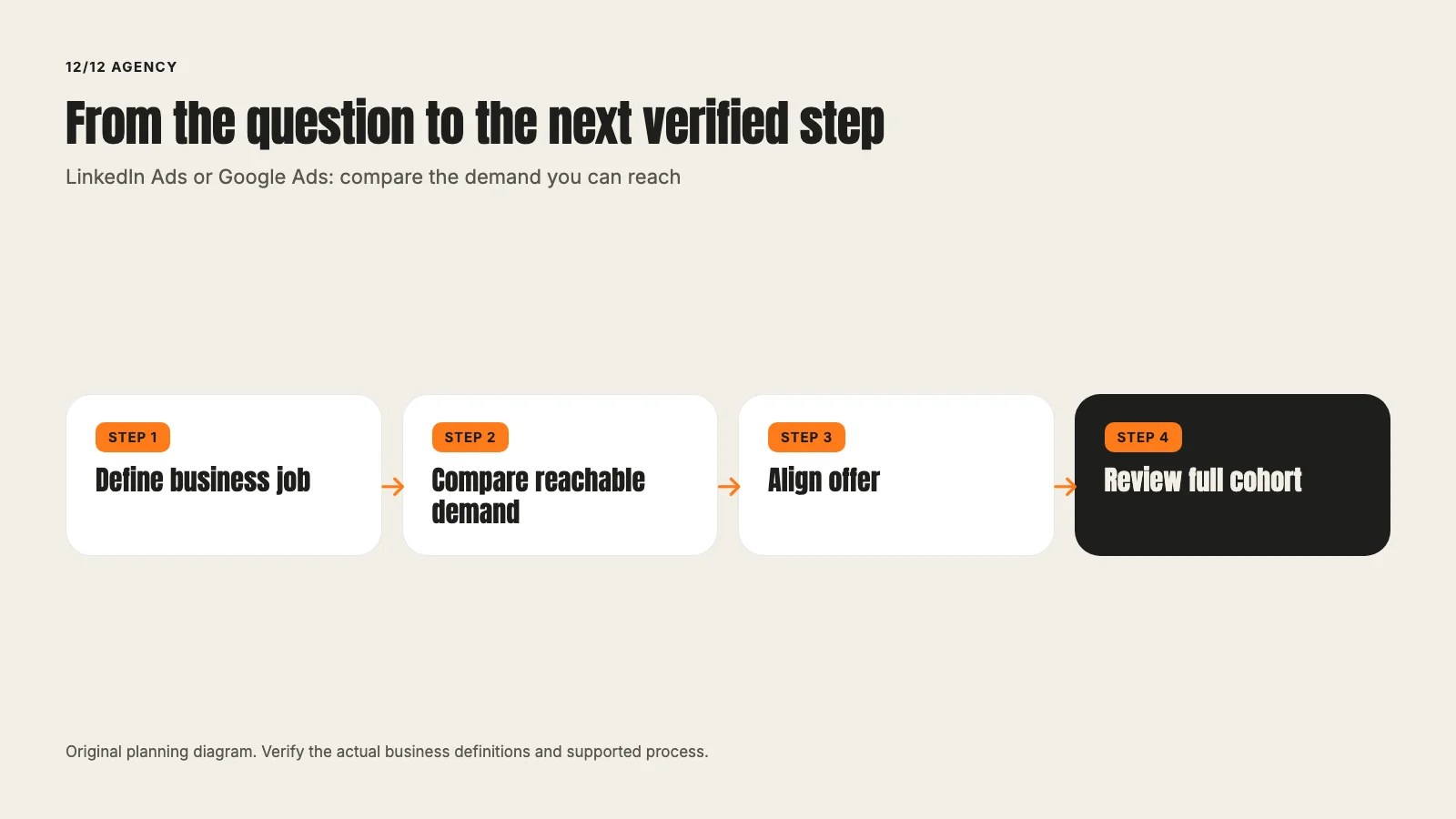
Compare professional-audience reach and active search against the same business job. Keep offer, full cost, qualification and attribution differences visible.
LinkedIn and Google can reach different versions of a buying moment. A person may be identifiable by a professional role without actively searching for a product. Another may state a clear need in a search query while revealing little about their organization.
The useful comparison is which reachable demand fits the business's next job and whether the destination can support it. This guide does not declare one channel cheaper or better for all B2B companies. It develops a fairer decision process with fictional examples.
Start with the business constraint
Ask what the team needs to learn or change. It may need to reach a narrow buying role, answer an existing product search, explain a new category or improve the quality of accepted inquiries.
A channel cannot fix every downstream problem. If the product explanation is inaccurate or the request does not reach sales, changing platforms may create a different version of the same failure.
The SaaS overview and industrial overview can help define the business context. The LinkedIn and Google Ads service pages should remain distinct commercial explanations rather than a promise that either is universally right.
Compare the evidence of demand
Google's search terms documentation describes available actual-query reporting. A query can express a job, application, alternative or research question, but the keyword and the reported search are not identical inputs.
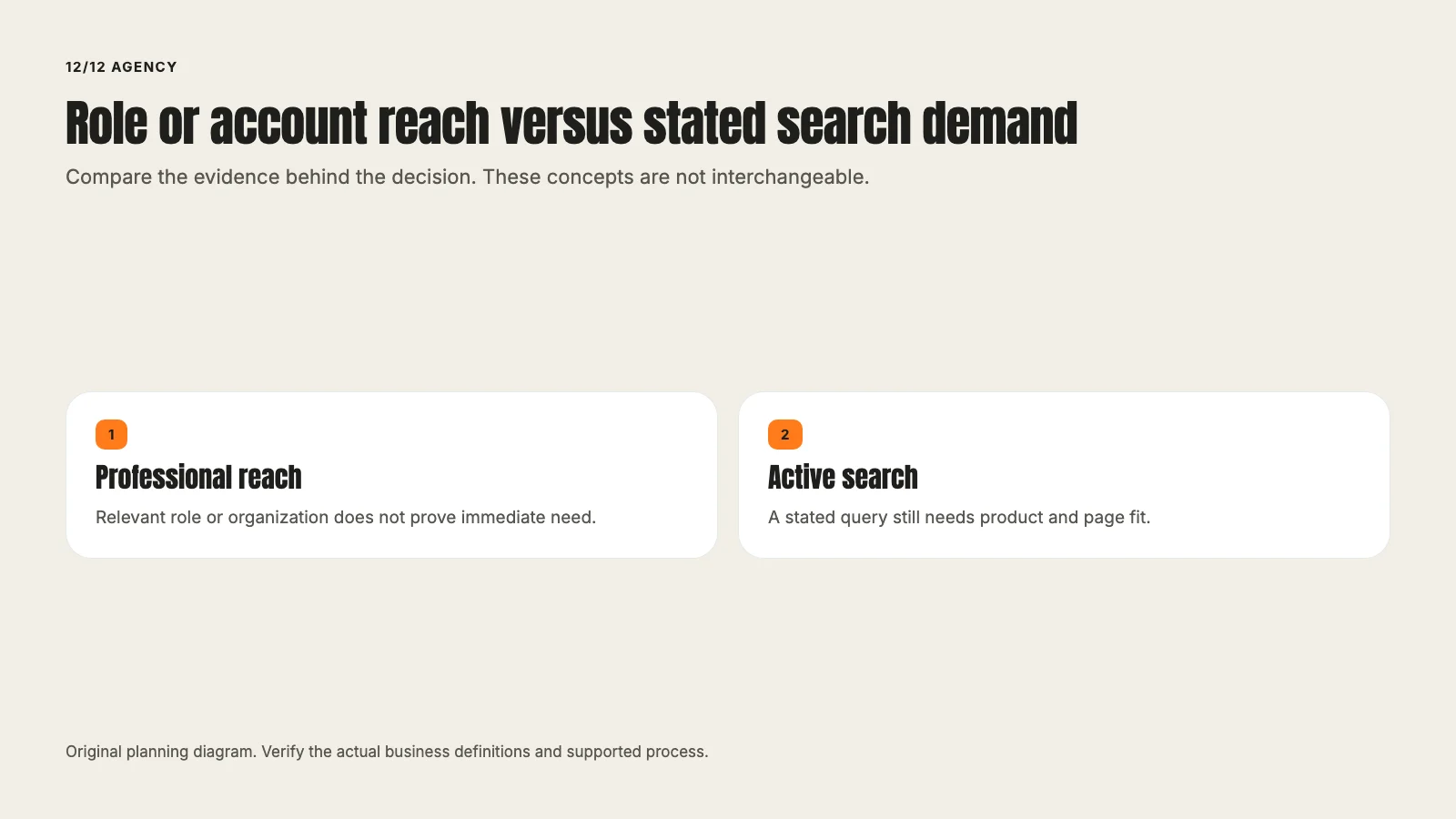
Professional-audience reach answers a different question: can the approved campaign reach relevant roles or organizations with an appropriate offer? The current supported controls and audience evidence must be verified for the account.
Do not equate a role with purchase readiness or a query with perfect fit. A search for a product category can still come from a student, competitor or unsupported use case. A relevant executive can still have no current need for the product.
Match the offer to the buying moment
An active search may support a specific capability explanation or request. A professional audience may benefit from a technical resource, demonstration or evaluation question before a sales conversation. The appropriate offer depends on the actual buyer journey.
For a fictional industrial supplier, a process query could lead to an accurate capability page and RFQ preparation. A professional campaign could explain one application problem to the relevant buying roles. Those offers may contribute at different stages.
Do not force both channels into the same low-context download simply to make the forms look comparable. If the offers differ, record that difference and avoid claiming that the test isolates the platform alone.
Define the same later business outcome
Agree on accepted request, contact, booked meeting, held meeting and qualification. A native form, website form and resource download can have different entry definitions even if all appear under a lead column.
The B2B lead-generation guide supplies the broader stage framework. A person moving through several stages remains one buyer or opportunity. Do not add every stage as a separate customer count.
Later outcomes need evidence. A platform form cannot establish sales qualification by itself. A CRM label should be checked against the business's agreed criteria, source and timestamp.
Compare the complete cost boundary
LinkedIn's pricing overview explains the relationship between objective, billable event and auction. Google campaign costs also depend on the actual setup. Neither platform's click price is the full acquisition cost.
Include media and relevant management, creative, page and sales-handling work under one defined boundary. Avoid double counting shared production. Keep the currency, period and cohort consistent.
The paid media overview can support a scoped plan. Current fees and production commitments come from the actual agreement, not an example in this article.
Work through a fictional comparison
Suppose source A includes $5,000 of acquisition cost and produces 25 accepted requests. Source B includes $6,000 and produces 20. Early cost per accepted request is $200 and $300.
After the same outcome window, assume A has five qualified opportunities and B has six under the same definition. Included cost per qualified opportunity is $1,000 for both. The initial CPL ranking no longer distinguishes them.
Those invented counts illustrate why the later stage matters. They do not establish platform benchmarks, expected opportunity rates or incremental effect. Different audiences, offers and sales handling can still make the cohorts imperfectly comparable.
Also review total useful volume and capacity. Equal acquisition cost does not mean the same amount of reachable demand or the same operational fit. The business's decision may depend on what it can learn and fulfill next.
Verify both handoffs
Follow each supported path into the receiving business process. Check the accepted action, source information, confirmation and later record. A technical tag receipt is not proof that the intended business outcome occurred.
The conversion-tracking guide explains the system contract. Native forms may have a different retrieval path from website forms. Do not assume an integration is complete because a platform advertises the option.
If a labeled real test is needed, agree on notifications and booking consequences first. Preserve QA and exclude it from business counts. Do not create a second request just because one platform's report is slower to refresh.
Distinguish attribution from causality
Platforms can credit the same later business under different rules. Their totals should not be added as if each represents a unique sale. A CRM cohort can provide another view, but it also depends on source capture and stage recording.
A platform-attributed outcome does not prove the advertising caused it. A credible incremental claim needs a suitable design. A before-and-after comparison can be affected by season, product changes, existing demand and other channels.
Report the narrower evidence honestly. This may be an observed matched cohort, a directional comparison or a technical readiness check. Those are useful results when their limits are clear.
Choose the next test by what it can teach
A useful brief names the business question, audience, offer, destination, included cost, intended outcome and review window. It also records the differences that cannot be held constant.
The next step may be a channel test, but it may first be a page explanation, a routing repair or a better qualification contract. Do not turn a comparison article into automatic authority to launch or pause campaigns.
Bring the business constraint and outcome definition to a planning session.
Record what the channel comparison cannot hold constant
A role-based campaign and a search campaign may reach different intent, use different offers and have different outcome timing. Write those differences beside the result rather than treating them as inconvenient details.
For a fictional software test, a resource campaign may introduce an evaluation question while search reaches people already comparing a category. Both can contribute, but their early forms are not automatically equivalent. A later qualified-opportunity comparison may be more useful, provided the definition and window are consistent.
The report should also preserve the costs of producing and maintaining each path. A reusable resource and a campaign-specific page may allocate production differently. State the chosen boundary so the business can reconstruct the comparison.
The next decision can reflect practical fit rather than a claim that one platform is universally superior. The team may choose the path that answers the most important current uncertainty or matches available sales capacity, while leaving the broader causal question unresolved.
Frequently asked questions
Want this run for your business?
Tell us where to send it and we'll follow up with the strategies that fit your market.