
Google Ads for roofers: match the search to the job
David A · Founder, 1212 Agency
Published November 16, 2026

Separate roofing repair, replacement and inspection searches. Build a practical Google Ads plan around real service areas, suitable requests and booked work.
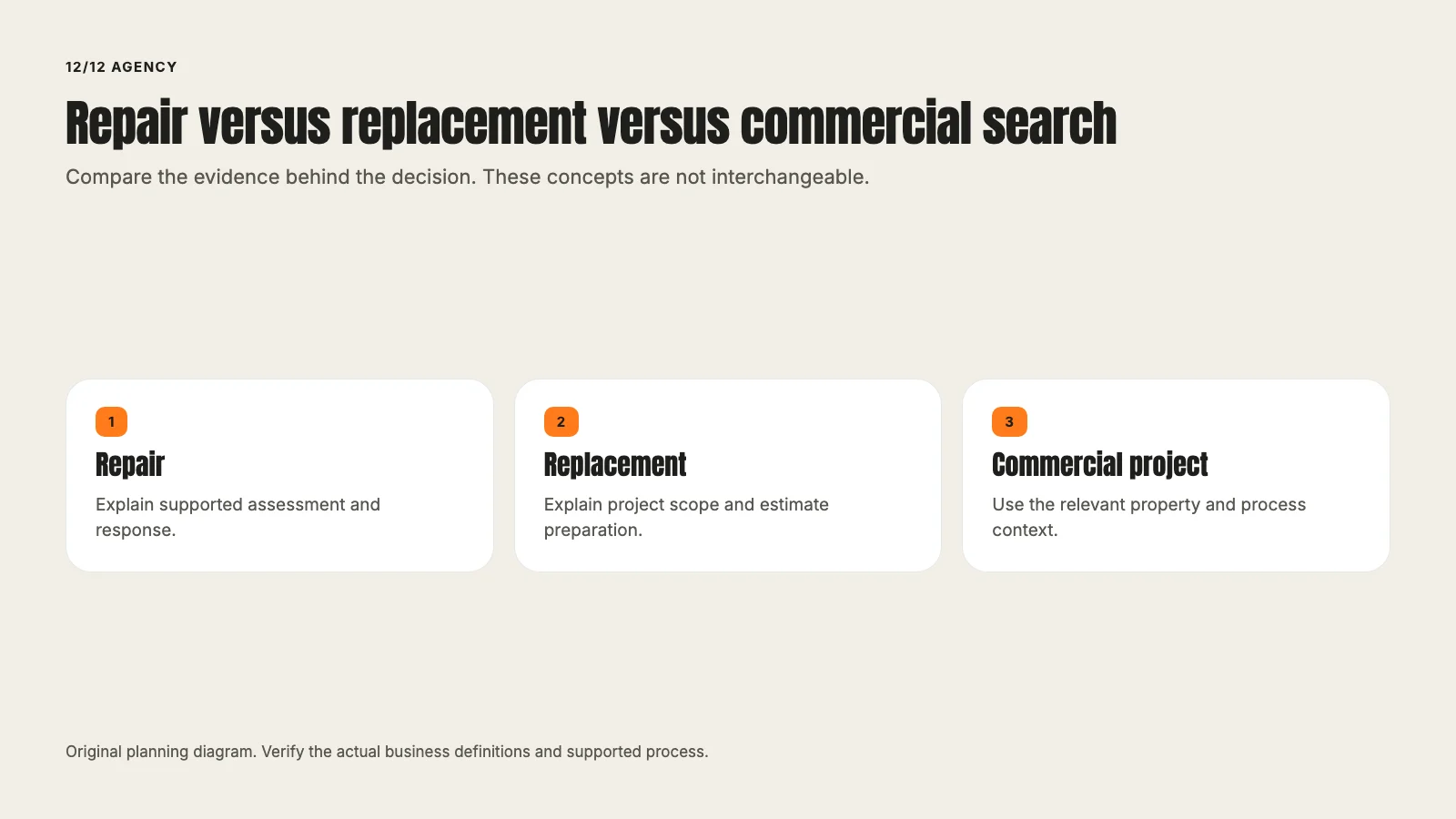
A homeowner who needs a small repair may not be looking for a full replacement. A commercial property manager may need capabilities a residential crew does not provide. A person researching roof materials may be months from requesting an estimate.
A roofing campaign should make those differences visible. The goal is not to send every search containing roof to the same page and call every form a qualified job.
This guide uses fictional examples to explain the planning process. No click cost, lead volume or job result is presented as a roofing benchmark or a 1212 client result.
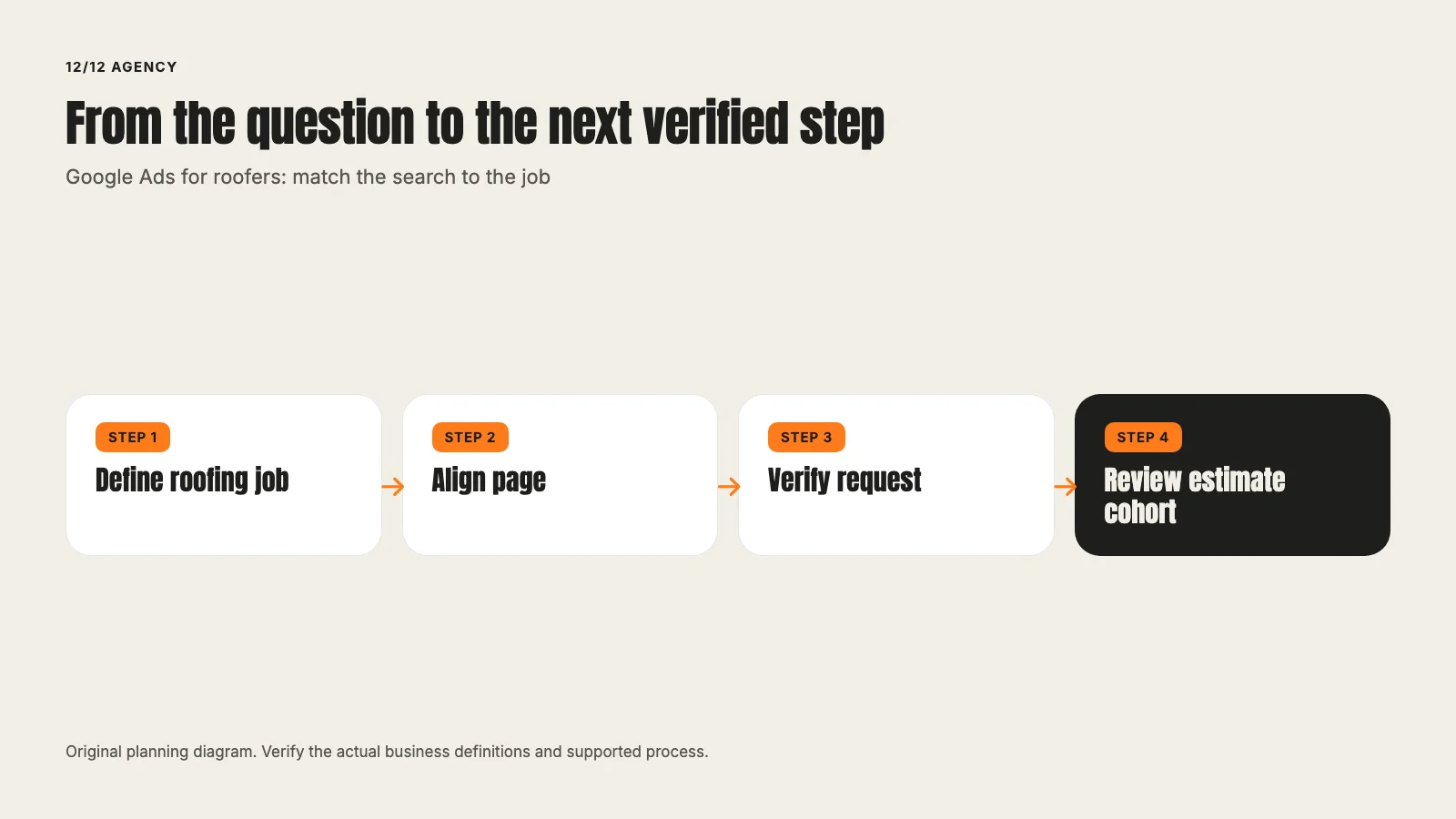
Write down the jobs the business wants
Begin with the actual service mix. List the repairs, replacements, inspections or commercial projects the company performs. Record what it does not offer. Include practical limits such as materials, building types and current capacity.
The person answering inquiries should review this list. If the advertising describes a service the team routinely declines, the account will produce frustration even when the search is relevant.
Keep the offer honest. An estimate, inspection and emergency response are different promises. Do not advertise a free service, guaranteed arrival time or insurance outcome unless the business has explicitly approved and can support that claim.
Separate demand by the decision the buyer faces
Create a map that connects the search family with a useful destination. A fictional roofing company might consider the following:
| Search family | Useful page job | Intake question |
|---|---|---|
| Roof repair | Explain relevant repair work and limits | What problem needs attention? |
| Roof replacement | Explain replacement scope and evidence | What property and project are involved? |
| Commercial roofing | Establish supported building and system types | Is this within the company's capabilities? |
| Inspection | Explain what the inspection includes | What is the purpose and location? |
This map does not dictate a fixed number of campaigns. Split work when the offer, destination or control decision needs to differ. Avoid fragmenting a small budget into many groups that cannot answer separate questions.
Google's keyword-list guidance can help explain matching options. It cannot decide which jobs are right for your company. That comes from the business and the searches people actually make.
Target the areas the crew can serve
Use genuine operating areas. A nearby town can still be impractical because of travel, crew availability or project size. The advertising plan should reflect those limits.
Check the actual location options and exclusions in the account rather than assuming a place name in a keyword handles all geography. If different areas need different promises or routing, document why.
Do not create dozens of nearly identical area pages just to match ad text. A destination should contain useful information about the service and the company's ability to perform it. Our home-services marketing overview explains the broader path from local demand to booked work.
Make the landing page answer the practical questions
A roofing page should tell the visitor which work is offered, whether their property is a fit and how to request the next step. Use genuine project evidence and accurate credentials. A stock image of a roof is not proof of the company's work.
The page should also set expectations for the response. If calls are handled during defined hours, explain that accurately. A form needs a clear acceptance message and an owner who can act on the request.
Review the mobile path. Can someone read the service explanation, use the phone link and complete the necessary fields? Does a required field make sense for the actual routing decision? A complicated form is not automatically better qualification.
Check what counts before comparing lead cost
An ad click, a phone-link click, a connected call, an accepted form and a booked estimate are different events. Decide which ones the account records and which ones the business can verify.
Our conversion-tracking guide explains why identifiers and handoffs matter. The Google Ads audit article covers the campaign-goal check. Use those resources for implementation detail rather than treating a green tag indicator as the whole QA result.
A tracking test should be approved if it can notify staff or create records. Label it clearly and keep it out of business results. Do not submit repeated fake inquiries to prove the same path.
Classify actual inquiries with the office team
The office can give useful feedback with a short set of categories: outside service area, unsupported job, duplicate, unreachable, suitable estimate and booked work. Define them together.
Keep the original request date and later outcome dates. An inquiry received yesterday has not had the same chance to become a job as one received several weeks ago. Compare matched cohorts rather than a month's new leads against unrelated jobs completed that month.
This is why a lower cost per form can be misleading. If the cheaper group produces fewer suitable estimates, the office may spend more time without winning better work. The contractor Meta Ads article examines that quality problem from a different platform angle.
Review the full search before excluding a word
Some terms clearly describe employment, training, materials shopping or unrelated products. Other words are ambiguous. Rental, commercial or inspection may be relevant in one service mix and irrelevant in another.
Classify the full phrase and the buyer's likely job before choosing an exclusion. Avoid broad negative lists copied from another account. A term that protected one contractor may block a useful request for another.
The negative-keyword guide provides the deeper decision process. Record the reason for a change so the next reviewer can understand what the account was trying to prevent.
Model an affordable request using your own economics
Use a planning worksheet with the contribution a completed job leaves, the rate at which suitable inquiries become jobs and the non-media costs of acquisition. Do not use total contract revenue as if it were available advertising profit.
For a fictional example, a business with $2,000 contribution per won job and a 10% lead-to-job rate has $200 expected contribution per lead before acquisition costs. If it reserves $80 per lead for non-media costs and retained contribution, the remaining media allowance is $120. Those are invented scenario inputs, not a recommended roofing CPL.
The purpose is to expose the assumptions. A small change in job mix or close rate can materially change the result. Our existing budget calculator is a planning resource, not a guarantee of future leads.
Decide what the next review should answer
Choose one important uncertainty. Are repair searches producing the jobs the company wants? Is the commercial page reaching supported properties? Are forms getting an accepted record and the right owner? Does the crew have capacity for the work advertised?
Make a bounded change after review and keep the date. Avoid changing the offer, page, geography and goals together if the team then needs to understand which decision mattered.
Roofing demand can be seasonal and uneven. Sparse data does not justify a confident winner. Report the sample, time period and quality evidence alongside the cost.
Verify the offer as carefully as the query
The FTC's advertising guidance provides a primary baseline for truthful supported claims. A roofing page should not use an unverified warranty, financing statement or project outcome merely because it may improve response.
Keep the approved source beside the creative brief. If a claim changes, review the ad and destination together. That is a factual correction with an acceptance check, rather than an experiment to see whether an unsupported promise generates more requests.
Discuss that path through roofing marketing services or book a strategy session.
Frequently asked questions
Want this run for your business?
Tell us where to send it and we'll follow up with the strategies that fit your market.