
Google Ads Negative Keywords: Block Waste Without Blocking Buyers
David A · Founder, 1212 Agency
Published October 15, 2026

An exclusion can block an integration buyer as easily as an irrelevant click. Check buyer intent, match type and campaign scope before making your list longer.
A buyer searches for software that connects with the tools their team already uses. Your campaign excludes the word "connect." The ad never gets a chance to answer.
That is the risk inside a negative keyword list. A word that looked irrelevant when someone added it can also describe the job your customer needs done. Adding more exclusions feels like tightening the account. Sometimes it simply makes the account less able to reach buyers.
Google Ads negative keywords are useful when they remove searches you would not serve. The practical question is whether the rule removes that intent precisely, in the campaigns where it belongs. This guide explains how we make that decision, including a review of 29 campaign-level negatives for a B2B video software company.
What negative keywords do
A positive keyword makes an ad eligible for relevant searches. A negative keyword excludes searches that match its rule. Neither guarantees a particular impression, click or result. You still have the rest of the account's targeting, bids, ads and landing pages to consider.
Think of an exclusion as a sentence about your business: "In this campaign, we do not want searches matching this rule." The sentence needs to remain true for the full set of searches it covers. A contractor that never sells supplies may have a sound reason to exclude a supply-store lookup. A software company that works with an editing application needs more care before excluding that application's name.
This article focuses on Search campaigns. Display and Video exclusions work differently. Do not carry a Search match-type explanation into another campaign type without checking its rules. Google maintains the current distinction in its negative keyword documentation.
For account-wide exclusions, the test is especially strict: would this search be irrelevant anywhere in the eligible inventory receiving the list? If the answer changes by product or offer, keep the decision closer to that campaign. In our Google Ads management work, that scope check comes before importing a large shared list.
Broad, phrase and exact negatives cover different searches
Negative match types do not behave like their positive counterparts. Broad does not mean that Google infers every related meaning. Phrase and exact do not provide the same expansion you may expect from a positive keyword. Learn the exclusion rule separately.
For a negative broad match containing multiple words, a search containing all those words can be excluded even when their order changes. A search containing only part of the negative may remain eligible. A single-word broad negative therefore deserves special attention: it can remove that word wherever it appears in a query covered by the rule.
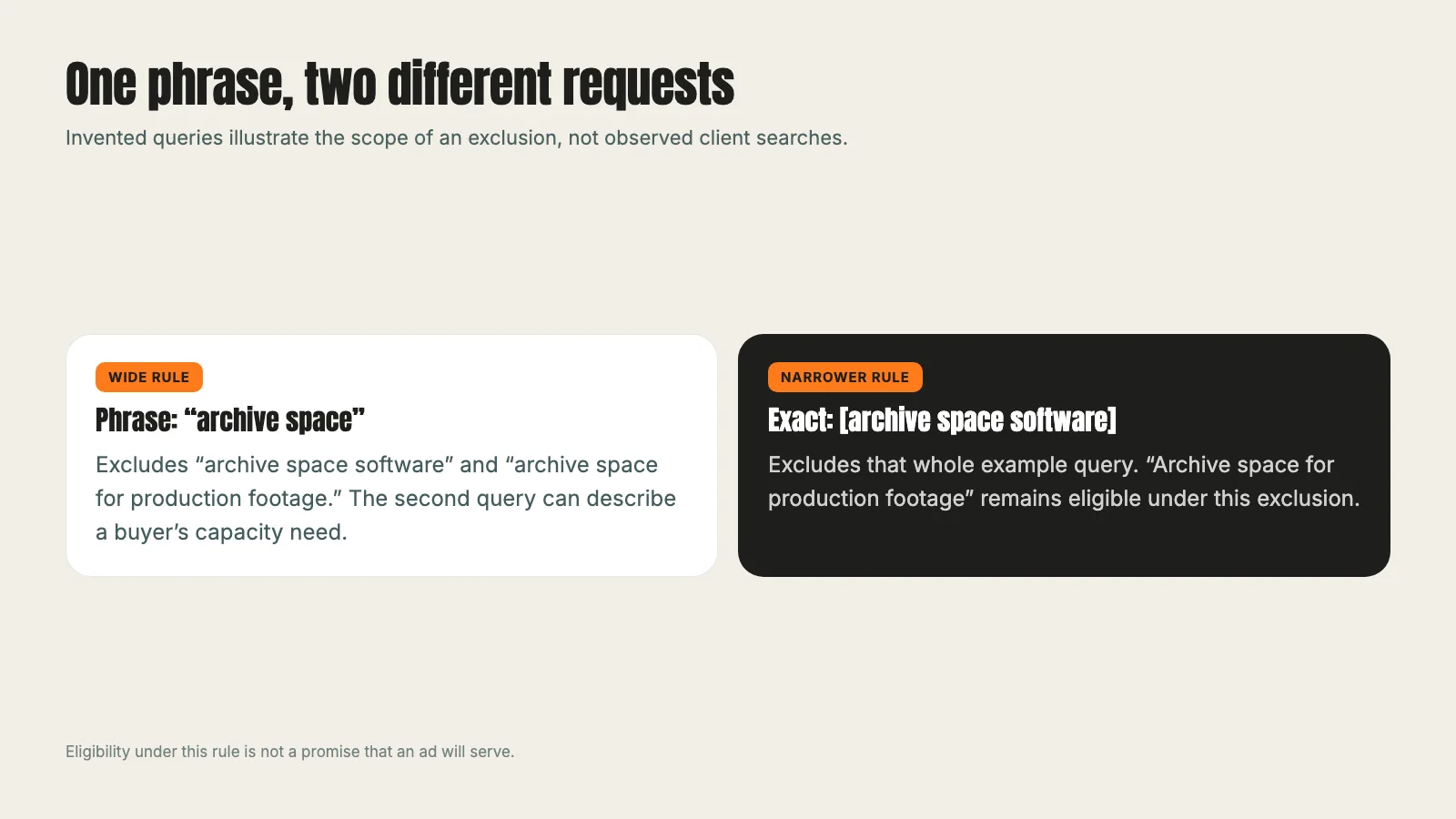
A negative phrase match excludes searches containing the words in the same order, including searches with words before or after the phrase. A negative exact match targets the matching whole query, without extra words. That makes exact useful when an observed query is irrelevant but longer queries containing it could be valuable.
Here is an invented example, unrelated to a client's live query history. A video archive service wants to exclude searches for a separate cataloguing tool. The phrase "archive space" also describes capacity a buyer might need. Excluding that phrase could exclude "archive space for production footage." An exact exclusion for the irrelevant whole query can preserve that longer search under this rule.
| Proposed exclusion | What to ask before adding it |
|---|---|
| A single word | Could a qualified buyer use it in a longer search? |
| A phrase | Could those words describe our service as well as the unwanted product? |
| An exact query | Is this whole search irrelevant, while longer searches might be useful? |
Keep variant handling current. Google says negatives account for casing and misspellings, but do not expand to synonyms and singular or plural forms in the same way as positive keywords. Old audit templates can repeat outdated advice. Check the live documentation instead of treating a years-old spreadsheet as the matching specification.
Judge buyer intent before judging a word
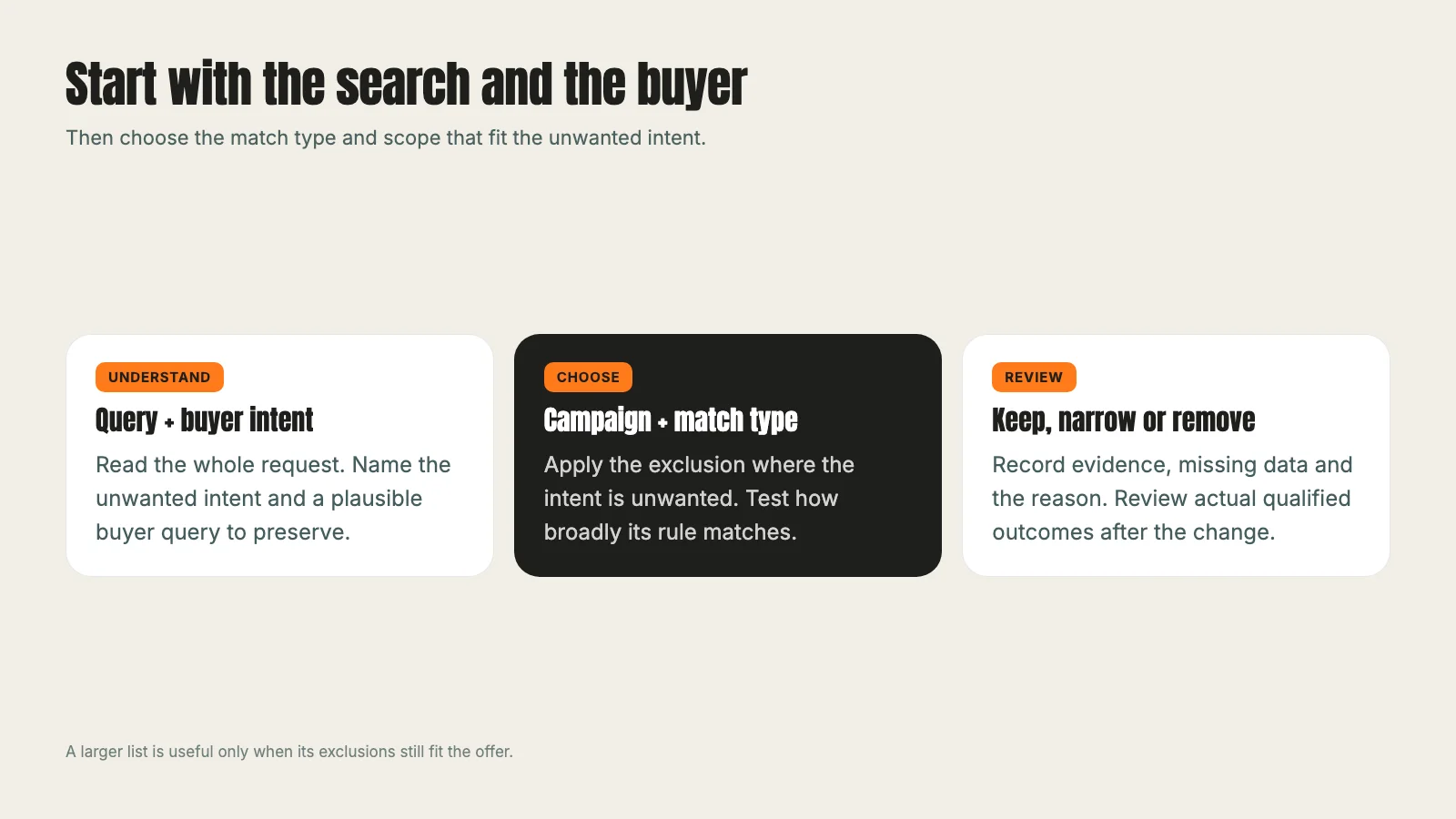
Start with the query someone actually typed, when it is visible. Read it as a request, not as a collection of tokens. What are they trying to buy, compare, integrate, repair or learn? Which product would satisfy that request? Does this campaign have an honest answer?
An integration query may include another application's name because the buyer needs your product to work with it. A comparison query may include a competitor because the buyer is considering a switch. A job query may be irrelevant to a sales campaign, but a word that appears in it can also describe a service. The full request provides the context.
Then read the landing page. If it promises integrations, team workflows or adjacent services, a blanket exclusion on those words may contradict the offer. If the campaign serves a narrowly defined service, a query valuable to another product may still belong elsewhere. Buyer intent and campaign fit are two separate questions.
This matters for home-service advertising as well. Someone seeking a replacement system and someone seeking a replacement part may share a word while needing different businesses. Excluding that word globally can remove the service request too. Begin with the unwanted query, and widen the exclusion only as far as the evidence supports.
Use sales feedback to test the interpretation. Ask what qualified buyers call the problem before they know your category name. The team's vocabulary can explain a search that appears odd in an advertising report. It is not a reason to keep every vague query; it is another source of evidence before blocking one.
What our 29-keyword review changed
We reviewed 29 campaign-level phrase negatives for a B2B video software company. The result was to keep 26, narrow 2 and remove 1. That was a review of exclusion rules, not a claim that every negative was wrong or that the changes increased conversions.
The review looked at search history across 180 days. The newer campaigns had existed only since launch, so their own history was shorter. We checked which campaign held each negative and where the matching queries had actually served. That distinction prevented an account-wide conclusion from evidence belonging to another campaign.
In the visible history, we found no recorded converting search blocked in the campaign where it had converted. Some buyer signals appeared in other campaigns, where the exclusions did not apply. That finding supported keeping most of the list. It did not establish that every hidden or future query was safe to exclude.
The three changes had different reasons. A generic connection word added little to an existing exclusion but could remove integration searches. Another term covered both an irrelevant lookup and people seeking compatible workflow software. A phrase made from ordinary archive-capacity words overlapped the name of a separate tool. We removed the redundant rule and narrowed the ambiguous ones.
The lesson is precision. We did not discard 29 exclusions because three needed attention. We also did not leave the three unchanged just because no blocked conversion was visible. Historical performance and the meaning of the rule answered different parts of the decision.
For examples of how query quality fits a broader program, see our custom pool builder case study and building materials manufacturer case study. A case study's results belong to its own program. They are not a forecast of what a negative-keyword edit will do in another account.
Choose the narrowest useful rule and the right scope
Write the unwanted intent down before changing the account. "People looking for a download of an editor" is more useful than "bad software traffic." It gives you a specific category to exclude and a way to judge whether your proposed rule is too wide.
Next, write one plausible buyer query that should remain eligible. If the exclusion matches that query, reconsider its wording, match type or scope. This simple counterexample is valuable when the query history is thin. It exposes the consequence of the rule without pretending the hypothetical search has already produced a lead.
Consider the campaign's job. A branded product lookup may belong in a brand campaign while being unsuitable for a broader workflow campaign. A supplies query may be irrelevant to a contractor's estimate campaign but relevant to a separate retail offer. Apply exclusions where the unwanted intent is unwanted, not wherever a list can be attached.
For an ad-group exclusion, ask whether you are guiding traffic between relevant offers or suppressing it entirely. Check the intended destination can actually serve the search. Routing a query away from one ad group is not useful if another exclusion removes it from every alternative.
Keep an audit record with the old rule, the new rule, scope, reason, evidence and review date. A useful note explains the buyer it protects as well as the traffic it removes. Someone reviewing the account later should not have to reconstruct the rationale from a spreadsheet of words alone.
Review visible searches and document the blind spots
The search terms report is a starting point, not a complete transcript of demand. Google explains that some low-activity queries are omitted for privacy, while search terms insights can group them into themes. Read those limits in the search terms report guidance.
This changes what you can honestly conclude. "No visible converting query matched the exclusion" is supportable when you checked the relevant rows. "No buyer ever used this word" is a much stronger claim that the report cannot prove. Keep the wording of your decision matched to what you could observe.
Check the meaning of the conversion column too. An account may count form submissions, bookings, imported sales stages or smaller engagement actions. A query with a conversion is not automatically a qualified buyer query. A query without one may have too little history, a longer sales cycle or incomplete tracking.
Our conversion tracking guide covers the handoffs between a click and the customer relationship management system. Review those handoffs before interpreting a zero as proof of poor intent. When tracking is uncertain, classify the uncertainty instead of using it to justify a wider exclusion.
After an edit, review actual query mix and qualified outcomes over a window that fits the campaign's activity. Changing multiple bids, ads, pages and exclusions at once makes attribution harder. Keep the log specific enough to distinguish restored eligibility from a measured improvement in leads.
A checklist that protects buyers
Before keeping or adding a negative, confirm these points:
- You can describe the unwanted intent in plain language.
- You checked the whole query where it is visible.
- You tested a plausible qualified query against the rule.
- The match type excludes no more than the evidence supports.
- The scope matches the product and campaign receiving the rule.
- You checked relevant history in the campaign where the rule applies.
- You know which outcomes the conversion columns count.
- You recorded missing query data and tracking limits.
- You saved the decision and a date to review it.
For an old list, prioritize single words, ambiguous phrases, integrations, product-adjacent terms and exclusions inherited from a different offer. You do not need to remove them all. You need to verify why they still belong.
For a new launch, run the same check against the new landing page and sales offer before carrying the list over. A rule that was sensible for yesterday's service can be wrong for today's integration or package. That is why negative-keyword maintenance belongs beside campaign planning, not just inside a periodic cleanup.
The account should answer the searches your business can serve and exclude the ones it cannot. If you need help reviewing that boundary, our paid ads management service covers the campaign and its follow-through. Start with the ambiguous rule most likely to remove a real buyer, and explain its purpose before making the list longer.
Frequently asked questions
Want this run for your business?
Tell us where to send it and we'll follow up with the strategies that fit your market.