
A Business Profile review starts with accurate facts
David A · Founder, 1212 Agency
Published November 16, 2026

Review your Google Business Profile against the business customers actually reach. Check service facts, useful evidence, contact paths and measurement limits.
A Google Business Profile can be complete and still leave a customer unsure whether the business serves the job, area or visit they have in mind. Optimization should begin with accurate facts and the real customer path, rather than a promise to unlock a particular map position.
Use a review that the business can maintain. Record what is verified, who can approve a correction and how a change will be checked. This guide is a marketing review process, not a claim about any current 1212 client's profile or ranking.
Establish who is authorized to represent the business
Identify the person responsible for the profile and the source of the business details. Access should use the platform's normal permissions. Do not share passwords or assume that an agency's ability to view a profile grants authority to change every field.
Read Google's representation guidelines before proposing edits. The profile should accurately describe the real business. Invented locations, misleading names and unsupported service claims are not optimization techniques.
Create a small fact sheet with the public name, appropriate address or service-area model, contact number, website, operating hours and actual services. Record the person who verified each detail. This makes later changes easier to review when staff, hours or service coverage change.
Follow the customer from the listing
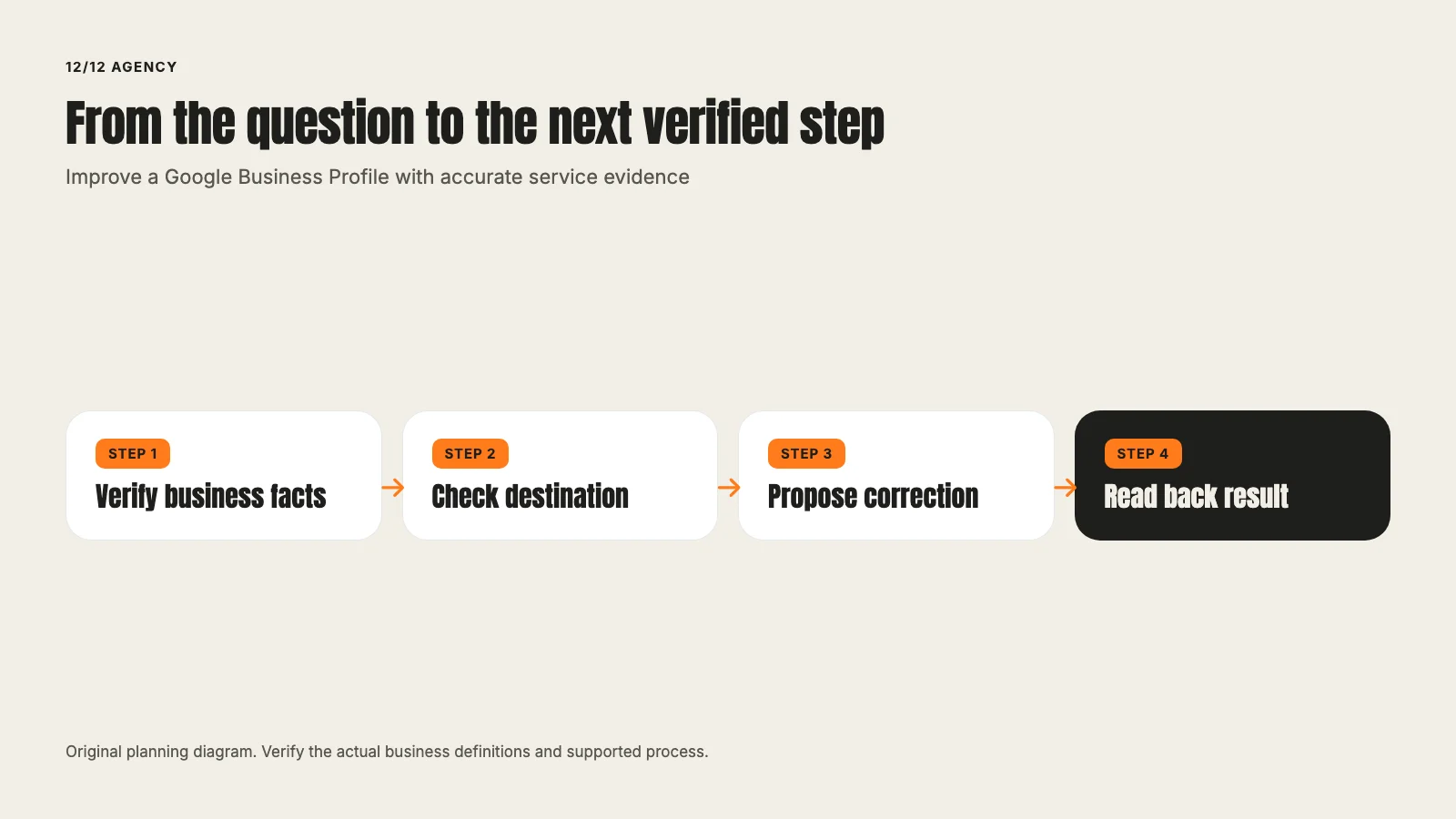
Open the website destination and identify the next action. Does the landing page explain the same business and service? Is the phone number appropriate for the inquiry? Does the contact route match the stated operating model?
A local-business service page may support visits, calls or consultations. A restaurant page may need a reservation or location explanation. A contractor page may need service coverage and an estimate process. These paths should not be treated as interchangeable.
Inspect the route on mobile as well as desktop. A destination can load while its main action is obscured, its form fails or its booking expectation is inaccurate. A listing interaction is only the beginning of that journey.
Review service information with operations
Ask which services are actually available and which details affect fit. A category or service label should describe the business rather than become a wish list of searchable phrases. If a company does not offer a service, adding its name creates the wrong customer expectation.
For a fictional showroom, delivery coverage and appointment availability may matter. For a contractor, travel boundaries and project type may matter. Write the appropriate facts in the profile and website contexts the platform supports, without forcing every detail into the business name.
Avoid assuming that one public field can solve an operational problem. If the team cannot consistently answer calls during the advertised hours, the issue deserves a staffing or routing decision as well as a wording review.
Use photos as evidence, not decoration
Choose current, approved images that help someone recognize the place or understand the work. Check whether a photo is accurate for the specific business or location. A stock image of a large showroom can mislead if customers will arrive at a different kind of space.
For project businesses, use cleared work and truthful captions. Avoid identifiable customer details unless permission covers their public use. A photograph does not prove a typical price, guarantee an outcome or establish every capability the business offers.
Set a maintenance trigger. A changed entrance, moved showroom, new service boundary or retired product display can make an old image less useful. The review should explain what needs updating rather than prescribe a fixed image-upload quota regardless of need.
Build a responsible review process
Customer reviews can provide useful evidence and reveal recurring misunderstandings. Ask the business how it requests feedback, who responds and which issues need private operational follow-up. The response should be accurate and should not disclose private customer information.
Do not invent reviews, write as customers or offer misleading incentives. When a review appears inaccurate or raises a policy concern, use the current platform process and the responsible person's approval. This guide does not authorize deleting content or disputing every negative comment.
The internal review can group themes such as unclear expectations, booking confusion or service praise. Those themes may inform better website explanations without turning an individual customer's story into an unapproved public case study.
Separate ranking factors from controllable work
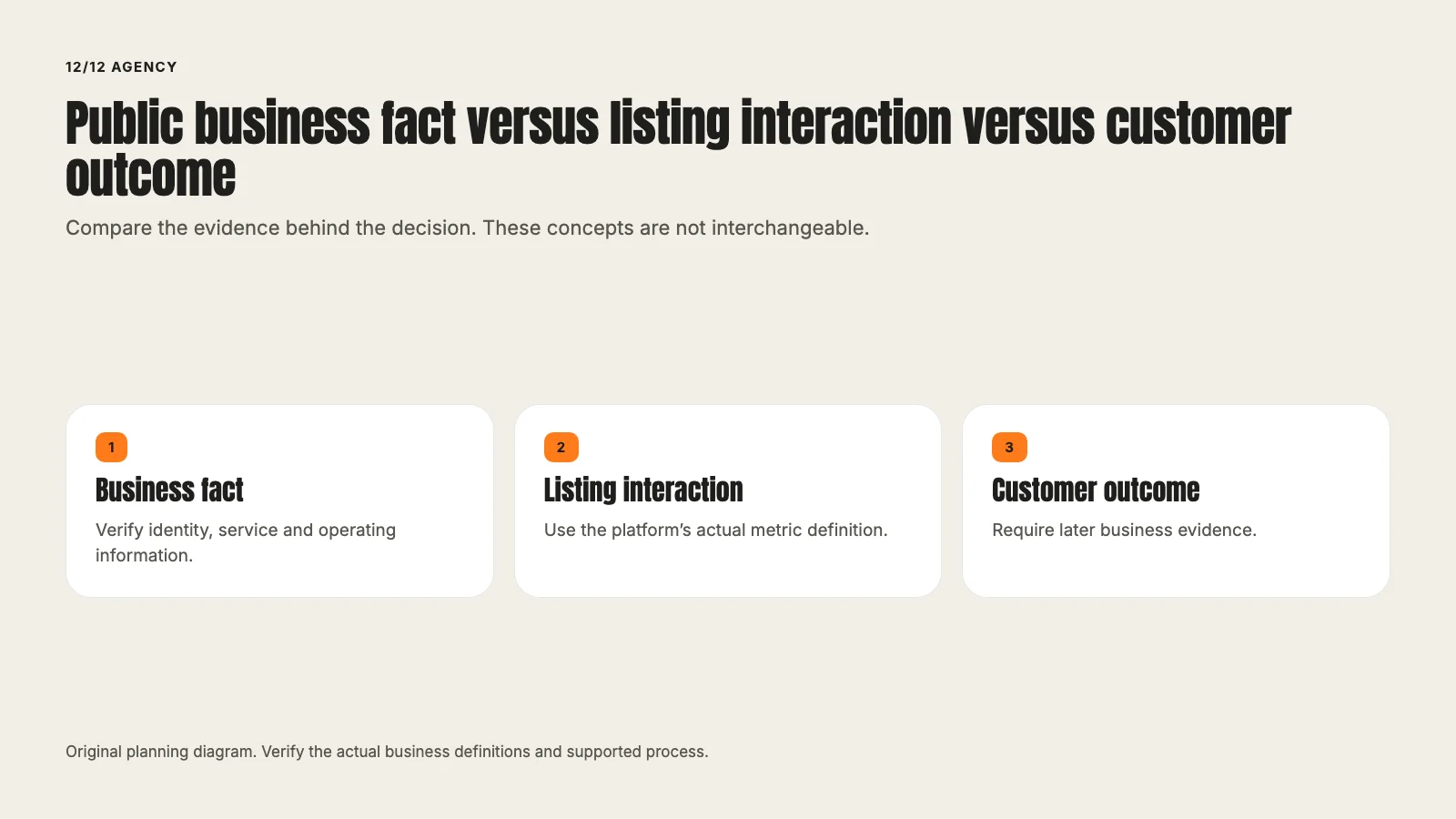
Google's local-ranking guidance describes relevance, distance and prominence and states that businesses cannot request or pay for a better local ranking. That is a limit on the promise an agency should make.
A useful plan still has concrete work: correct inaccurate details, improve the destination, provide truthful evidence and resolve the customer handoff. It should explain why each action matters without claiming that a checklist guarantees the top result.
Avoid treating a single manually observed search as a complete ranking baseline. Location, device, query and other context can change the result. Record the observation accurately and keep it separate from broader performance reporting.
Measure the action and its limits
Define what the profile metrics represent in the current interface. A website click, call interaction or direction request is not automatically a completed visit, connected conversation or customer.
Connect approved source information to the business process where technically and appropriately supported. Our conversion-tracking guide explains why accepted requests and later outcomes need their own evidence. Do not claim that every offline visit can be identified or attributed.
Review a consistent period with the business. Note operating changes, holidays, moved locations and altered service availability. A trend may reflect those changes rather than the effect of one profile edit.
Turn the review into a short action plan
Use one row per observation: current fact, evidence, proposed correction, responsible person and acceptance check. Separate a verified inaccuracy from an optional content improvement. Identify any access or policy dependency precisely.
Prioritize changes that affect customer understanding and contact. The paid media overview can remain a separate discussion if the business also wants acquisition campaigns. Paying for ads and improving profile accuracy are different decisions.
After an approved edit, read the result back. A submitted change may be pending or displayed differently. Do not report it as live merely because the editor accepted the input.
Use a change receipt the next manager can understand
A profile review should leave a small record of the original fact, verified source, exact proposed edit and displayed result after approval. This is especially useful when the person managing the profile changes.
For a fictional showroom, the record might say that the public hours differed from the operations-approved schedule. The proposed correction is specific. After submission, the reviewer checks whether the public profile shows the intended hours or whether the change remains pending. The receipt should not simply say profile optimized.
Keep optional improvements separate from verified inaccuracies. A new photo or revised explanation may be useful, but it has a different urgency from a wrong phone number. Record why the item matters and who can approve it.
This record also prevents unnecessary repeated edits. If the fact is correct and the public display is confirmed, leave it alone until a meaningful trigger appears. The maintenance plan should follow business changes and customer needs rather than a quota of monthly profile activity. A read-only review can legitimately conclude that a particular field needs no change.
Bring the profile, verified business facts and the next action customers should take to a review.
Frequently asked questions
Want this run for your business?
Tell us where to send it and we'll follow up with the strategies that fit your market.