
Contractor SEO: choose the pages that deserve to exist
David A · Founder, 1212 Agency
Published November 16, 2026

Build contractor search coverage from real services, operating areas and useful evidence. Decide when to improve, add or merge a page before writing more.
A contractor website does not become more useful because it has more URLs. It becomes useful when a prospective customer can identify the relevant service, understand the company's fit and take the next step without discovering a different promise on the phone.
SEO planning should decide which answers deserve a page and which belong together. Start with the actual service map, then inspect current searches and the website you already have. This is an architecture decision before it is a writing assignment.
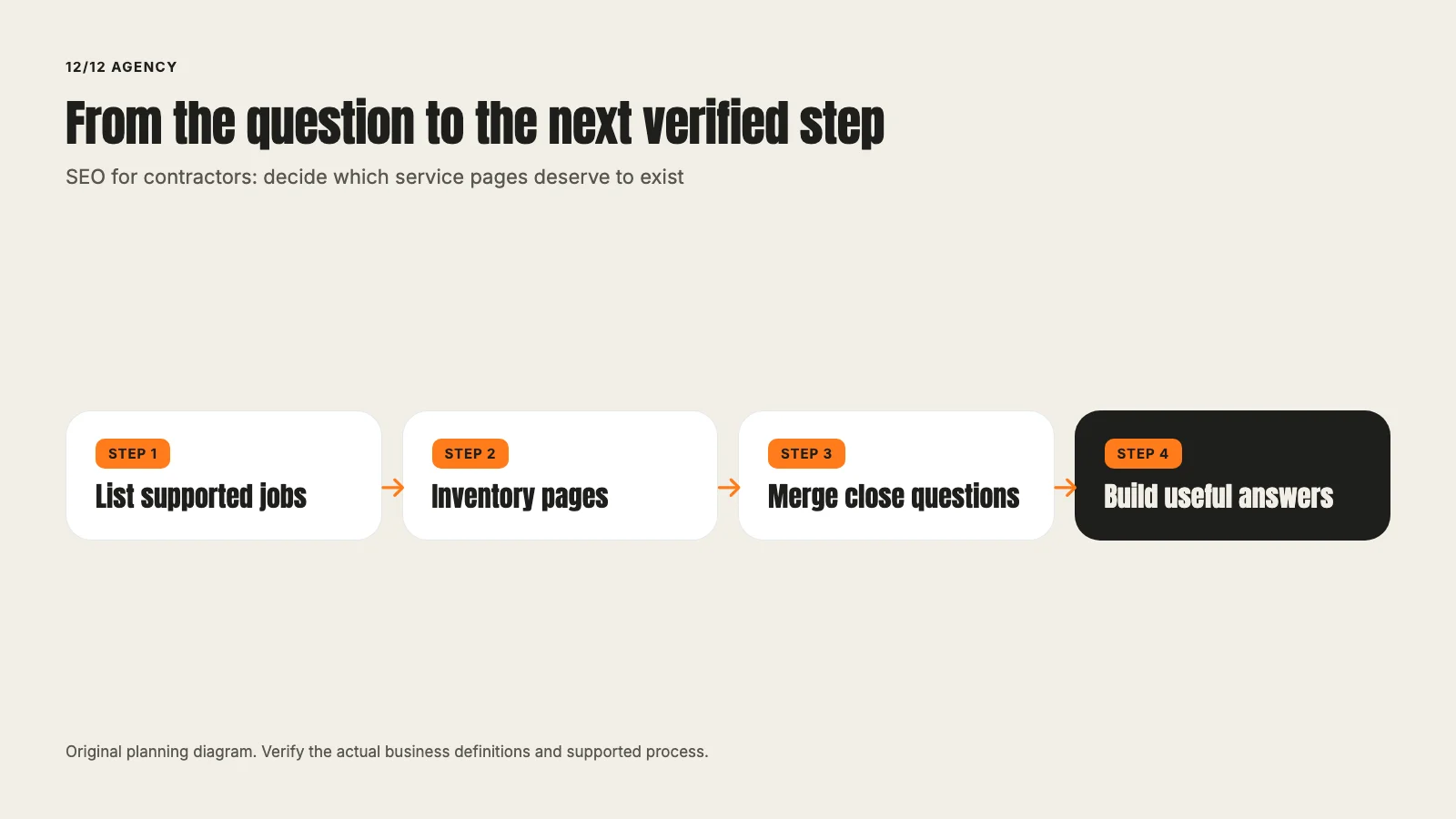
List the jobs, not every keyword variation
Ask operations and sales to define the services the business accepts. Separate jobs where the buyer needs different evidence or a different process. Repair, replacement, renovation and new construction can be meaningful distinctions. Best contractor, trusted contractor and local contractor are not automatically different reader jobs.
Record supported property types, areas, materials and limitations where relevant. A home-services marketing plan should reflect those boundaries. The specific roofing, HVAC and pool-builder pages should explain their own work rather than repeat the same generic paragraph.
This map is an evidence record, not permission to add services. If the company cannot verify a capability, the keyword does not make it true.
Inventory current pages before proposing new ones
Collect the public URLs, their main purpose and the requests they support. Note old campaign pages, duplicate explanations, private routes and content that may be out of date. A page can return successfully and still answer the wrong question.
If Search Console is available, inspect its query and page evidence alongside the public inventory. Keep that separate from a crawler's availability checks. A public page's HTTP success is not proof that Google indexed it or that it ranks for a target phrase.
Read the content before assigning a new article. The existing HVAC SEO guide and pool SEO guide already have specific jobs. A broad contractor architecture article should link to those examples, not reproduce their full advice under a new title.
Match each search family to one useful answer
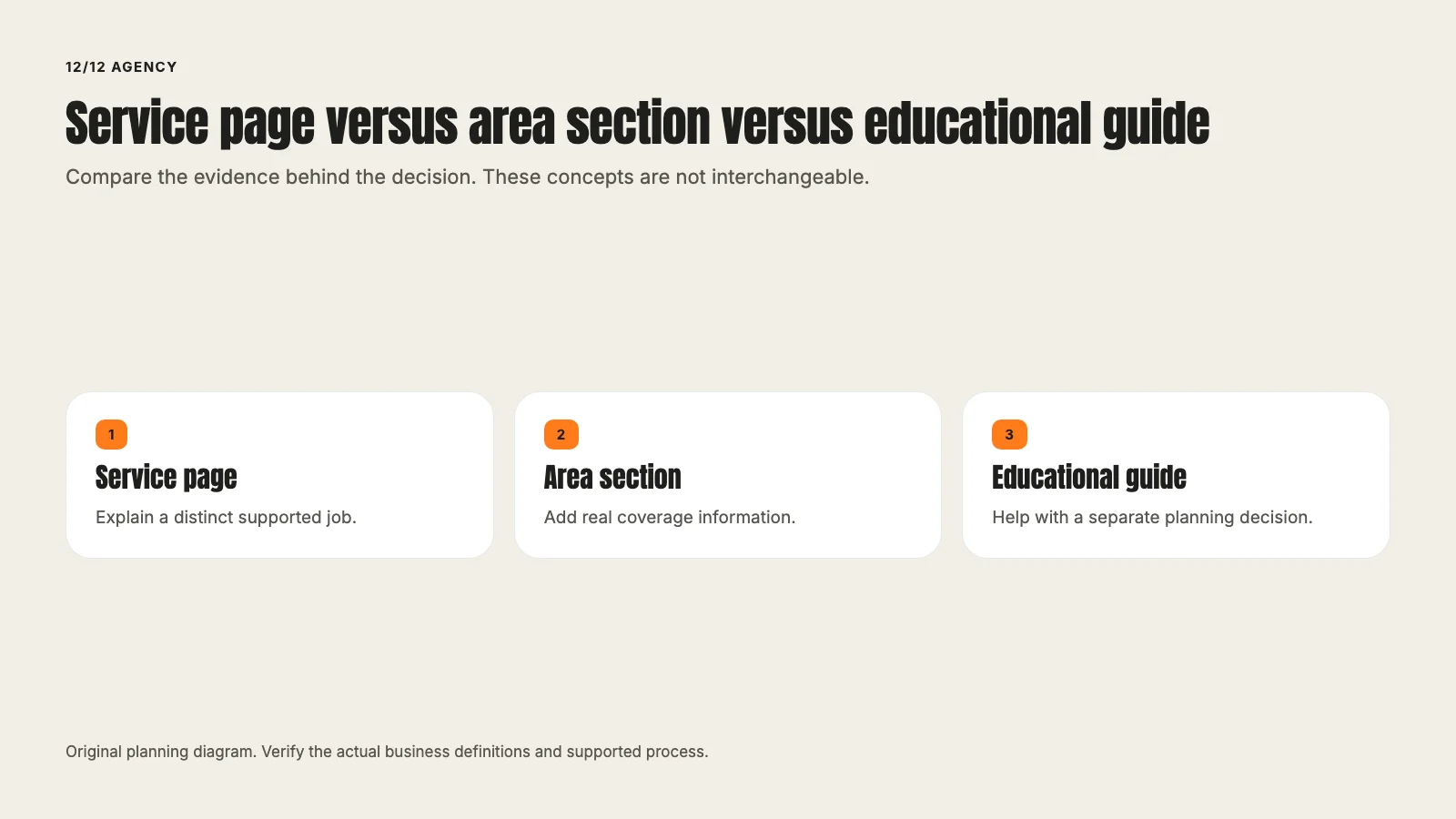
For each group, record the reader's question, intended page, evidence and next action. Several close phrases can lead to one page. Separate pages need a meaningful difference in the explanation, not just a different target keyword.
A fictional contractor offers both concrete patios and commercial foundations. Those jobs may require different scope, evidence and inquiry preparation, so separate pages can make sense. Concrete patio company and patio concrete contractor may belong on the same page.
A buyer researching how the estimate process works may need an educational guide. A buyer selecting a provider needs the commercial service explanation. The pages can link to each other without competing to be the same answer.
Decide what to do with local intent
An operating area is not a license to create a page for every town. Ask what the visitor would learn on a separate area page that is not already clear on the service and coverage pages.
Useful differences might include a genuine staffed location, approved local project evidence, a distinct service boundary or practical logistics. If the only change is a city name, improve the shared page instead.
Google's business representation guidance supports accurate real-world information. It does not support invented addresses. The website and Business Profile should describe the business the customer will actually reach.
Keep sensitive project details private. A customer's street address or construction plans are not required to prove broad service coverage in a public article.
Give each page an evidence plan
Ask what would help the buyer evaluate the service. That can include an accurate process, approved project context, relevant credentials, scope limits and a clear estimate path. A review quote needs permission and an accurate source. A warranty or financing statement needs current verification.
Original explanations from the team often provide the strongest distinction. Ask which requests are unsuitable and what information improves the first conversation. The resulting answer can be more useful than several stock paragraphs about quality craftsmanship.
Google's helpful-content guidance asks whether a page provides original value and a complete useful answer. A word count alone does not satisfy that question. The production standard is a floor, not the reason the page should exist.
Plan links as the next reader decision
A service hub should help visitors reach the relevant work. A detailed service page can lead to the estimate process or a useful preparation guide. An educational article can lead back to the commercial page when the reader is ready to discuss the job.
Write down the reason for each link. Related keyword is weaker than helps the reader compare the supported project types. Avoid forcing every page to link to every service, city and article.
Check proposed links against actual routes. An unbuilt future page should remain a production note rather than a broken public link. If a page is merged or moved later, the redirect and internal-link work require a deliberate reviewed plan.
Keep the contact process within the architecture
The best service explanation still fails if the request does not reach the right team. Identify the accepted action and what information is necessary for routing. Repair mobile errors and unclear confirmation states before treating them as a marketing experiment.
The conversion-tracking guide can support the measurement contract. Preserve distinctions between a page visit, accepted request, booked estimate and won job. The website map should make those journeys understandable, not collapse them into one conversion label.
A labeled test may be needed to verify the path. Agree on any notification or booking consequences before sending it. Tests should not quietly become reported leads.
Prioritize a complete slice of work
Choose a service where the business fit, evidence and customer path are clear. Improve or create that page, prepare its original visuals, verify the contact handoff and connect it through navigation. Then inspect what the next page needs.
This sequence is more useful than launching a large set of nearly identical pages and promising to improve them later. It also makes review possible: the team can judge one complete explanation, not an inventory of placeholders.
Keep a backlog for ideas whose source evidence is missing. Missing proof is a real dependency, but it should be named precisely. A generic review needed label should not become an excuse to leave useful copy unwritten.
Bring the current page list and service map to a planning session. Decide what each useful page is meant to answer before adding another URL.
Give a proposed page a reason to be maintained
A useful page brief records the source person, approved evidence and trigger for review. For a service page, that trigger might be a changed project scope or operating boundary. For an educational guide, it may be a changed process or outdated reference.
Ask what would be lost if the page did not exist. If the answer is only another keyword variation, reconsider the separate URL. If the answer is a distinct buyer decision that current pages cannot support, document that difference and prepare the complete explanation.
The same test applies after publication. A page should not remain unreviewed merely because it once attracted visits. Keep the useful content, source record and next maintenance job visible. This makes the architecture a business system the team can sustain, rather than a one-time expansion whose accuracy depends on memory.
Frequently asked questions
Want this run for your business?
Tell us where to send it and we'll follow up with the strategies that fit your market.