
SEO for HVAC Companies: How to Rank for the Searches That Book Jobs
David A · Founder, 1212 Agency
Published August 31, 2026

Paid search buys demand today. SEO is how an HVAC company stops paying for every call. Here is what actually moves local rankings, in the order worth doing it.
Paid search is the fastest way to get an HVAC phone ringing. It is also a rental agreement. The day you stop paying, the calls stop, and every competitor entering your market raises what you pay for the next one.
SEO for HVAC companies is how you stop renting all of your demand. It is slower, it compounds, and it produces calls at a marginal cost close to zero once it is working. The two belong together: Google Ads covers you while organic builds, which is the sequencing we lay out in the broader HVAC marketing strategies playbook.
This is the SEO half, in the order worth doing it.
Start with the map pack, not your website
Search "AC repair" in almost any city and count what sits above the first organic result. A paid block, then a map with three businesses. For a homeowner whose system died this morning, that map is the entire search results page. They call one of the three and never scroll.
That means the highest-leverage SEO work for an HVAC contractor is not on the website at all. It is on the Google Business Profile.
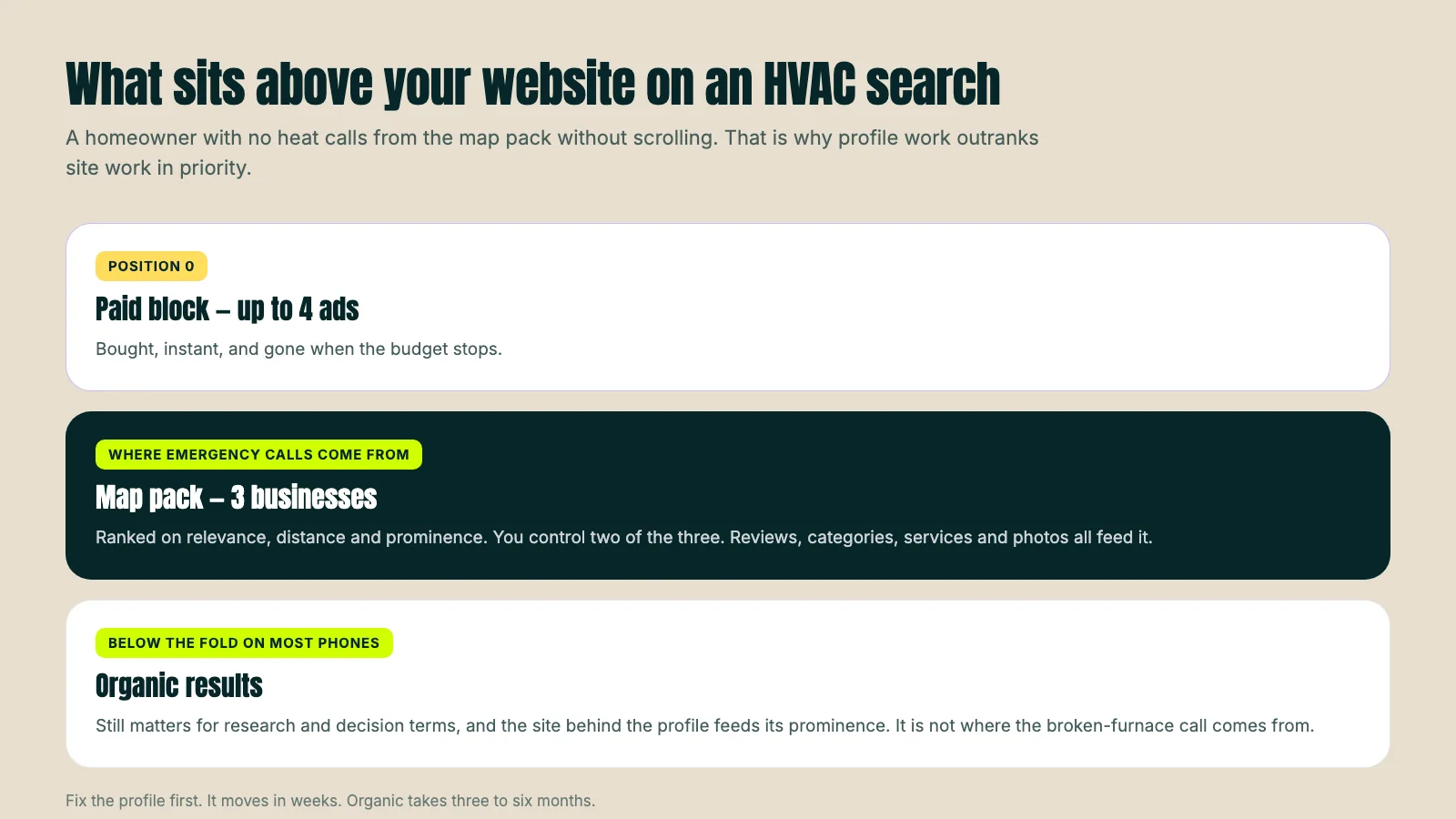
Three things drive whether you appear in that pack: relevance, distance, and prominence. You cannot change distance, which is why a single profile does not cover a metro. You can change the other two.
Relevance comes from categories and services. Your primary category should be the service that matters most commercially, not the broadest one available. Secondary categories should reflect what you actually do. Every service you sell should be listed as a service on the profile with its own description.
Prominence comes from reviews, citations, and the authority of the site behind the profile. It is the slow half.
Before changing categories or service areas, read Google's guidelines for representing your business. Suspensions in this vertical are common and almost always trace back to a service-area or category configuration that violated a rule the contractor never read.
Build city pages that deserve to exist
The most common HVAC SEO mistake is not doing too little. It is doing the same thing forty times.
A contractor learns that city pages rank, so they build one for every town within driving distance. Same template, same 400 words, city name swapped. Six months later none of them rank and the diagnosis is usually "SEO doesn't work."
Five real city pages beat forty templates, and the difference is not close.
What actually happened is that forty near-identical pages competing for variations of the same query split whatever relevance the site had, and Google picked none of them.
A city page earns its place when it contains something only that page can say:
- Installs you have completed in that market, with photographs
- Permitting and inspection specifics for that jurisdiction
- The equipment and system types common in that housing stock
- Reviews from homeowners who live there
- The technicians who actually cover it
Build one for each market you genuinely sell into and can prove work in. Let a strong metro page carry its suburbs in the copy. Five real pages beat forty templates, and the difference is not close.
Match pages to how homeowners search
Homeowners do not search the way contractors write. They search a symptom, a system, or a decision.
"AC not blowing cold air" is a symptom. "Heat pump vs furnace" is a decision. "Emergency AC repair [city]" is someone with a wallet out. These need different pages, and only the last one is a service page.
Map your site to those three intents:
- Symptom pages capture early research and feed your authority. They rarely convert directly and that is fine.
- Decision pages reach homeowners choosing between system types before they choose a contractor. This is where replacement revenue starts.
- Service and city pages capture the buyer who has decided and is choosing between companies. These are the ones to optimize hardest.
Most contractor sites have only the third kind, which is why they compete exclusively on the most expensive terms in the vertical. If you want to see what that costs, model it against your close rate with the cost per lead calculator.
Make reviews a system, not a request
Reviews affect local ranking, and they affect it more in home services than in most verticals. But the version that works is not "ask for reviews."
What works is a system with three properties. It fires automatically, right after the job, by text, while the technician is still in the driveway. It asks for specifics rather than stars, because a review that names the service and the city carries relevance a rating cannot. And it runs continuously, because recency is part of the signal and thirty reviews from two years ago read as a company that stopped.
Respond to all of them, including the bad ones, in public, without arguing. A homeowner reading a measured response to a complaint is being shown how you behave when something goes wrong, which is the thing they are actually trying to find out.
Fix the technical basics, then stop
HVAC SEO does not require a technical overhaul. It requires that the site not be actively broken on a phone.
Google's Core Web Vitals are the standard worth holding to: largest contentful paint under 2.5 seconds, interaction to next paint under 200 milliseconds, cumulative layout shift under 0.1. For contractor sites the wins are almost always the same three:
- Compress the photography. It is nearly always the largest payload on the page.
- Set explicit width and height on every image so the layout stops jumping.
- Make the phone number a real tap target, not text inside an image.
Then make sure your pages can be found: one clear page per service, one per market, internal links between them in the language a homeowner would use, and a sitemap listing all of it.
Beyond that, technical SEO has sharply diminishing returns for a contractor. The next hour is better spent on a city page or a review flow.
Build authority you can actually earn
Link building in home services is mostly unglamorous and local.
Trade associations are the reliable start. Membership and certification through the Air Conditioning Contractors of America produces a citation from an authoritative industry domain and means something to a homeowner comparing three companies, which is a rare combination.
Beyond that: chamber of commerce listings, supplier and manufacturer dealer locators, sponsorships of local teams and events, and the local press that follows them. None of these scale. All of them are difficult for an out-of-market competitor to replicate, which is exactly what makes them worth having.
Consistency matters more than volume. Your name, address, and phone number should be identical everywhere they appear. Contractors who have moved, rebranded, or changed numbers usually have a trail of stale citations quietly undermining the profile they are trying to rank.
What order to do this in
If you are starting from nothing:
- Google Business Profile: categories, services, hours, photos, service areas
- Review system: automated, by text, immediately after the job
- Core service pages: one per service that carries real margin
- City pages: one per market you can prove work in
- Technical: images, layout stability, mobile tap targets
- Citations and local links
- Content for symptoms and decisions
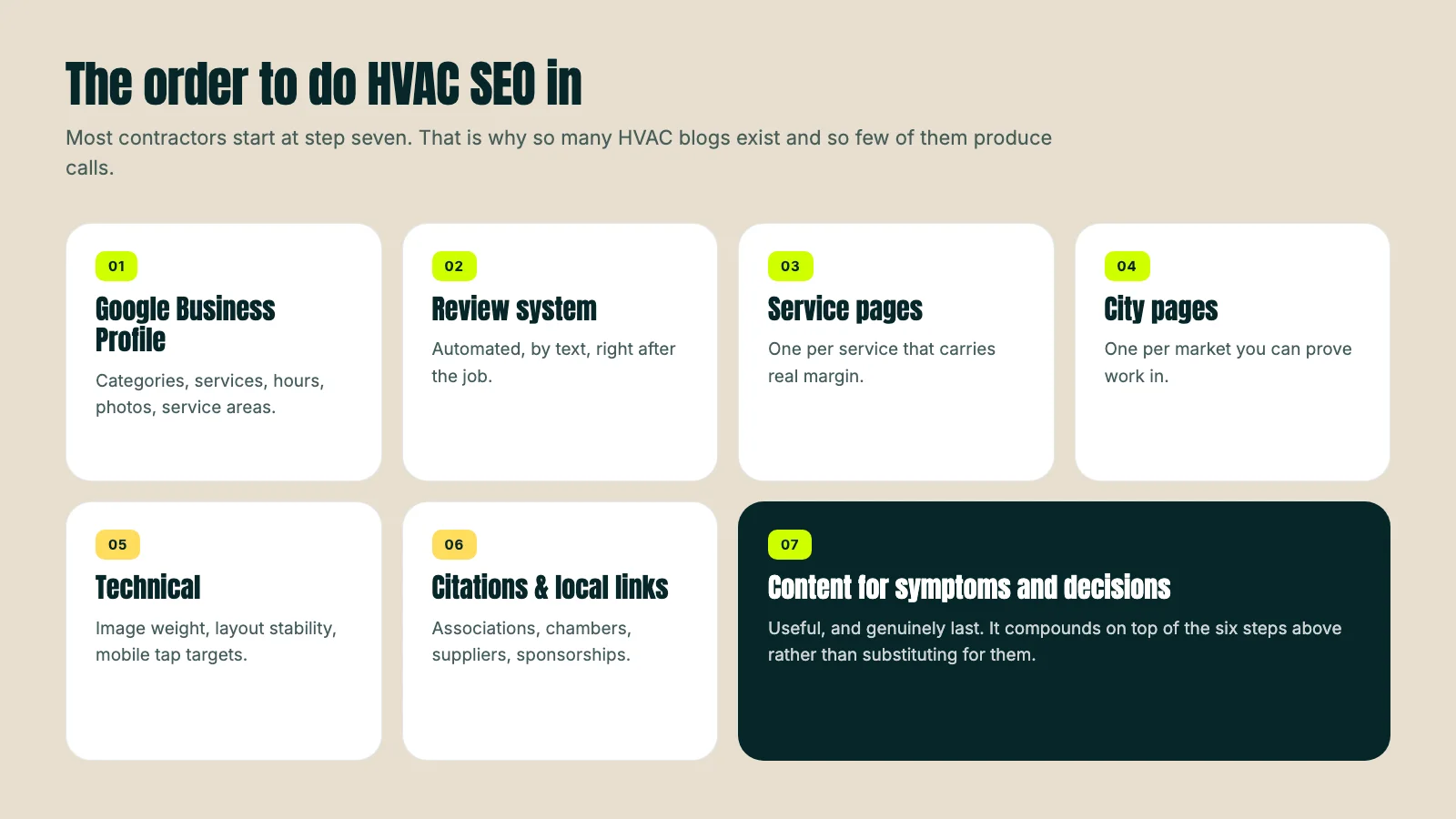
Most contractors invert this and start at step seven, which is why so many HVAC blogs exist and so few of them produce calls.
You can see the compounding effect in our home improvement case study, where organic and local visibility took over the volume paid search had been buying and cut blended cost per lead substantially.
If you would rather have this run for you, that is what our HVAC marketing services and broader home services marketing work cover.
Frequently asked questions
Want this run for your business?
Tell us where to send it and we'll follow up with the strategies that fit your market.