
SEO for Pool Contractors: How to Generate More Qualified Pool Leads
David A · Founder, 1212 Agency
Published February 18, 2026 · Last updated August 31, 2026
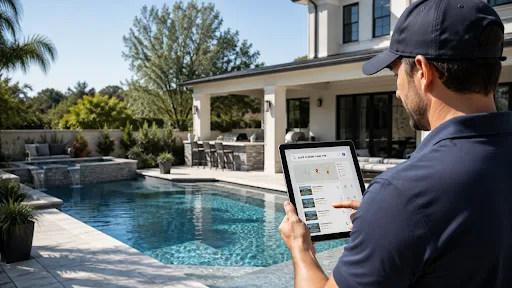
Pool projects are high-ticket, highly local, and extremely competitive. Here is how to build search visibility that produces qualified estimates instead of traffic.
Pool projects are high-ticket, highly local, and extremely competitive. When a homeowner decides to build a pool, renovate an existing one, or hire a company for a major repair, the search for a contractor often begins online.
That makes visibility incredibly valuable. Showing up when someone searches for a pool builder in your market can put your company in front of a homeowner at exactly the moment they're considering a project. Missing from those results means that opportunity may go directly to a competitor.
This is where SEO for pool contractors becomes more than a way to increase website traffic. Done correctly, it creates a consistent source of qualified demand by connecting your company with homeowners who are already searching for the services you provide.
But successful pool company SEO isn't about adding "pool builder" to every page of your website. It starts with understanding how homeowners search, which searches signal real buying intent, and how your website can become the most relevant result in the markets you serve.
Start with how homeowners actually search
One of the easiest mistakes to make with SEO is building a strategy around how your company describes its services instead of how customers search for them.
Homeowners rarely begin by searching for a specific company. They search for what they want, where they want it, or the problem they're trying to solve.
Someone planning a new pool might search for "pool installation Tampa" or "pool builder Alpharetta." A homeowner with an existing pool may search for "pool leak repair near me." Someone earlier in the buying process might search for "fiberglass vs. gunite pool" before they have decided what type of contractor they need.
Those searches represent different stages of the same customer journey.
This matters because a strong pool service marketing strategy shouldn't focus on one keyword or one page. Your website needs to meet potential customers at several points in their research.
A comparison article can reach someone deciding what kind of pool to build. A service page can capture someone who already knows they want a gunite pool. A city page can reach the homeowner who is specifically looking for a contractor in Tampa.
Instead of asking, "How do we get more website traffic?" a better question is, "What would our ideal customer search before requesting an estimate?"
That question leads to a much more useful SEO strategy.
Choose keywords based on revenue, not just search volume
Keyword research can quickly become a numbers exercise. A term receives 2,000 searches, another receives 500, so the larger keyword must be more valuable.
For pool contractors, that logic can be misleading.
The best pool installation keyword research starts with the economics of the business. Which projects do you actually want more of? Which services produce the best margins? Which jobs are worth having your sales team spend time pursuing?
A search for a broad topic about swimming pools may generate plenty of traffic without producing a single estimate. A much more specific search for a custom pool builder in your service area might receive only a fraction of the search volume but represent someone preparing to spend tens of thousands of dollars.
The same principle applies beyond new installations. Renovations, resurfacing, heaters, automation systems, lighting, decking, salt systems, and other high-value services can all create valuable search opportunities depending on what your company offers.
Geography adds another layer.
A contractor serving Tampa should understand how demand differs across Tampa and surrounding communities. The same applies to companies operating in Miami, Clearwater, Tucson, Alpharetta, Colorado, or any other market.
Terms such as SEO for pool contractors in Tampa or SEO for pool contractors in Miami shouldn't simply be repeated throughout a page because a keyword tool identified them. The real opportunity is understanding the local intent behind those searches and building content that genuinely deserves to rank for them.
SEO works better when keyword decisions follow business priorities, not the other way around. If you are not sure what a project is worth to you at the top of the funnel, work backwards from close rate and average job value with the cost per lead calculator before you commit to a keyword set.
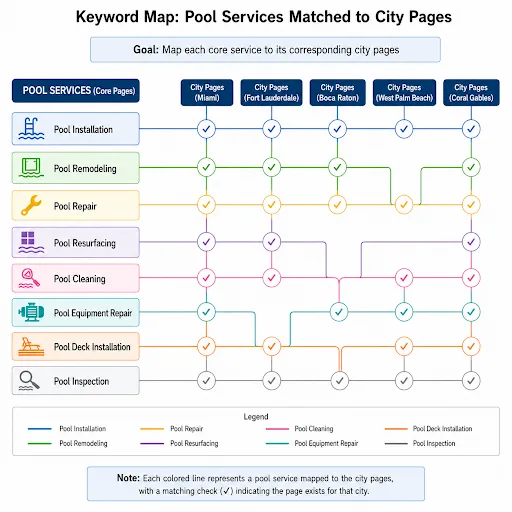
Don't create 50 identical city pages
Once pool companies recognize the importance of local searches, another problem tends to appear. They create a page for every city within driving distance.
The template stays exactly the same, while "Tampa" becomes "Clearwater," then "St. Petersburg," then another suburb. Before long, the website has dozens of nearly identical pages designed primarily to capture variations of the same keyword.
That isn't a strong pool service area pages strategy.
If a market is important enough to deserve its own page, the page should contain information that's genuinely useful to someone considering a pool project in that area.
For example, a Tampa service-area page might discuss the types of projects your company completes there, communities you frequently serve, typical project considerations, local permitting questions, relevant customer projects, and testimonials from homeowners nearby. Original project photography can make the page even more useful.
This creates a page with a reason to exist beyond changing the city name in an H1.
You also don't necessarily need a page for every small community you serve. A strong page for a major market can naturally explain that your company serves surrounding neighborhoods and suburbs.
If a homeowner lands on your Tampa page, they should immediately understand that you know their market and actually work there.
Think about service-area pages as local sales pages rather than SEO templates. If a homeowner lands on one, they should immediately understand that you know their market and actually work there.
That distinction can make the difference between building meaningful local visibility and wondering why your pool company is not ranking despite having dozens of location pages. We took exactly this approach with a custom pool builder and again with a pool builder in Houston, where consolidating thin location pages into fewer, deeper ones was the change that moved qualified estimate volume.
Your Google Business Profile may be more important than your homepage
Search for a pool contractor in almost any city and you'll usually encounter the local map results before reaching many traditional organic listings.
For a homeowner who is ready to call someone, those results are extremely influential.
They can immediately see where a company operates, its reviews, project photos, hours, phone number, and overall reputation. In many cases, the homeowner can contact the business without ever visiting its website.
That's why pool builder Google Business Profile optimization deserves just as much attention as traditional website SEO.
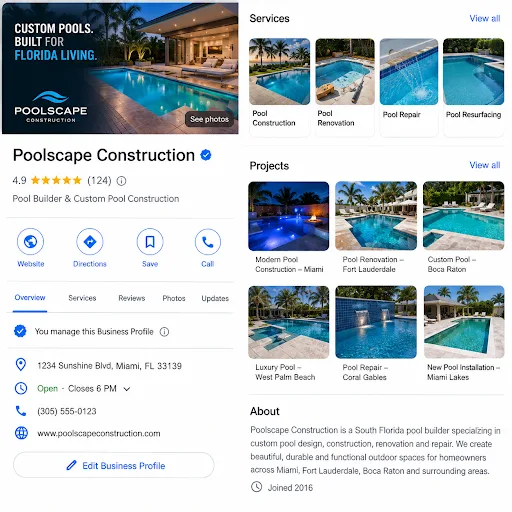
Start with accuracy. Your primary business category should reflect the service that matters most to the company, and your listed service areas should match the markets you genuinely serve. Google's own guidelines for representing your business are worth reading before you make category or service area changes, because getting them wrong is one of the more common causes of a suspended profile.
Then focus on proof.
A pool contractor has an advantage that many businesses don't: the work is highly visual. Finished pools, renovations, jobsite progress, equipment installations, and before-and-after photos provide potential customers with immediate evidence of what your company can do.
Reviews serve a similar purpose. A steady stream of detailed reviews from real customers gives homeowners another reason to trust your company while also strengthening your local presence.
Your profile should also make it easy to understand what you offer. Services, business information, project updates, common questions, and relevant photos all help turn a basic listing into something closer to a mini sales page.
Finally, track it. Adding appropriate campaign tracking to website links and monitoring calls or form submissions helps you understand whether local search is actually producing opportunities.
For many contractors, pool company local SEO isn't about choosing between the website and Google Business Profile. The two should reinforce each other. Your profile creates immediate local visibility, while your website provides the depth and credibility a homeowner needs before committing to a high-ticket project.
Build credibility signals a homeowner can verify
A pool is one of the largest discretionary purchases a homeowner will make. Before they fill in a form, most of them are quietly checking whether your company is real, licensed, and still going to exist in two years.
Search engines are looking for versions of the same signals. Consistent name, address, and phone details across directories. A real physical presence. Pages that name the people doing the work. Certifications that can be checked.
Industry affiliations do double duty here. Membership and certification through the Pool & Hot Tub Alliance is meaningful to a homeowner comparing three contractors, and it produces the kind of authoritative, verifiable citation that supports local visibility at the same time.
The same applies to your own evidence. Permit-ready project galleries, named service areas, warranty terms, and financing detail all reduce the friction between "this company looks credible" and "I'll request an estimate."
Make the technical foundation invisible
None of the above survives a website that loads slowly on a phone in a driveway.
Pool searches skew mobile and they skew impatient. Google's own Core Web Vitals guidance is the right standard to hold your site to: largest contentful paint under 2.5 seconds, interaction to next paint under 200 milliseconds, and cumulative layout shift under 0.1.
For most contractor sites the wins are unglamorous and large. Compress the project photography, which is usually the single biggest payload on a pool builder's site. Set explicit width and height on every image so the page does not jump while it loads. Make sure the phone number is a tap target and not an image.
Then make sure the pages can be found at all. One clear page per service, one per market you actively sell into, internal links between them that use the language a homeowner would use, and a sitemap that lists every one of them.
The goal isn't more traffic. It's more of the right projects
Pool contractors don't need thousands of random website visitors. They need homeowners in the right service areas who are interested in the projects the company actually wants to sell.
That's an important distinction.
A successful SEO strategy should help a pool company become visible throughout the homeowner's research process, from early questions about pool types and costs to highly commercial searches for builders and installers nearby. While that visibility builds, Google Ads management is usually what keeps the estimate calendar full, because organic and the map pack take months to compound and a build season does not wait.
That means understanding customer intent, prioritizing profitable services, creating genuinely useful local pages, and treating your Google Business Profile as an important part of the buying experience.
When those pieces work together, SEO stops being a ranking exercise and becomes something much more valuable: a predictable way to put your company in front of qualified homeowners at the moment they're looking for what you do. See how we approach this in our pool builder marketing services, and how the same playbook runs across home services marketing more broadly.
Frequently asked questions
Want this run for your business?
Tell us where to send it and we'll follow up with the strategies that fit your market.