
Choose the next SaaS marketing problem
David A · Founder, 1212 Agency
Published November 16, 2026

Build a SaaS marketing plan around the buyer, product journey and available evidence. Compare channels using capacity, economics and a defined next decision.
A SaaS marketing plan becomes hard to use when every channel is a priority. The team publishes articles, runs ads and sends emails, but cannot say which business constraint the work is meant to change.
Start with a narrower question: what prevents the next suitable customer from making progress? The answer could be weak demand, an unclear product explanation, unsuitable inquiries, a difficult trial or limited sales capacity. Each problem implies different work. This guide develops a practical planning sequence using a fictional scheduling-software business. Its examples are planning illustrations, not 1212 client results.
Write the journey the product actually supports
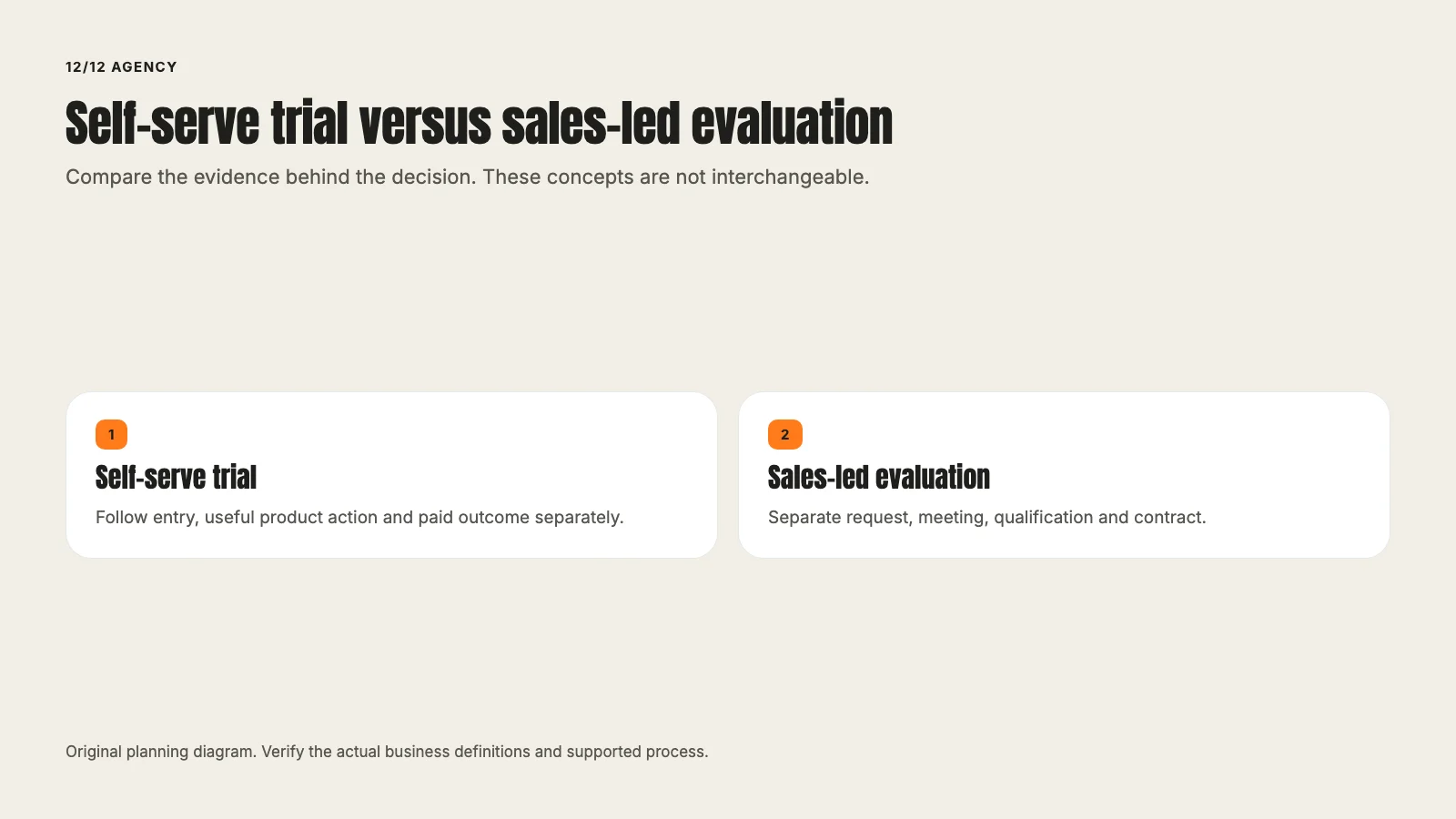
A self-serve product may let someone sign up, complete a setup task and purchase without speaking to sales. A sales-led product may require a demo, security review, proposal and contract. A hybrid product may have both journeys, but they should not be combined into one undefined conversion rate.
For the fictional scheduling product, a small operator can start a trial while a multi-location organization requests a demonstration. The marketer first records those two paths. A trial signup is not a booked demo. A booked demo is not attendance. A signed contract is not necessarily collected cash.
Write a simple stage map with the action, source system, timestamp and evidence required. This gives the team a shared definition before it compares channels. Our existing SaaS lead-generation guide explores later-stage distinctions in more detail.
Find the business constraint
Review recent evidence with product, sales and support. Are suitable buyers reaching the site? Can they understand the product's actual use case? Are requests arriving in the right system? Do trial users reach the step that demonstrates value? Are sales conversations delayed because the team has no capacity?
A channel cannot repair every downstream problem. Buying more trial signups while a required setup step fails will create a larger broken cohort. Publishing comparison pages before the team can explain its product boundaries can increase confusion rather than confidence.
Choose a constraint that has an observable symptom. The fictional company finds that operators ask whether the product supports separate room schedules, but its website describes only generic booking. That suggests a product explanation problem. A specific use-case page and demonstration may be more useful than another broad awareness campaign.
Check which demand already exists
Search research can reveal the language of the job, but a keyword estimate is not a forecast of customers. Read current results and the actual questions buyers ask. Distinguish a category search, a workflow problem, an integration requirement and a competitor comparison.
Then inspect the existing website. A useful page may already answer the question poorly. Improve it rather than adding a second URL with a slightly different phrase. Our SaaS SEO strategy proposal belongs within a wider plan that also accounts for distribution and product learning.
The fictional company might choose one page about managing multiple bookable spaces. It would show the supported workflow, real limitations and a suitable next step. It would not claim that every business with a calendar is an ideal customer.
Choose a channel for a job
Search ads can test an existing query family when the offer and destination fit. Organic search can make an accurate explanation discoverable over time. Social content can demonstrate a workflow to people who are not currently searching. Permission-based email can help an existing prospect or user complete a relevant next action.
Those are roles, not guarantees. A narrow B2B audience may be reachable through professional targeting, but the resulting traffic still needs a useful offer and follow-up. A high-volume keyword can be irrelevant to the product. A successful content distribution partnership may reach a different stage from a paid demo campaign.
Write a test brief for the chosen role. Name the audience, question, asset, accepted action and evidence needed for the next decision. Keep the work small enough that the team can actually interpret it.
Model the costs you are approving
Separate media from management, creative, page work and sales follow-up. In a fictional scenario, a $3,000 media test with $1,000 of additional work costs $4,000 to run. That does not establish its expected return.
If the team assumes a $6 click cost, 5% click-to-request rate and 20% request-to-qualified-opportunity rate, the model produces 500 clicks, 25 requests and five qualified opportunities. Those are assumptions multiplied together. They are not observed outcomes or a quote. A different rate at any stage changes the result materially.
Review whether the sales team can handle the modeled volume and whether an opportunity has a defined meaning. Do not add form requests and opportunities together as if they were separate customers.
Define the review before starting
A useful review asks whether the test answered its question. Did the page reach the intended buyer? Did people understand the supported workflow? Did accepted requests arrive with enough context? What did sales learn about fit?
Record the time window, attribution limits and any changes to the product, offer or audience. A low-volume test may provide descriptive evidence without proving that one channel is better. If the destination failed, repair it before interpreting cost per request as a market verdict.
Decide what evidence would justify expanding, revising or stopping the test. Budget and campaign changes still need the responsible business person's approval. An attractive dashboard does not grant that authority.
Turn the plan into a work sequence
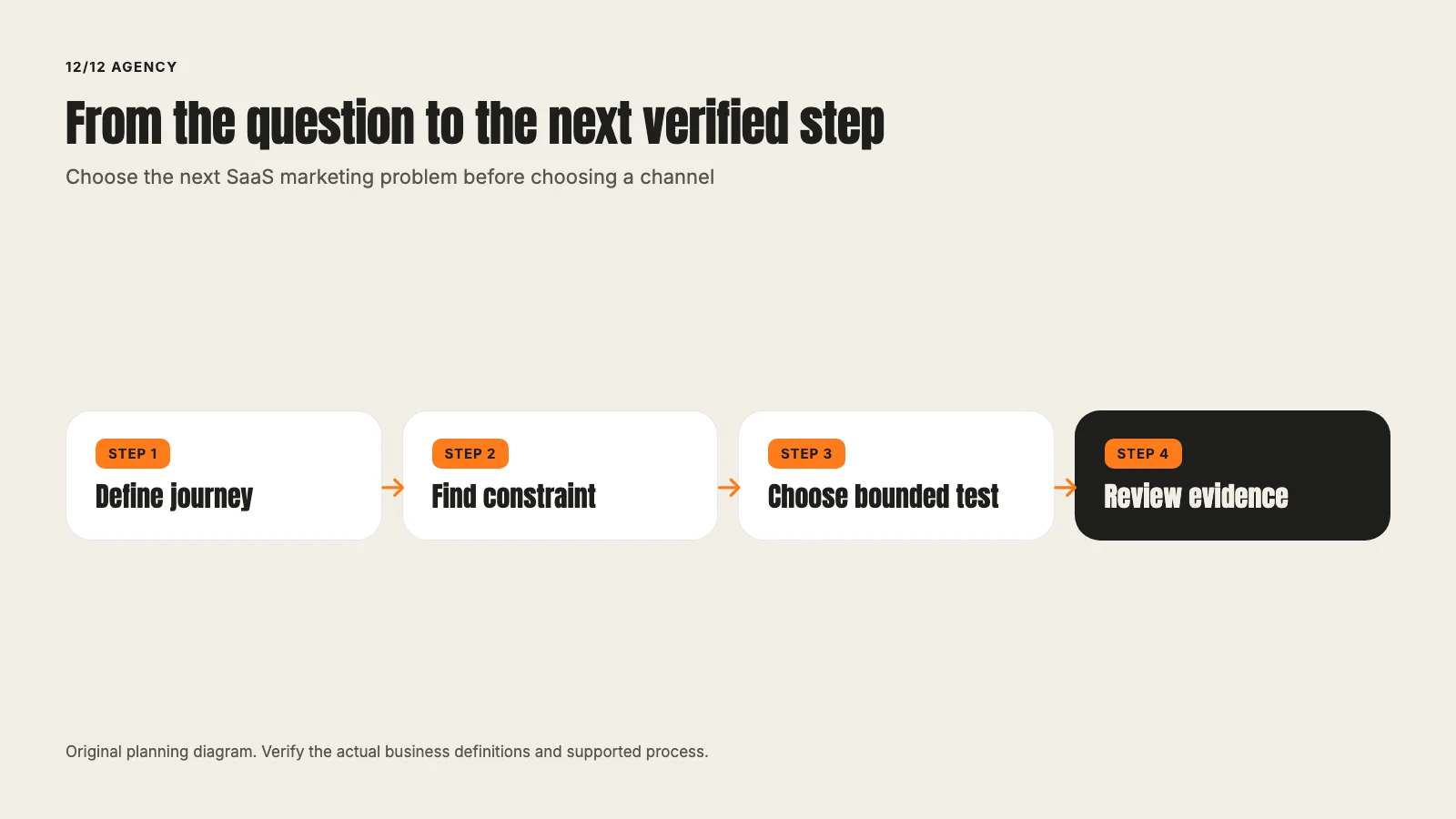
For the fictional scheduling company, the first sequence could be: verify the workflow with product; improve its explanation; confirm the request and trial paths; prepare a bounded acquisition test; then review the resulting cohort with sales and product. The next sequence depends on what that work reveals.
The plan also records what is deliberately deferred. A second industry, an integration page or a larger content program may be sensible later. Deferral is useful when it protects the team's ability to finish and learn from the current work.
Put the constraint into a working brief
The fictional scheduling team can write its first brief on one page: operators need to understand how room availability is represented; product must verify the workflow; the current page needs a clearer explanation; the test will review suitable accepted requests. Sales capacity and the observation window belong on that same page.
Use the existing SaaS service context to preserve the commercial fit, the B2B lead-generation framework to define the stages and the tracking guide to identify the actual evidence. These are complementary jobs rather than three competing strategies.
For the content portion, Google's helpful-content guidance is a quality reference. For the public page, its technical requirements describe eligibility rather than a ranking guarantee. Neither reference can establish that the product supports a feature. Product evidence still controls the promise.
At review, the team should be able to answer whether the explanation reached the intended reader, whether the request arrived intact and what the buyer still needed to know. If those questions remain unanswered, name the missing record or source. Do not replace the gap with a broader campaign or an invented success rate.
Questions to resolve together
Bring the product journey, the current constraint and the evidence you trust to a strategy session. The first deliverable should be a clear next decision.
Frequently asked questions
Want this run for your business?
Tell us where to send it and we'll follow up with the strategies that fit your market.