
Performance Max for leads starts with the outcome
David A · Founder, 1212 Agency
Published November 16, 2026

Review Performance Max lead generation through conversion definitions, creative inputs and a verified business handoff. Keep setup evidence separate from results.
A campaign can become efficient at the action it is asked to acquire while producing the wrong business outcome. Performance Max does not remove the need to define that action. It makes the quality of the input especially important because the campaign spans several advertising surfaces and automated decisions.
Before recommending a new campaign type, review the outcome, evidence, destination and operating capacity. This guide explains that review. It does not claim that Performance Max is always the right next campaign or that a particular account is ready to launch it.
Define the business action precisely
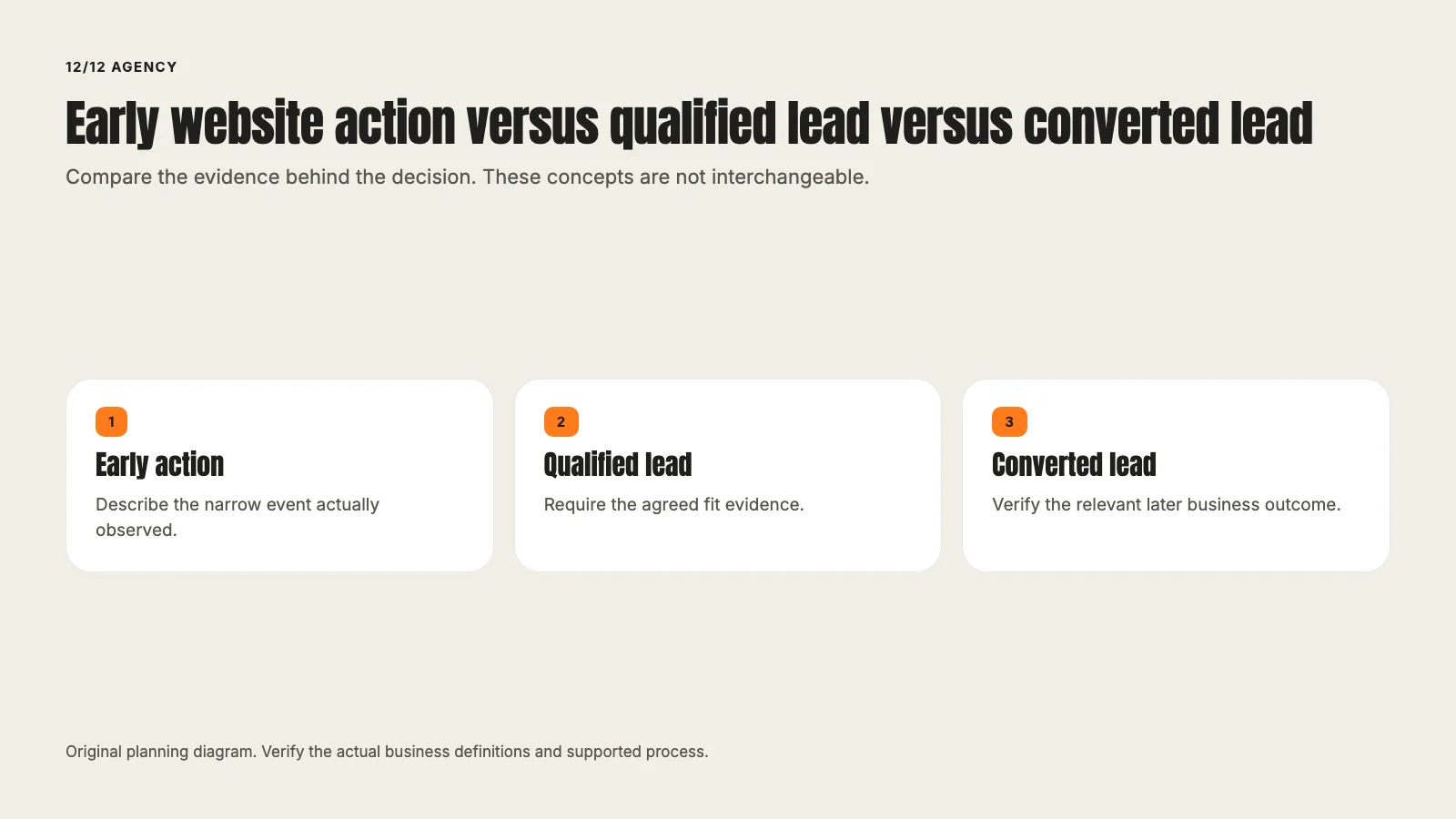
Start with the event the business wants, then identify the evidence available. A page view, accepted form, confirmed booking, qualified opportunity and won customer are separate stages. The fact that an event has a conversion name does not make it a useful optimization target.
Google's current Performance Max lead-generation guidance emphasizes measurement and meaningful conversion inputs. Apply that principle to the business's actual path rather than copying a goal name from another account.
For a fictional software company, an accepted demo request might be the first measurable action. Later sales qualification may be available only after a reviewed CRM connection. Do not describe the earlier event as a qualified lead simply because the later evidence is not yet connected.
Check campaign goals and action settings together
Inventory the relevant actions, their source, counting behavior and evidence. Then inspect which goals the campaign uses. A setting at account level does not by itself describe every campaign's behavior.
Google's conversion-goal documentation explains the relationship between actions and selected goals. Custom goals can also affect how account-level Secondary actions are used. The audit should read the actual configuration rather than rely on a blanket Primary-versus-Secondary slogan.
The existing Google Ads audit guide retains the detailed account-review process. This article uses that foundation to assess a Performance Max lead-generation decision, not to create another generic audit checklist.
Verify the journey before feeding it more traffic
Open the actual destination and follow the supported path to the accepted action. Check form acceptance, confirmation, routing, relevant technical event and the receiving business record. A button click or contact record alone may not prove a booking.
The conversion-tracking guide explains these system distinctions. Source information can disappear at an intermediate link even when the first page looks correct. Inspect the actual route under the site's normal consent behavior.
If a real labeled test is needed, agree on its consequences before submission. Keep it out of business counts. Do not replay the same outcome or create additional bookings merely because reporting has not refreshed.
Prepare creative that supports a verified promise
A multi-surface campaign needs accurate assets that still make sense when shown in different combinations. The creative brief should identify the buyer problem, supported offer, evidence, destination and limits.
Avoid treating an asset quantity target as a substitute for message quality. Several versions of the same vague benefit do not necessarily help the buyer understand fit. A product demonstration, clear service explanation and relevant proof can answer different questions when the business actually supports them.
Review images, text and video for implied claims. A screenshot should not expose private information. A stock scene should not imply a real client case. A feature that exists only in a concept mockup should not be advertised as live.
Understand what the campaign can expand or select
Review the current account's available controls and the role of each input. Audience guidance, destination choices, brand handling and exclusions can have different meanings. Do not infer a fixed boundary from a label without checking the actual current behavior.
Record the approved page set and any URLs that should not receive the campaign's traffic. If an automated destination reaches an unsuitable page, investigate the setting and page map. Do not quietly rewrite unrelated site content to make the campaign appear aligned.
The Google Ads service page can support the commercial engagement. A configuration review should still identify which changes require approval and which evidence verifies the final state.
Review lead quality as a chain of evidence
When requests look unsuitable, distinguish spam, unsupported service, outside geography, incorrect contact information, unclear permission and a broken handoff. These symptoms imply different next work.
A form can create easy conversions while omitting the information sales needs. A page can attract the wrong buyer because the offer is broad or inaccurate. A later-stage import can be incomplete. None of those problems is solved by declaring that the campaign type is either magical or useless.
The B2B lead-generation guide can support a wider funnel review. Preserve its business-stage definitions when comparing sources. Do not add early and late actions together as a count of customers.
Model costs using the actual stage
Suppose a fictional plan includes $4,000 of media and $1,000 of other acquisition work. If the completed cohort contains 50 accepted requests, included cost per request is $100. If ten meet a separately verified qualification definition, included cost per qualified inquiry is $500.
Those figures illustrate the stage and cost boundary. They are not Performance Max benchmarks. They do not show incremental lift, won revenue or profit. If qualification is not recorded reliably, the report should not manufacture the ten later outcomes.
Compare equal opportunity windows and note changes in offer, geography, sales capacity and destination. A sparse or immature cohort can change materially with one later result. Treat the evidence at the precision it supports.
Separate learning time from unresolved defects
A campaign needs time to produce outcomes, but waiting is not a reason to ignore a reproducible broken form or incorrect goal. Verify material setup issues promptly and record any approved correction.
After a change, preserve the date, expected effect and affected measurement definition. A before-and-after comparison across different goals is not automatically comparable. The paid media overview can connect that review to the broader acquisition plan.
Avoid repeated unplanned changes driven by a few days of noise. Choose a review rule before the test and obtain the appropriate approval for budget, bid, status or targeting changes. A platform recommendation is evidence to assess, not an instruction that overrides business authorization.
A concrete readiness packet
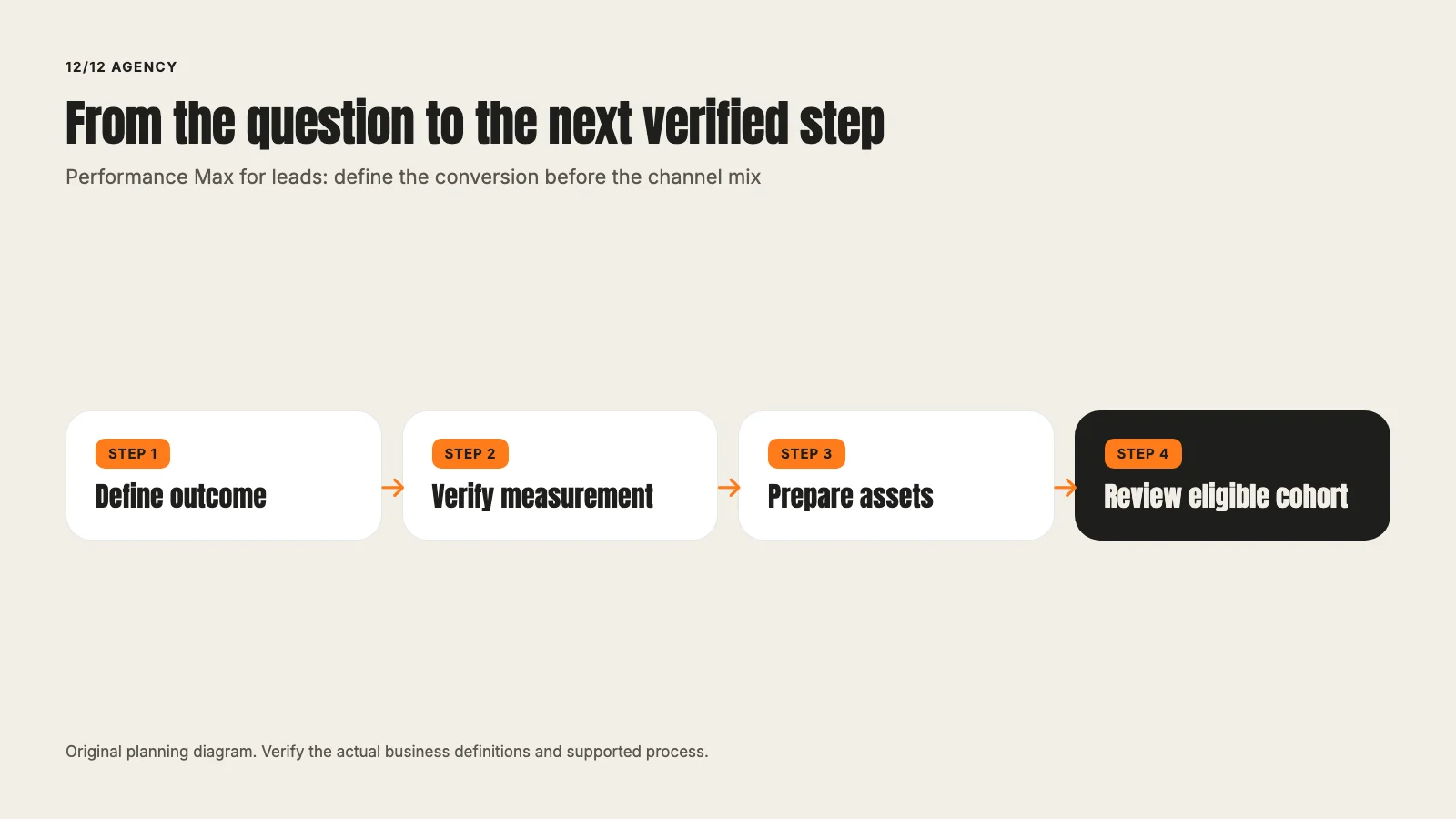
Prepare the accepted-action definition, actual goal configuration, destination map, verified asset claims, technical receipt, CRM-stage contract, cost boundary and review window. Mark missing evidence by name.
That packet lets the team decide whether the next job is a repair, a measurement connection, a creative revision or a bounded campaign test. It is more useful than a readiness score with no explanation of what remains unknown.
Keep the goal-change receipt
If the approved review changes a goal or its definition, record the previous state, intended state and actual readback. The reporting comparison should show that boundary rather than present the two periods as identical.
A campaign can appear to produce more conversions because another early action entered the selected goal. That is a measurement change to explain before claiming improved business performance. Likewise, a narrower goal may reduce the reported total while improving the meaning of the number.
The receipt should identify what was checked technically and what still needs later outcome evidence. It lets the next reviewer understand whether a trend reflects the campaign, the measurement contract or both.
Bring the actual outcome and current evidence to a review.
Frequently asked questions
Want this run for your business?
Tell us where to send it and we'll follow up with the strategies that fit your market.