
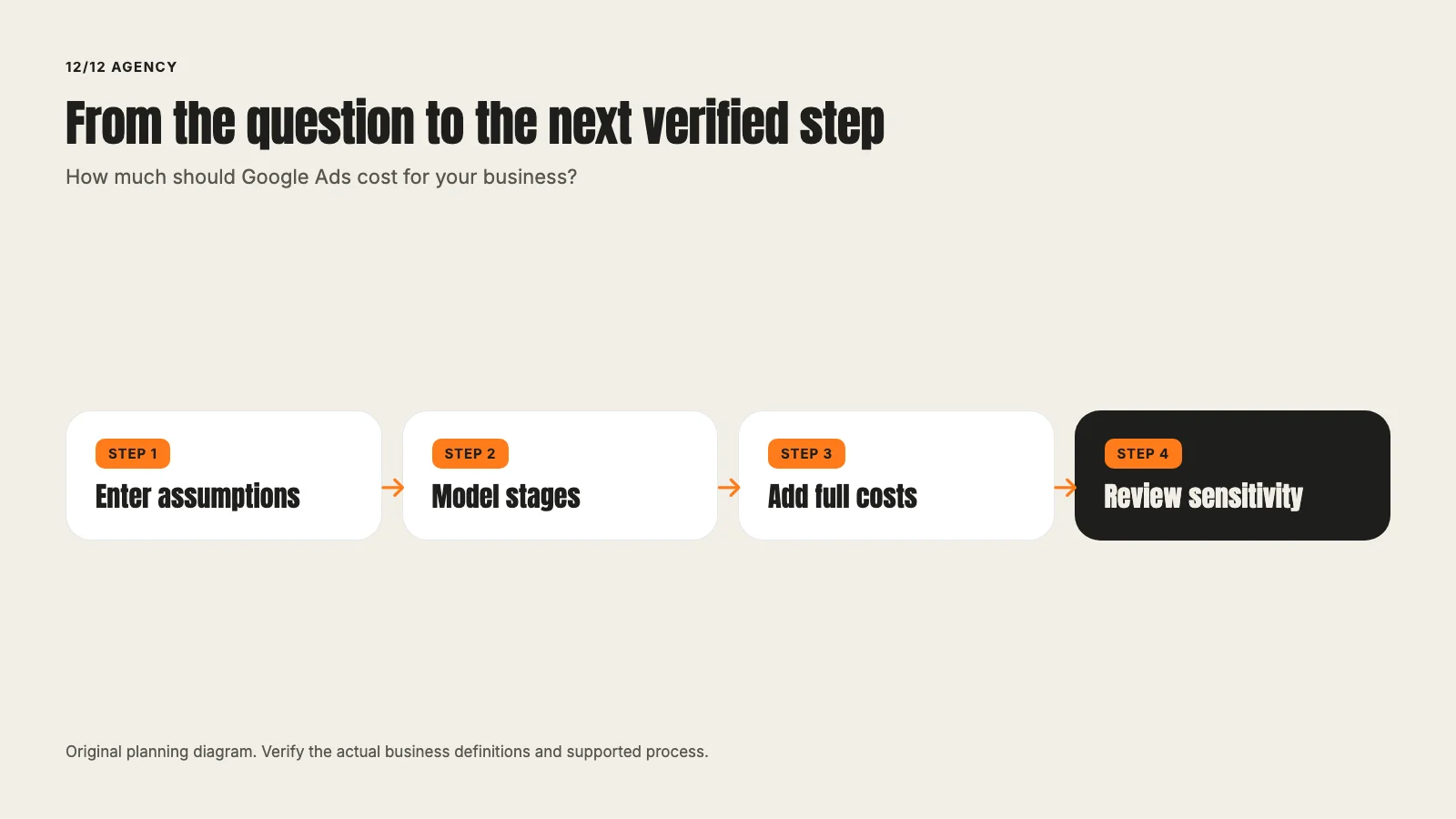
How much should Google Ads cost for your business?
David A · Founder, 1212 Agency
Published November 16, 2026

Estimate Google Ads costs with your own click, lead and customer assumptions. Separate media from fees and check what the business can afford to acquire.
The useful question is not what every business pays for Google Ads. It is what your business can spend to learn whether a defined offer reaches suitable buyers.
A click price alone cannot answer that. You also need the landing-page response, the quality of accepted requests, the rate at which they become customers and the contribution those customers leave after delivery costs.
This guide builds a model with fictional inputs. The dollar amounts and rates are examples for explaining the arithmetic. They are not market benchmarks, a 1212 Agency quote or a forecast of what your account will produce.
Separate the costs before comparing proposals
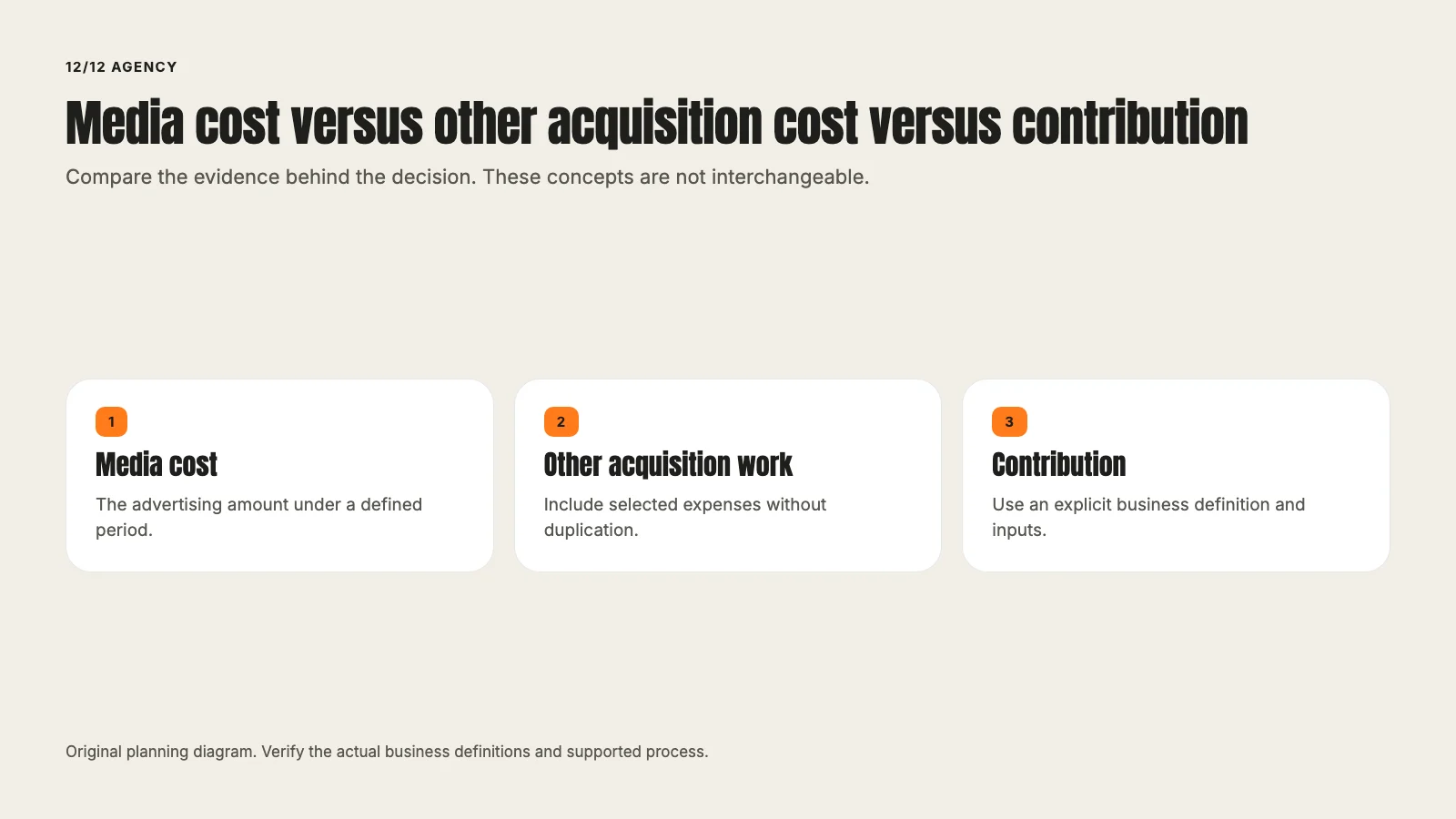
Media spend is paid to the advertising platform. Other acquisition work may include research, management, creative production, landing pages, tracking, software and sales follow-up.
List those costs separately. A proposal showing a management fee does not tell you the media required. A platform report showing spend does not include every cost the business incurred to acquire a customer.
Also define what is already in place. A working page and measurement setup require a different initial scope from a new offer with no accepted-action tracking. Ask which costs are one-time, recurring or dependent on another team.
Our paid media overview explains the work around a campaign. Engagement scope and prices need confirmation for the actual account rather than a generic example in an article.
Define the action you are buying
A click is not a lead. A lead is not automatically a suitable inquiry. A booked meeting is not necessarily attended, and an opportunity is not a paid customer.
Choose clear stage names before calculating costs. For a lead-generation business, that might mean accepted request, suitable request, booked appointment and won customer. A direct purchase journey has different stages.
Record the numerator, denominator and time period for each rate. A request-to-customer rate should follow a defined request cohort far enough to observe the relevant sales cycle. Combining this month's forms with unrelated sales closed this month gives the model a misleading input.
The SaaS cohort article provides one example of why stage and timing definitions matter even when the arithmetic is simple.
Build the click-to-customer model
Start with media spend divided by assumed cost per click. Multiply the estimated clicks by the click-to-accepted-request rate. Then multiply accepted requests by the request-to-customer rate.
Here is a fictional monthly scenario:
| Input or calculation | Illustration |
|---|---|
| Media spend | $3,000 |
| Assumed cost per click | $5 |
| Estimated clicks | 600 |
| Assumed click-to-request rate | 10% |
| Estimated accepted requests | 60 |
| Assumed request-to-customer rate | 10% |
| Estimated customers | 6 |
| Media cost per customer | $500 |
This model is not evidence that a $3,000 campaign will win six customers. It shows how three assumptions connect. If the click costs more or the later-stage rate is lower, the result changes.
Google's keyword planning guidance can support demand research. Keyword estimates are inputs to a plan, not a guarantee that the account will receive the modeled clicks or inquiries.
Add the costs the platform report leaves out
Suppose the fictional scenario also includes $1,000 in eligible management and production costs. Total acquisition cost becomes $4,000. With the same hypothetical six customers, the fully loaded cost per customer is about $667 rather than $500.
Keep the definitions visible. A media-only result can be useful for managing advertising. A business decision may need a broader cost view. Neither number should silently replace the other.
Avoid double counting. If a production cost is already included in a retainer, do not add it again. If the expense supports several channels, explain how it is allocated. A clean assumption table is more useful than a precise-looking output built from mixed definitions.
Compare cost with contribution, not only revenue
Revenue includes money needed to deliver the product or service. The contribution left after relevant delivery costs is the more useful starting point for an acquisition allowance.
For another step in the fictional scenario, suppose each new customer contributes $1,000 before acquisition costs. Six customers contribute $6,000. Subtracting $4,000 acquisition costs leaves $2,000 before other business costs under the model's definitions.
Those figures do not establish profit for the whole company. They explain the decision boundary. Refunds, fulfillment, ongoing service, sales compensation and retention can materially change the contribution available.
A recurring business should also consider timing. A customer value expected over a long period is different from cash collected now. Do not use a lifetime-value estimate as if all of it were immediately available to fund advertising.
Show uncertainty with a small scenario range
Change one important assumption at a time. With the same fictional $5 click and 10% click-to-request rate, a 5% request-to-customer rate produces three modeled customers. A 15% rate produces nine. Fully loaded cost per customer changes accordingly.
That sensitivity helps identify the evidence the team needs. If later-stage conversion drives the decision, improving CRM definitions may be more valuable than debating a small click-cost difference.
Use conservative, central and optimistic inputs only when their basis is clear. They should describe uncertainty, not make an unsupported plan look scientific. Avoid selecting the optimistic column simply because it reaches the revenue target.
Understand the budget setting you are approving
Google uses average daily budgets and spending limits that depend on campaign and billing rules. An average daily amount should not be described as a hard maximum on every individual day.
Read the current Google spending-limit documentation for the account's applicable rules. Then agree on the actual budget setting, monitoring responsibility and conditions for any proposed change.
No calculator should quietly change an account. A planning output is information for review. Budget, bid, targeting and status changes remain separate implementation decisions.
Validate the conversion path before buying more evidence
The model assumes the accepted action is measured and reaches the business. Verify the page, form or checkout, confirmation, tag destination and relevant record.
Our conversion-tracking guide covers that path. The Google Ads audit guide adds the goal-selection check. A campaign using the wrong event can make an unsuitable action look efficient.
If the journey fails, a larger budget does not repair it. Fix the known workflow problem and record the change before evaluating the next period.
Decide what the first test needs to teach
A useful budget plan names the learning objective. It might be whether a search family attracts the intended buyer, whether the page supports the offer or whether suitable requests can become a sales conversation.
Set a review period that reflects the sales cycle and available data. Sparse results need a cautious interpretation. A few clicks or one sale do not establish a stable future acquisition cost.
The next decision should use actual query fit, accepted-action quality and later outcomes. It should not automatically raise spend because a generic benchmark says the budget is too small.
Keep the scenario beside its assumptions
A result should remain visibly connected to the entered costs and rates. If an assumption changes, the displayed output should update or become clearly stale. Do not let a copied acquisition-cost number circulate without its period, stage and included expenses.
This is a practical reporting discipline as well as a calculator requirement. A precise-looking value is only useful when the business can reconstruct what it means and which evidence would justify replacing the assumption with an observed rate.
Use the existing ad budget calculator as a starting worksheet, then review the assumptions with us.
Frequently asked questions
Want this run for your business?
Tell us where to send it and we'll follow up with the strategies that fit your market.