
Search terms: turn a query into the next decision
David A · Founder, 1212 Agency
Published November 16, 2026

Use Google Ads search terms to review buyer intent, destination fit and proposed changes. Keep ambiguous queries, exclusions and reporting limits visible.
A search terms report is useful when it changes a decision. A long export with red and green cells does not tell the business whether to clarify a page, propose an exclusion or investigate a new buyer question.
Read the query in the context of the campaign's job and the supplier's actual offer. The same word can be suitable in one account and irrelevant in another. This guide builds a review log around that distinction rather than prescribing a universal negative-keyword list.
Know what the report represents
Google's search terms documentation explains that reported searches differ from the account's keyword list and that reporting visibility has limits. A missing individual query is not proof that it never occurred.
Record the date range, campaign context and conversion definition before reviewing the export. A comparison across different goal setups can be misleading. A conversion column may describe an accepted form rather than a qualified opportunity.
The Google Ads audit guide supplies the broader account checks. Search-term decisions make more sense after the team understands what each campaign is asked to acquire.
Start with the campaign's intended job
Write the supported customer, service or product and the action the campaign should produce. A fictional manufacturer seeking application inquiries needs a different review from a local repair company seeking service calls.
Ask the business which capabilities and areas it actually supports. Do not assume that every commercially worded query is suitable. A search for a material the supplier does not process may be high intent and still wrong for the campaign.
The Google Ads service page retains the commercial context. A manufacturing page or home-services page can explain the relevant buyer environment without changing the campaign's actual scope.
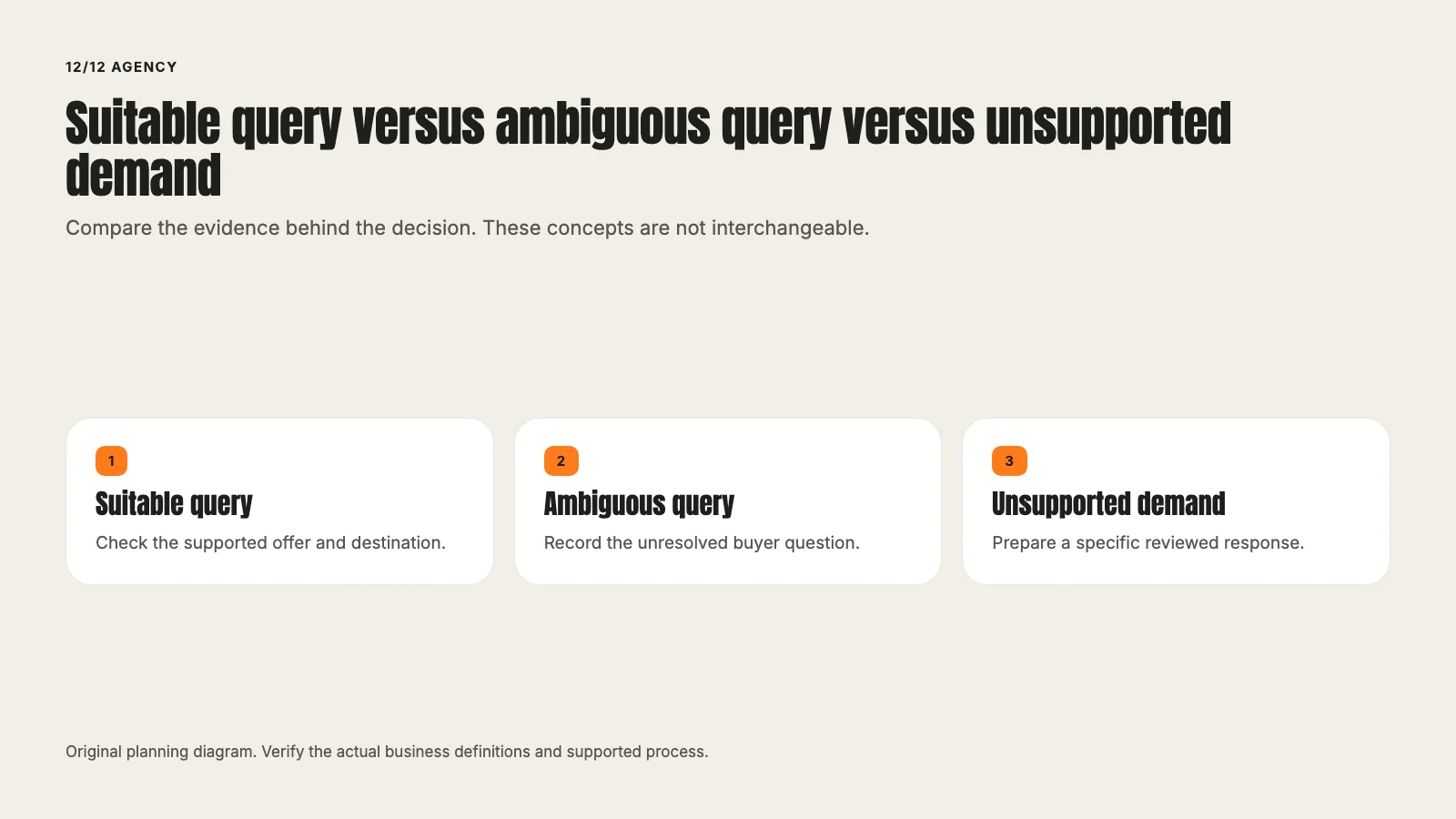
Classify the buyer question before the action
Use a small set of useful categories: clearly suitable, clearly unsupported, research-stage but potentially relevant, ambiguous, or evidence missing. The category should lead to a reasoned next step.
For a fictional booking product, room scheduling software may describe a supported use case. Room scheduling jobs may concern employment. Free room calendar could be unsuitable, or it could describe a buyer comparing a free alternative. Context matters before a broad exclusion is proposed.
Do not force certainty from a few words. Open the actual destination and review what the buyer would see. Ask sales or product when the query implies a capability the marketer cannot verify.
Check the destination fit
A suitable query can still reach the wrong page. The page may hide the relevant workflow, imply a broader feature or make the next action unclear. That is a page decision as well as an account decision.
For a fictional roofer, repair and replacement searches may need different explanations. Sending both to a general page can leave the office resolving a mismatch that the website could have clarified. Use the roofing service context to identify the actual supported work.
A page should not be added for every query variation. Several close searches can share one useful answer. A distinct page needs a distinct buyer job, evidence and maintained destination.
Separate exclusion, routing and investigation
A clearly unsupported search may justify a proposed negative. A relevant search with a poor page may justify a destination or copy review. An ambiguous term may need more evidence. Those are different actions.
The existing negative-keyword guide retains the detailed exclusion workflow. Do not duplicate it here or copy a list without checking the business context. A broad block can remove suitable searches that happen to share one word.
Record the exact proposed scope and expected effect. Google account changes require approval. The review log should not silently apply exclusions while presenting itself as read-only research.
Inspect performance with the correct denominator
Cost, clicks, accepted actions and later business outcomes answer different questions. A query with no reported conversion in a small sample is not automatically worthless. A query with cheap forms is not automatically valuable.
Review the outcome window and the actual campaign goal. The conversion-tracking guide explains why accepted requests, booked meetings and won outcomes should stay separate. A later CRM result may not yet be available in the ad report.
Avoid ranking every query by an unstable cost-per-result calculation. If the denominator is zero, the result is unavailable rather than zero cost. If the count is tiny, state the uncertainty and use the broader question the evidence can support.
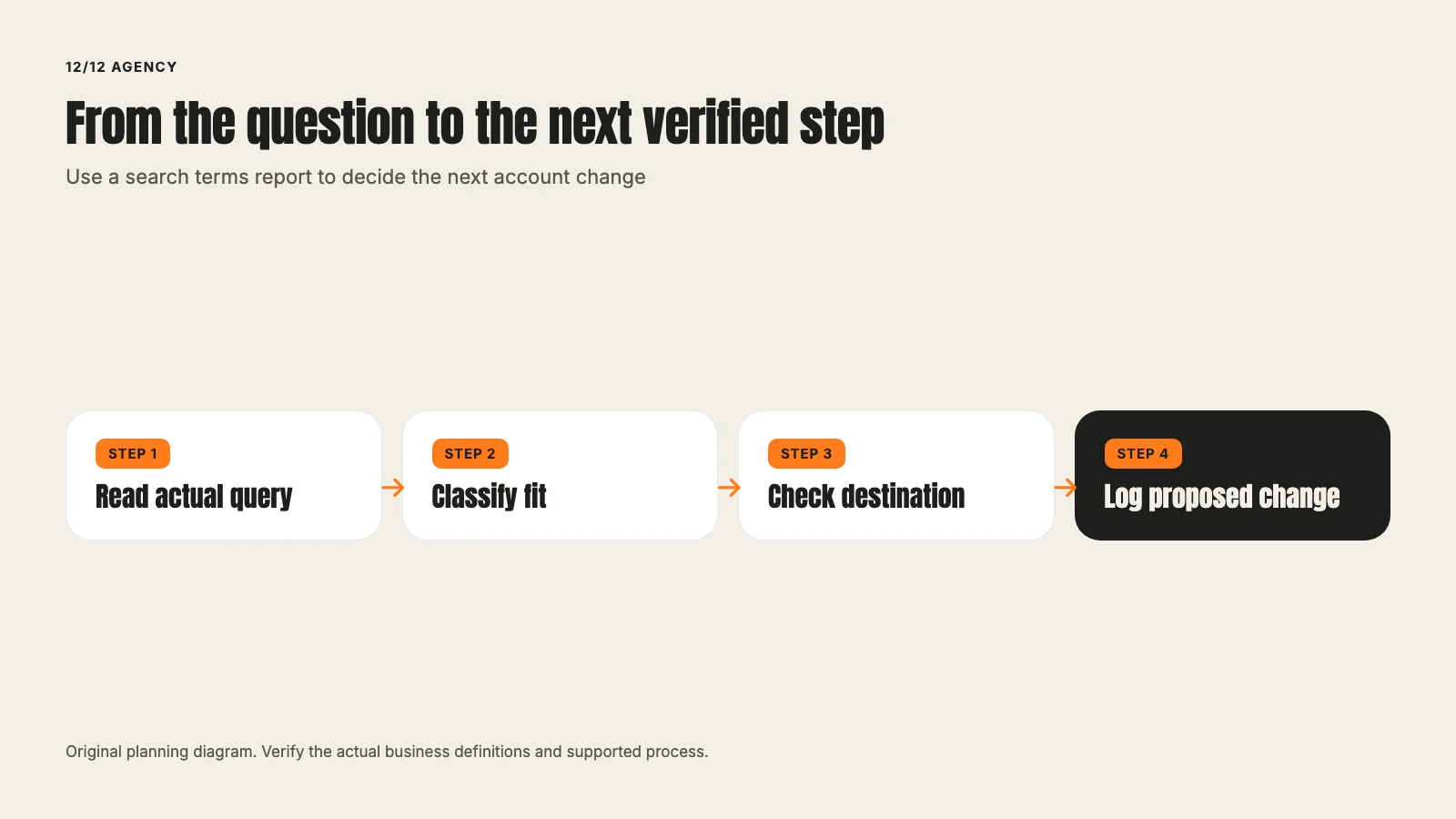
Work through a fictional decision log
Consider four illustrative queries for a scheduling product. Manage multiple rooms is suitable if the workflow is supported; review its destination and accepted requests. Calendar developer jobs is outside a customer-acquisition campaign; propose an appropriately scoped exclusion after checking overlap.
Booking tool with accounting sync is a product question. Verify the integration before advertising or excluding it. Venue booking spreadsheet could represent an alternative comparison; review the buyer context and page evidence before deciding.
The log records the query, apparent job, verified fit, destination, observed outcome, proposed action and responsible reviewer. It does not assign a quality score that pretends to know intent automatically.
Preserve the evidence for later review
Keep the original query text and the reason for the decision. If a change is approved, record its date and actual readback. A saved proposal is not proof that the account changed.
Review the result over a suitable period without assuming that every difference came from one exclusion. Offer, budget, competition, season and page changes can also affect outcomes. A before-and-after observation is not a randomized experiment.
For comparison with another search platform, Microsoft's UET overview illustrates the distinction between recorded behavior and selected conversion goals. Keep each platform's own definitions rather than forcing all totals to match.
Choose the next complete action
A useful weekly review may produce three jobs: clarify a supported use-case page, propose one narrow exclusion and ask product about an integration question. That is a concrete result even when it does not create a large change list.
Keep new content ideas in the existing page map. The paid media overview can connect the account work to landing pages and measurement. A query insight should not create a duplicate article without an overlap decision.
Preserve an ambiguous query as a question
An uncertain search does not need an immediate positive or negative verdict. Record the apparent job, the exact capability question and the person who can resolve it. Keep the proposed account action separate until that evidence exists.
For a fictional manufacturing query mentioning design, technical sales may explain that design assistance is supported only within a particular project scope. The useful response could be clearer destination language rather than a broad exclusion. Another query may concern an unsupported training course and justify a narrower proposal.
This distinction makes the review log useful beyond the week it was written. The next analyst can see why the term was held, what was learned and which actual change was approved. A red cell with no explanation cannot provide that history. The purpose is a defensible next decision, not to classify every search with artificial certainty.
Bring the campaign job and a small set of uncertain queries to a review. Turn the export into decisions the business can verify.
Frequently asked questions
Want this run for your business?
Tell us where to send it and we'll follow up with the strategies that fit your market.