Manufacturing Marketing: What Most Industrial Companies Get Wrong
David A · Founder, 1212 Agency
Published August 12, 2026 · Last updated August 31, 2026
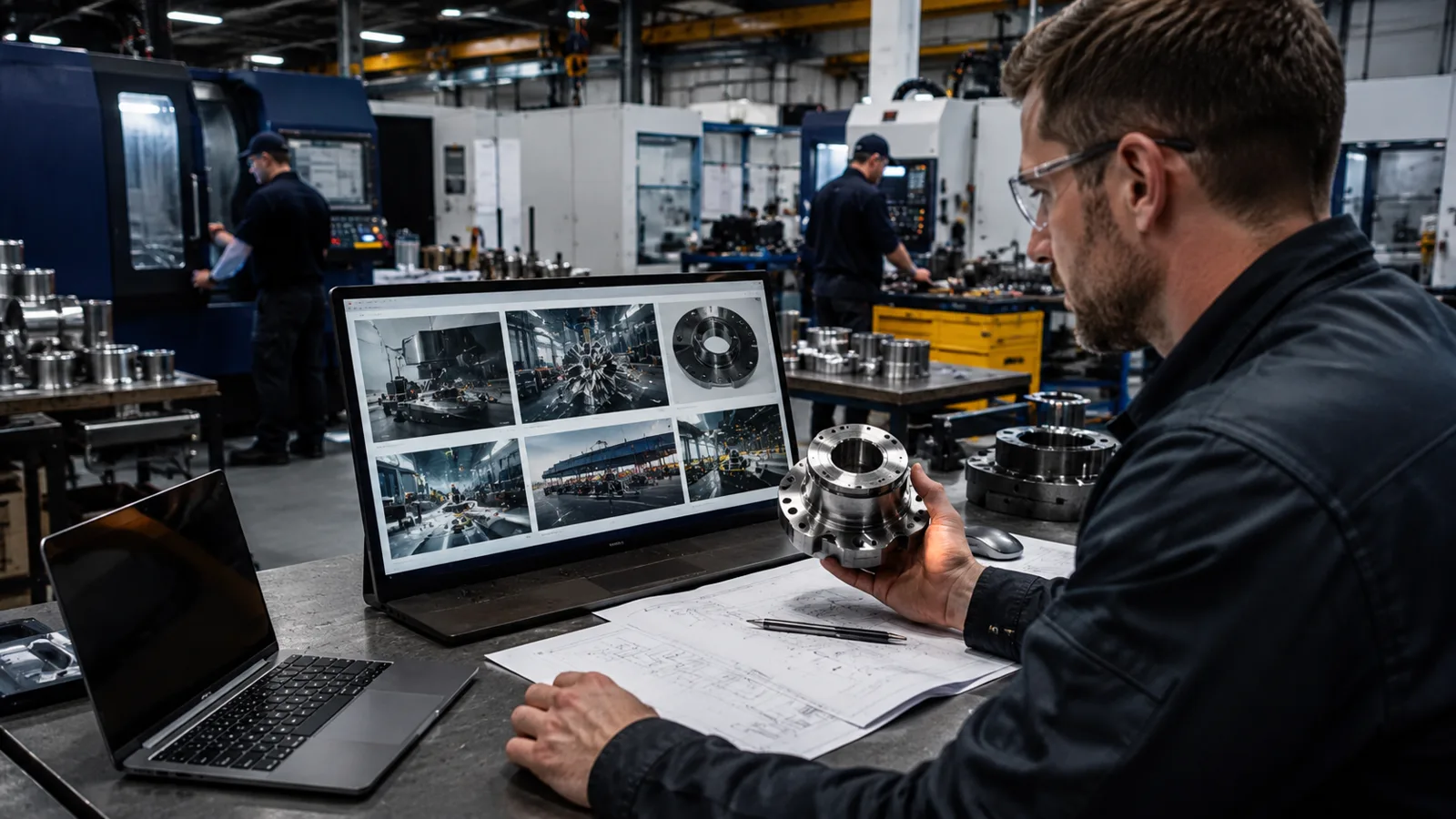
Industrial buyers research long before they contact a supplier. Most manufacturing websites are organized around the company instead of the questions those buyers are asking.
For decades, manufacturing companies relied on referrals, distributors, trade shows, and long-standing relationships to generate new business. Those channels still play an important role, but they no longer represent the entire buying journey.
Today's industrial buyers research online long before they contact a supplier. Engineers compare technical capabilities, procurement managers evaluate vendors, and decision-makers review websites, certifications, and case studies before requesting a quote. By the time your sales team receives an inquiry, a buyer may have already narrowed their options to just a few manufacturers.
This shift has changed what manufacturing marketing needs to accomplish.
The goal isn't simply to attract more website traffic or generate more leads. It's to help the right buyers find your business, understand your expertise, and feel confident enough to start a conversation.
Unfortunately, many manufacturers approach digital marketing the same way they approached brochures twenty years ago. They create a website that describes the company but doesn't answer the questions buyers are asking. That's where most opportunities are lost.
Stop organizing your website around your company
Take a look at the navigation of most manufacturing websites and you'll notice a familiar pattern: About Us, Capabilities, Equipment, Industries, and Contact.
While there's nothing inherently wrong with that structure, it reflects how the company is organized, not how customers search for information.
An engineer doesn't wake up thinking, "I need to find a company with a great capabilities page." They're searching for answers to specific challenges.
Maybe they need a supplier experienced in food-grade stainless steel fabrication. Maybe they're looking for a manufacturer certified to ISO 13485. Or perhaps they're trying to determine which production process is best for a new component.
When buyers search this way, they expect to land on a page that speaks directly to their problem.
Instead of organizing your website around internal departments, organize it around customer intent. Create pages that answer questions about applications, industries, materials, certifications, and manufacturing processes. The more closely your content matches the way buyers think, the easier it becomes for both search engines and potential customers to understand your expertise.
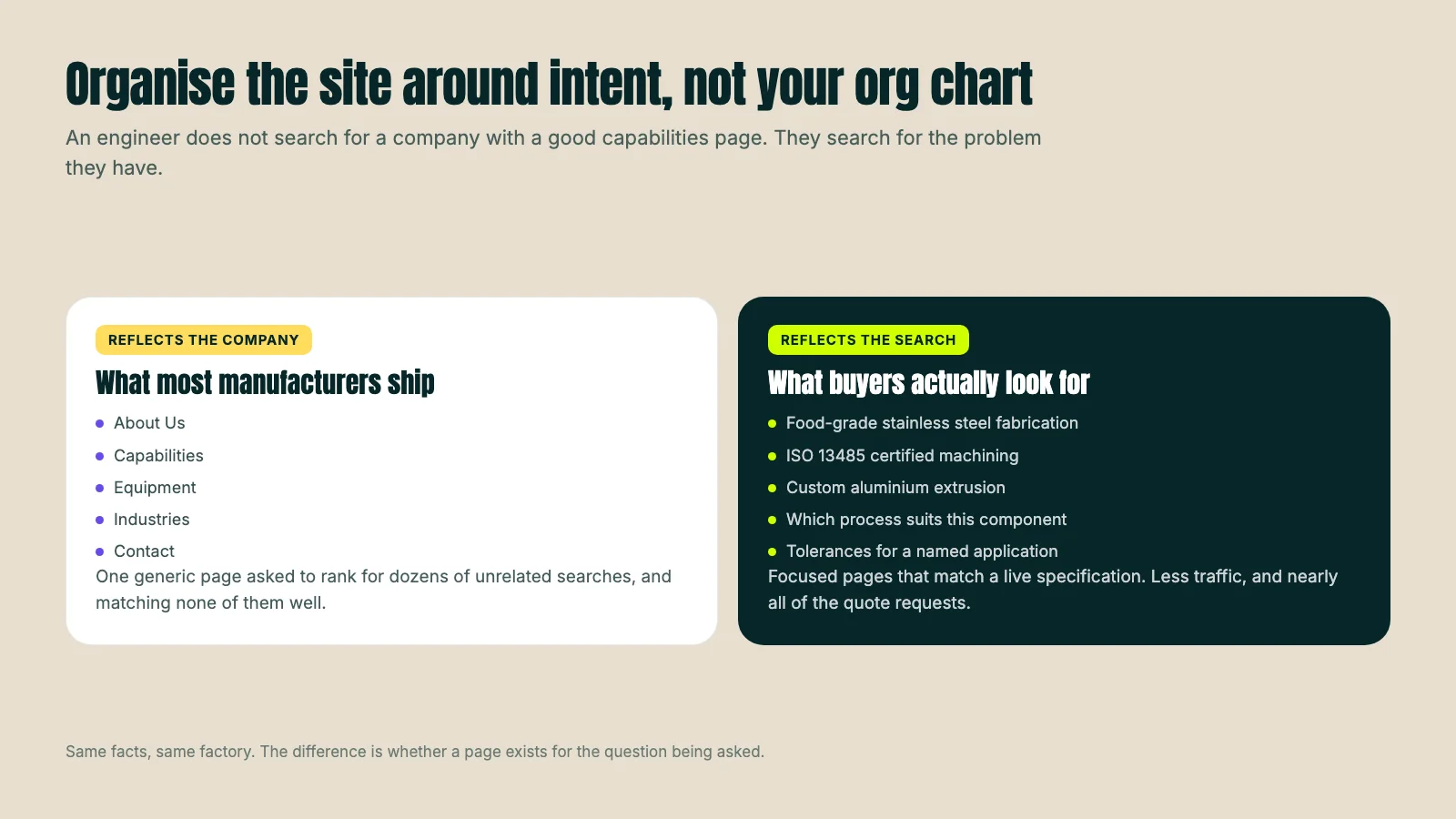
This approach is also the foundation of effective manufacturing SEO. Rather than trying to rank one generic "Capabilities" page for dozens of keywords, you're creating focused content that aligns with high-intent searches. It is the same structure behind our manufacturing marketing services.
Your best salesperson might be a case study
Many manufacturing websites spend hundreds of words describing machines, facilities, and production capabilities. While that information is important, it's rarely what convinces a buyer to reach out.
Industrial purchasing is driven by risk.
Before choosing a supplier, buyers want reassurance that you've solved similar problems before. They want evidence that you understand their industry, can meet their quality standards, and have experience delivering successful projects.
That's why case studies are often one of the most powerful marketing assets a manufacturer can create.
Instead of saying, "We provide precision machining services," show how your team reduced production time, improved product quality, or solved a complex manufacturing challenge for a customer. Even if you can't disclose sensitive information, explaining the process and the outcome demonstrates expertise in a way a product page never can.
Ours work the same way. A building materials manufacturer, a construction products manufacturer, and an industrial automation supplier each had a different problem, and in all three the specifics are what made the work credible to the next buyer.
Good case studies don't just showcase your work. They reduce uncertainty, which is often the biggest obstacle preventing a buyer from requesting a quote.
Why most manufacturers target the wrong keywords
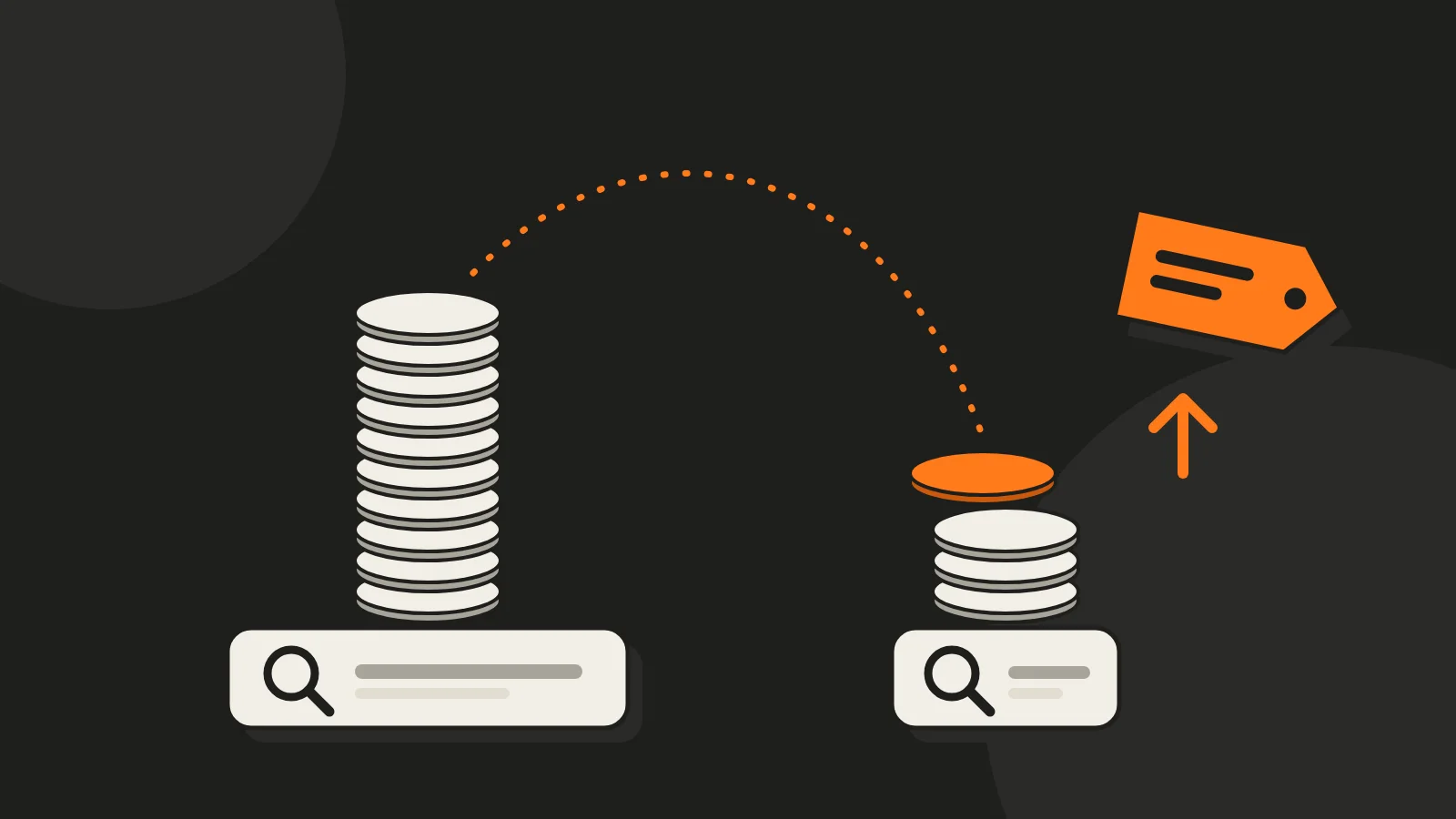
One of the biggest misconceptions about SEO is that more search volume always means more opportunity.
It doesn't.
A company ranking for "manufacturer" might receive thousands of visitors who are students, job seekers, or people conducting general research. None of those visitors are likely to become customers.
Now compare that with someone searching for "custom aluminum extrusion manufacturer" or "FDA-compliant stainless steel fabrication."
Those searches receive far less traffic, but they represent buyers with a specific need and a much stronger intent to purchase.
One qualified visitor who finds exactly what they were looking for is worth more than hundreds who were never going to buy.
Successful SEO for manufacturers isn't about attracting the largest audience. It's about attracting the right audience.
That means building content around the products, processes, industries, and applications that matter most to your ideal customers. It also means answering the technical questions your sales team hears every day, because those same questions are often being searched online.
One qualified visitor who finds exactly what they're looking for is worth far more than hundreds of visitors who were never going to buy.
Write for the buying committee, not the buyer
The phrase "industrial buyer" hides something important: there usually isn't one.
A meaningful purchase involves an engineer evaluating whether you can hold the tolerance, a procurement manager evaluating price, lead time, and supply risk, a quality function checking certifications and audit history, and often a finance approver who never visits your site at all.
Each is evaluating a different thing, and each can stop the deal.
Most manufacturing websites are written for exactly one of them, usually the engineer, and then stall when procurement cannot find lead times or quality cannot find the certification list. Pages that serve the whole committee move faster:
- For engineering: tolerances, materials, process limits, file formats, prototyping options
- For procurement: capacity, lead times, minimum order quantities, locations, supply chain resilience
- For quality: certifications with numbers and expiry, audit history, inspection process, traceability
- For finance: total cost framing rather than unit price, and what changing suppliers actually costs
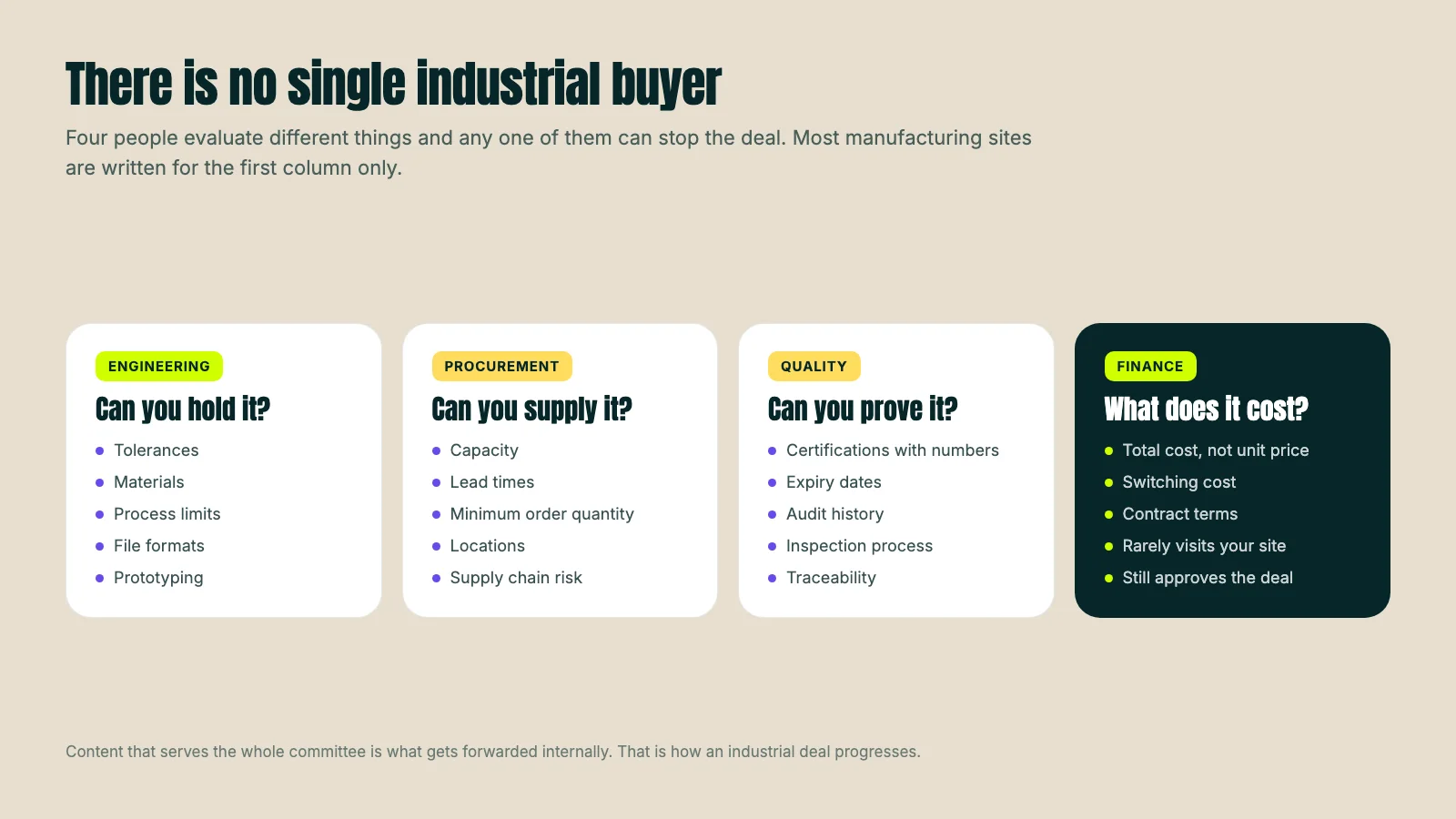
None of this is exciting to write. It is what gets forwarded internally, which is how an industrial deal actually progresses.
It is also why LinkedIn Ads works in this sector when broad channels do not. Targeting by job title and company lets you put a different message in front of engineering than in front of procurement, which is closer to how the decision is actually made.
Make your technical content machine-readable
Industrial buyers increasingly begin in an AI assistant or an answer engine rather than a list of blue links. That does not change what you write. It changes how legible it needs to be.
Three things help disproportionately.
Put specifications in real tables rather than in a PDF or a diagram. A tolerance range trapped inside a datasheet image cannot be read, quoted, or surfaced by anything.
Mark up what you can. Schema.org types for products, organizations, and FAQs let a machine understand what a number on the page means rather than guessing.
Answer the question in the first sentence of the section, then support it. Content organized as claim-then-evidence gets summarized accurately. Content that builds to a conclusion over six paragraphs gets summarized badly or not at all.
Marketing should make sales easier
One of the most common concerns manufacturing leaders have is whether marketing will generate a flood of unqualified leads.
That's a fair concern, but it's often based on the wrong objective.
Good manufacturing marketing shouldn't replace your sales team or overwhelm them with inquiries. It should make their job easier.
When your website answers common questions, explains your capabilities, demonstrates expertise, and showcases real results, buyers arrive better informed. Sales conversations become more productive because less time is spent explaining basic information and more time is spent discussing the customer's specific needs.
The best marketing doesn't generate more conversations. It generates better conversations.
Measure on a timeline that matches the sale
An industrial sales cycle runs months. Marketing measurement usually runs weekly. That mismatch causes more bad decisions in this sector than any targeting error.
A campaign judged on this month's cost per lead will look worst exactly when it is working best, because the leads worth having take two quarters to become quotes. Meanwhile a campaign producing cheap, junk inquiries reports beautifully.
Three changes fix most of it. Track quote requests and won revenue rather than form fills. Push closed-won data back into the ad platforms so bidding optimizes toward the accounts you actually want. And hold judgment on a channel until it has had a full sales cycle to produce, which for most manufacturers means two to three quarters, not two to three weeks.
For a sense of what that data discipline is worth, the US Census Bureau's Annual Survey of Manufactures is a useful outside benchmark for sizing your served market before you decide what a lead is worth.
Final thoughts
Manufacturing marketing isn't about chasing every new digital trend or publishing content for the sake of staying active online. It's about understanding how industrial buyers make decisions and creating a digital experience that supports that process.
Companies that organize their websites around customer questions, invest in meaningful content, and build credibility through real examples are far more likely to attract qualified buyers than those relying on generic service pages alone.
As the industrial buying journey continues to evolve, manufacturers that adapt their marketing to match the way customers research and evaluate suppliers will be in the strongest position to grow. That is the work behind our industrial marketing practice.
Frequently asked questions
Want this run for your business?
Tell us where to send it and we'll follow up with the strategies that fit your market.