
Write a landing-page test your traffic can answer
David A · Founder, 1212 Agency
Published November 16, 2026

Plan a landing-page experiment with a hypothesis, eligible audience, primary metric and stopping rule. Separate descriptive lift from statistical evidence.
A landing-page version can show a higher conversion rate in a small sample and still leave the business uncertain. The observed difference may be chance, a change in traffic or an artifact of how the test was stopped.
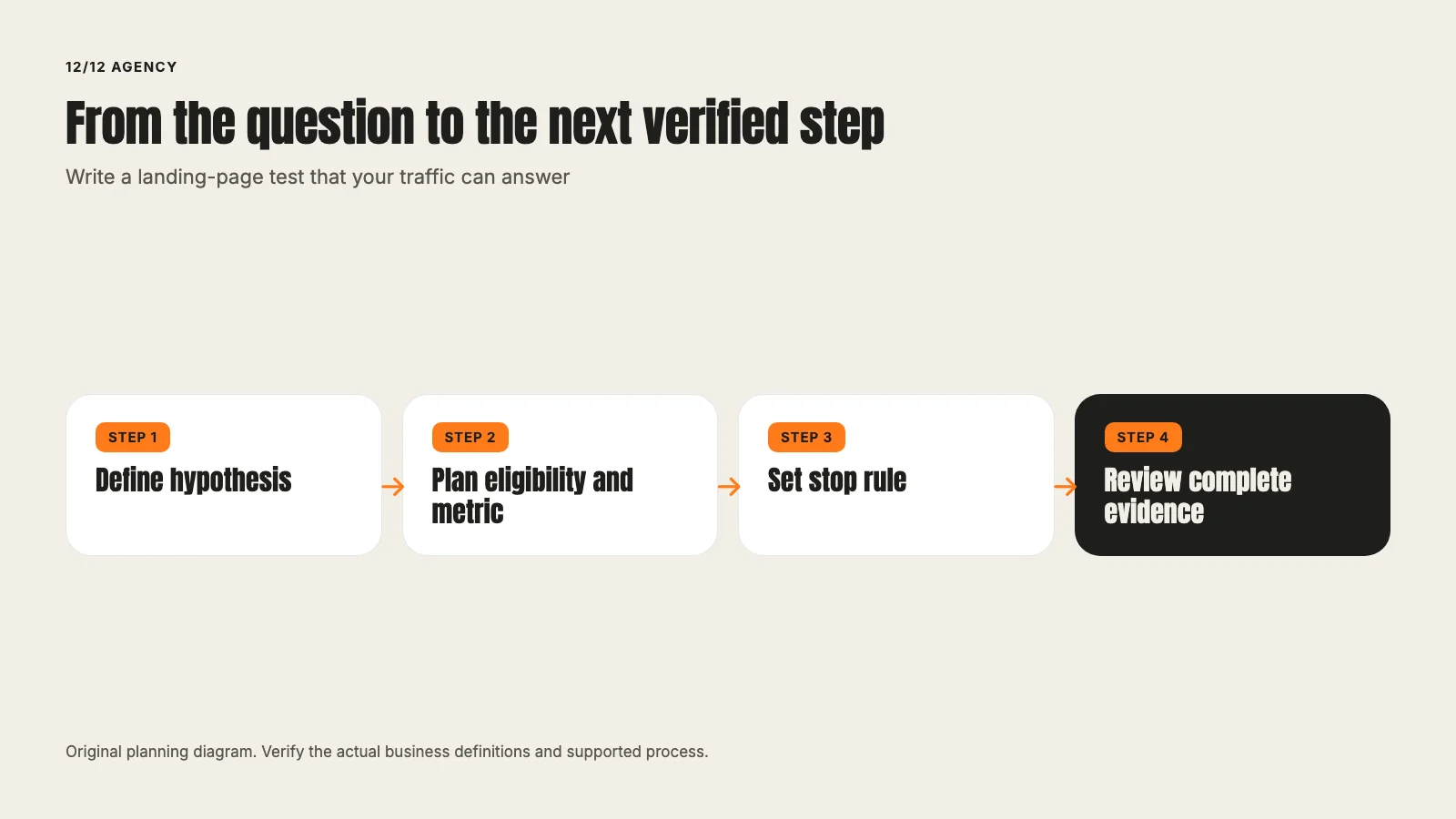
A useful experiment begins before the first visitor is assigned. Define the question, population, outcome and decision rule, then check whether the available traffic can answer it. This guide explains the planning work without offering a universal sample size or a live significance verdict.
Decide whether the work is actually an experiment
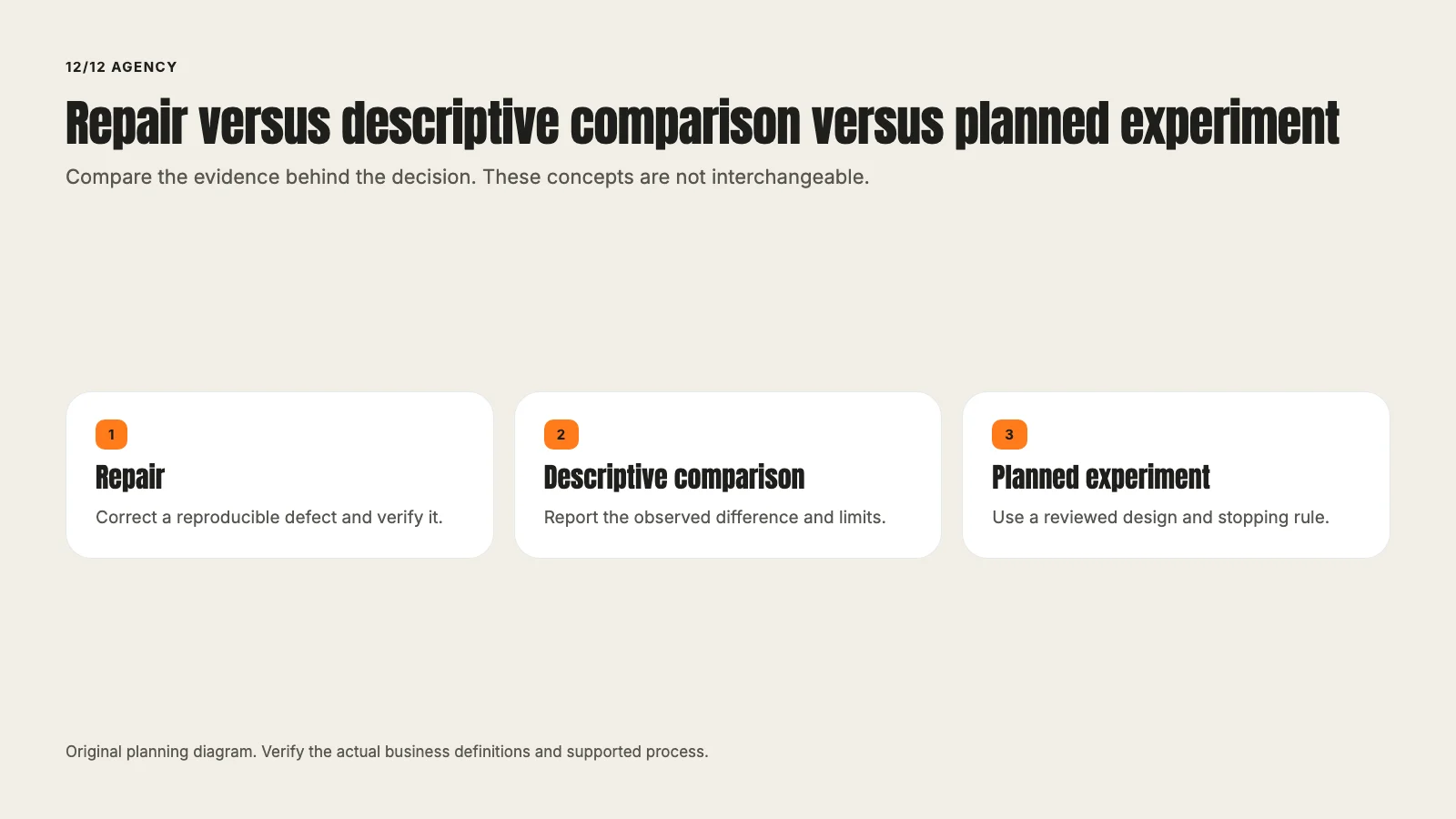
A broken form, inaccessible control or inaccurate claim is a defect to correct and verify. It does not need to win an A/B test before it can be repaired.
An experiment addresses uncertainty between acceptable alternatives. For example, two accurate explanations may emphasize different aspects of a supported workflow. The business wants evidence about which better helps the intended buyer complete a defined action.
The Google Ads audit guide and conversion-tracking guide help establish the measurement foundation. A test built on a misdefined event can produce a precise answer to the wrong question.
Write the mechanism in the hypothesis
A useful hypothesis names the buyer, observed difficulty, proposed change and expected reason it could help. New design will convert better is too vague to guide interpretation.
For a fictional scheduling product, buyers may not understand whether each room has separate availability. A test could compare two accurate explanations of that supported workflow. The expected mechanism is better understanding of fit, not a magical effect from a different button color.
The SaaS context can inform that question. A home-services page may need a different hypothesis about service boundaries or estimate preparation. Do not copy an experiment without the original buyer problem.
Define the eligible population and randomization unit
Specify who can enter the test and how assignment works. Visits, people and business accounts are different units. Repeated exposure can complicate a simple page-view comparison.
Identify exclusions before analysis, including internal tests and clearly ineligible traffic. Do not remove inconvenient records after seeing the result. If a system cannot maintain the intended assignment, document the limitation before treating the comparison as randomized.
A channel's ordinary creative allocation is not automatically a controlled experiment. The method actually used determines what can be inferred. A descriptive comparison can be useful, but it should keep its narrower label.
Choose one primary outcome and meaningful guardrails
An accepted request may be the main action, while suitability, error rate or later qualification are guardrails. A higher submission rate can be undesirable if the page creates misleading expectations or unsuitable requests.
Define the numerator, denominator and observation window. If a booking is the outcome, verify confirmed booking evidence rather than a calendar click. If the business needs later qualification, account for its delay and missing records.
The B2B lead-generation guide explains later-stage distinctions. Keep the primary metric and guardrails visible rather than selecting whichever result looks best after the test.
Plan sample needs with a reviewed method
Baseline rate, minimum effect worth detecting, allocation, error rates and desired power affect the required data. Those are assumptions and business decisions, not universal defaults that guarantee a useful test.
NIST's sample-size discussion illustrates that sample planning depends on the statistical question and assumptions. Its two-proportion test reference describes one large-sample method, not a license to apply it to every marketing dataset.
Have the actual design and method reviewed before making inferential claims. Sparse outcomes, extreme rates, unequal groups, clustered users, multiple variants and sequential monitoring may need a different approach. A generic calculator cannot silently solve those differences.
Distinguish percentage points from relative lift
If a fictional rate changes from 5% to 6%, the absolute difference is one percentage point. The relative descriptive lift is 20%, because one point divided by the 5% baseline equals 20%.
That arithmetic does not establish statistical significance, causality or business value. The sample sizes, assignment and outcome quality still matter. A relative percentage can sound dramatic while the underlying count is small.
Keep both rates, counts and denominators visible. If the baseline is zero, relative lift is undefined under the simple formula. Do not display infinity as if it were a meaningful business recommendation.
Set the stopping and review rule in advance
A fixed-horizon test should follow its planned rule. Repeatedly checking and stopping at the first attractive result can change the error properties of an ordinary fixed-sample analysis.
If a valid sequential method is used, name and review it. Do not mix methods after seeing the data. Record outcome lag and operating cycles so the review does not judge one group before its later actions can occur.
Also define material safety or correctness hold conditions. A broken submission path or unsupported claim deserves investigation. That is different from stopping because the current conversion percentage is disappointing.
Keep other changes in the record
Audience, offer, pricing, season, campaign goals and sales handling can affect comparability. If several things change during the experiment, identify the consequence for interpretation.
The paid media overview can connect the page work to the wider acquisition plan. A simultaneous campaign expansion and page redesign may be a practical business move, but it should not be reported as an isolated headline experiment.
Preserve version definitions and the actual release times. A mockup approval or local build is not evidence that every visitor received the intended version.
Review the complete result, including uncertainty
Report the planned question, population, counts, rates, method, uncertainty and guardrails. State whether the evidence supports a decision, remains inconclusive or is invalidated by a material problem.
No statistically detected difference is not the same as proof that the alternatives are equivalent. A small or underpowered test may simply be unable to distinguish them. Business cost and implementation effort can still inform a decision, but that rationale should be explicit.
Do not convert an early form-rate result into a revenue claim without the later business evidence. The next experiment may need to focus on fit or the handoff rather than the same top-of-page metric.
A reviewable test brief
Include the hypothesis, evidence, control, variant, eligible population, randomization unit, primary action, guardrails, method, sample assumptions, stopping rule, outcome lag and reviewer. Identify the actual dependency before implementation.
Bring the buyer question and traffic evidence to a test-planning review.
Make the method review answer a practical question
Give the statistical reviewer the actual outcome type, randomization unit, expected rate, meaningful effect, allocation, traffic and stopping rule. Ask whether the proposed method is suitable for those conditions and what would invalidate it.
A general approval of an A/B-test calculator is too broad. The review should identify the supported design and the cases that require another method. That makes the limitation usable in both the planning worksheet and the result report.
Record the decision before collecting data. If the observed dataset later violates the plan, explain the consequence rather than switching methods until one produces a favorable result. A trustworthy inconclusive finding can prevent an unnecessary rollout. It should not be rewritten as proof that the alternatives are identical or that a small apparent lift is guaranteed to persist in a broader audience.
Frequently asked questions
Want this run for your business?
Tell us where to send it and we'll follow up with the strategies that fit your market.