
B2B social should explain the work buyers need to trust
David A · Founder, 1212 Agency
Published November 16, 2026

Plan B2B social with expert explanations, product evidence and buying-role questions. Connect distribution and follow-up while keeping outcomes distinct.
A B2B buyer may need to understand the work before they are ready to discuss a contract. Social content can help by making a process, capability or decision easier to evaluate. A feed full of broad benefits often leaves those questions unanswered.
Begin with the buying role and the evidence the business can support. Then choose a useful explanation and an appropriate next step. This guide does not promise follower growth, qualified pipeline or a fixed return from publishing.
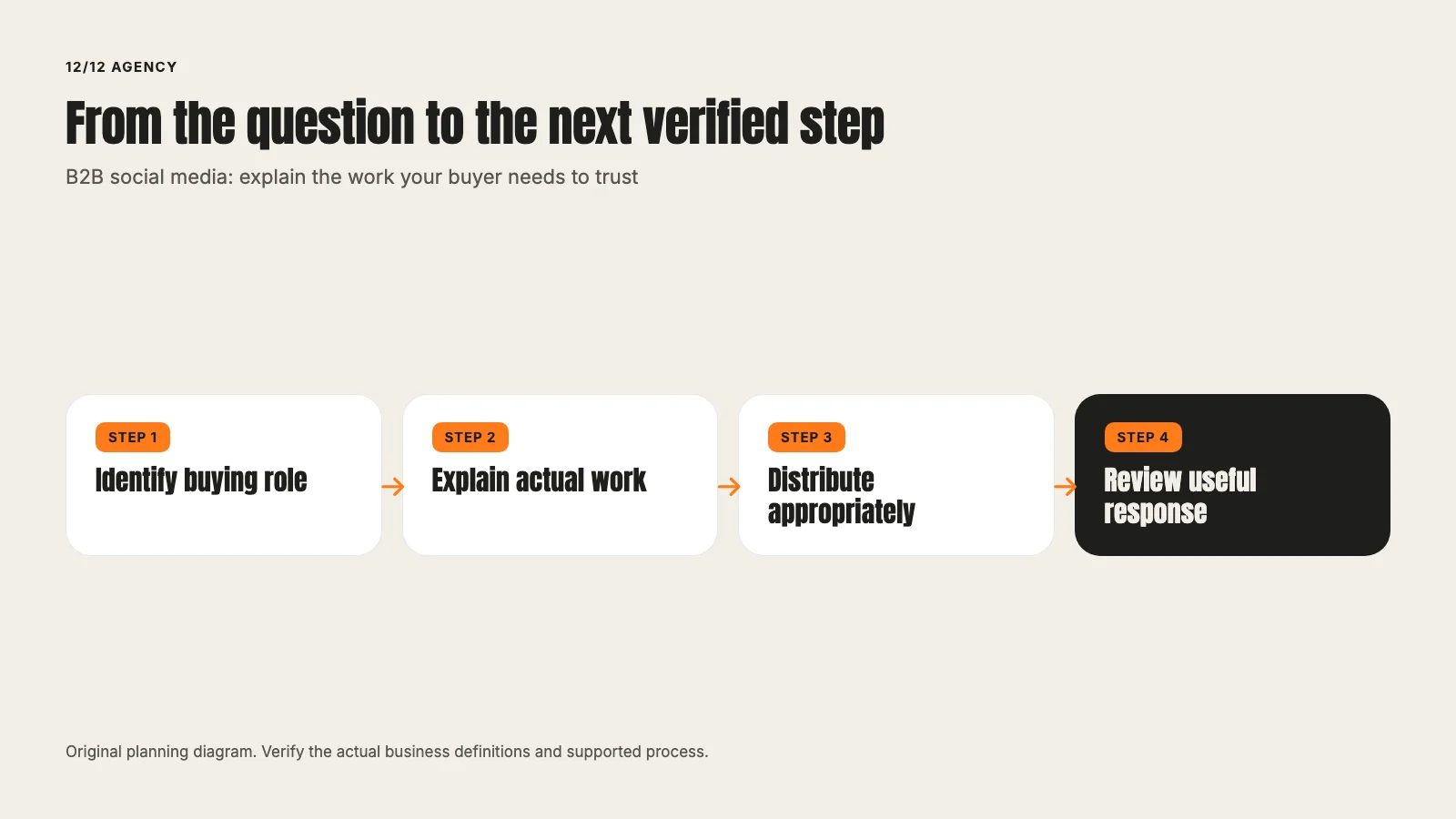
Identify the person and the question
A technical evaluator, operator, finance colleague and executive may need different answers. Do not collapse the buying team into one vague decision-maker persona.
For a fictional software product, an operator may need to see the workflow, while an evaluator asks about supported integrations and limitations. A manufacturing buyer may need capability evidence and RFQ preparation. The SaaS and manufacturing contexts should shape the explanation.
Write the reader's question before the hook. A useful post can answer one part of that question and point to a complete resource. It does not need to pretend the reader is ready for a sales call.
Use experts for the substance
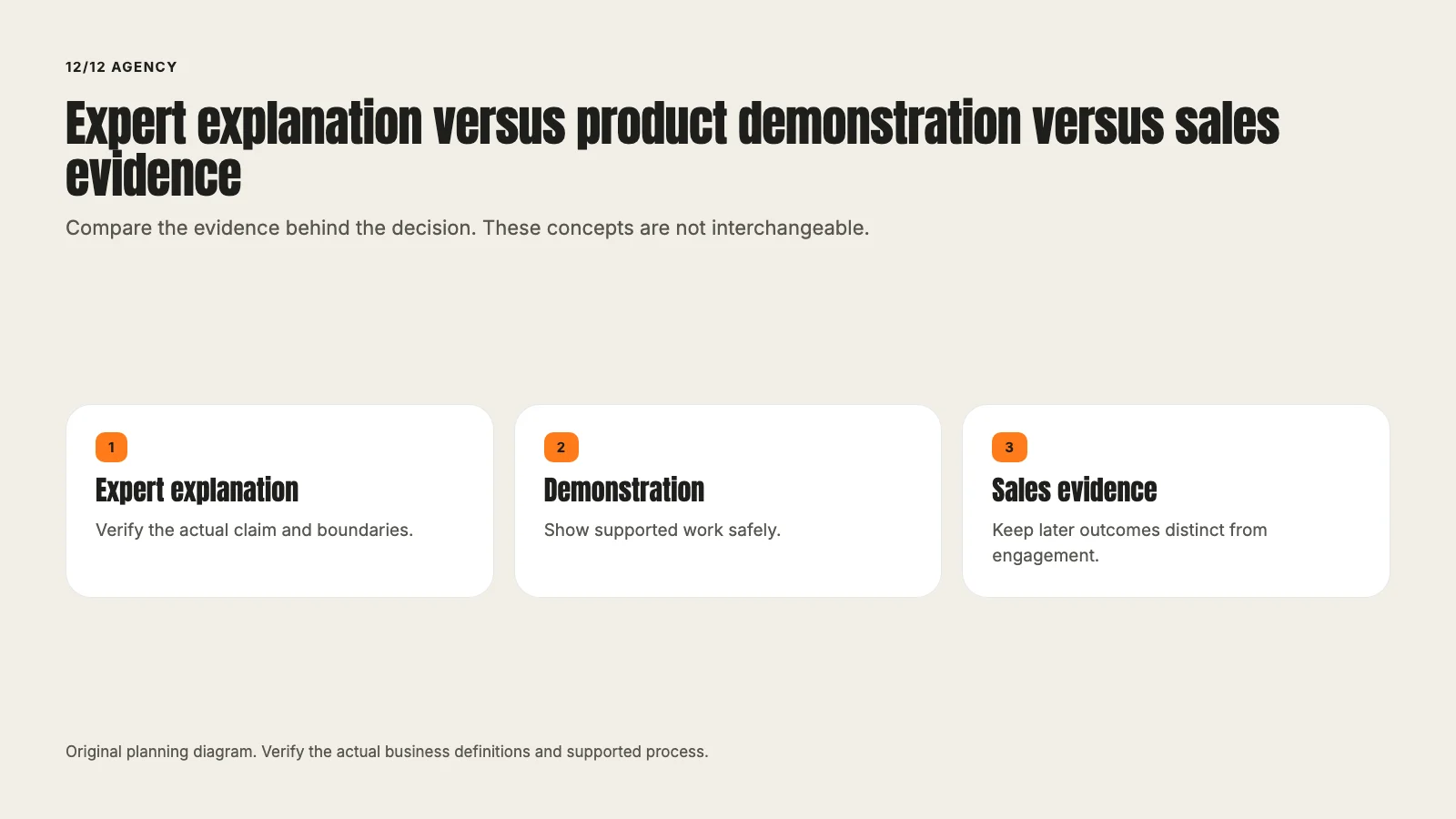
Ask the person who knows the product or process to explain what happens, what can go wrong and what the buyer often misunderstands. The marketer can shape the explanation, but should not invent technical authority.
Record the source and the scope. A capability that applies to one product version or facility should not become a company-wide promise. A concept mockup should not be shown as a live feature. A customer example needs permission and a verified definition of the result.
The FTC's advertising guidance provides the baseline for evidence-based commercial claims. The review should evaluate what the combined visual and wording imply, not only whether a sentence contains an explicit guarantee.
Demonstrate one supported job
A good demonstration makes a relationship visible. It can show how a request reaches a team, how a product handles a supported task or how an evaluator can compare two approaches.
Avoid recording private customer screens or credentials. Use an approved test environment, cleared source or accurately labeled illustration. The demonstration should not expose another person's information to make the post feel authentic.
The industrial overview can support a technical explanation, while the B2B lead-generation guide can support an operational handoff. Keep each post's job narrow enough that the visual adds evidence rather than decoration.
Make a comparison fair and explicit
A comparison should state the criteria and supported scope. Product A versus product B is not useful if the writer invents the competitor's limitations or hides a meaningful difference in price or workflow.
Use current public primary information for any named comparison. If that evidence is not available, write a category or approach comparison using clearly defined fictional examples. Do not produce an unverifiable ranking list merely because it may attract clicks.
A decision table can compare tasks, inputs, responsibility and limitations. It should help the buyer ask a better question, not declare every alternative inferior to the business.
Treat proof as a specific claim
Leads, booked meetings, held meetings, qualified opportunities, contract value and collected revenue are different measures. A milestone post should preserve the exact verified number and its definition.
Testimonials and employee or creator recommendations need appropriate disclosure and review. Do not write as an independent customer when the speaker represents the business. The commercial relationship should not depend on the viewer guessing it from a profile.
An honest process explanation can be useful even without a dramatic result. Do not manufacture a case study to make every post look like a success story.
Plan distribution for the actual context
An expert's own profile, the company page, a sales follow-up and paid promotion can reach different audiences. Adapt the surrounding message to the reader's starting point while preserving the same facts.
Publishing an explanation does not authorize cold outreach, customer enrollment or direct messages. Use the business's approved communication process and respect the actual request.
The LinkedIn service page can support a paid plan. LinkedIn's pricing overview makes clear that paid activity has its own objective and auction context. Do not treat an organic post as if it already has that distribution or attribution.
Keep the destination useful
If the post promises a guide, the link should deliver that guide. If it invites a conversation, the destination should explain the actual request or booking process. A general homepage may not continue the specific promise.
Do not link publicly to a future page that exists only in the production inventory. Use current useful resources or hold the link until the new page is implemented and reviewed.
The conversion-tracking guide can support the accepted-action contract. A resource click, form request and later business outcome remain separate evidence. The post should not label them all pipeline.
Review useful response, not only volume
Comments and questions can show what readers understood or still need explained. A smaller relevant discussion may inform the next resource more than a large generic reaction count.
Use the platform's actual metric definitions and record the period. Impressions, reach, views and engagements are different measures. Do not add them into a single invented audience total.
Qualitative evidence should also protect privacy. Aggregate recurring themes and use cleared examples. A private sales or support conversation is research context, not automatically a public quote.
Follow contribution without inventing causality
A buyer can encounter several pieces before taking action. Social may contribute to understanding even when another source receives the recorded credit. Conversely, following the account does not prove that social caused the sale.
A report can state the observed touch, relevant inquiry or platform attribution. Stronger causal claims need a suitable design and evidence. Keep opportunity value and collected revenue distinct.
The paid media overview can connect the content to the wider acquisition plan. The next decision may be a better explanation, a new source interview or a corrected destination rather than more distribution.
A practical production brief
Record the buying role, question, verified source, exact claim, chosen format, reviewer, destination and intended response. Include the actual final asset and full copy for approval.
A fictional software brief might use a current product demonstration to explain one scheduling boundary, an original diagram to show the roles and a guide link for the complete evaluation. It would not claim an unverified integration or a revenue result.
Keep the maintenance trigger with the piece. Product changes, revised service scope and outdated sources can make a formerly useful explanation inaccurate. Preserve historical drafts and obtain approval for live changes.
Bring one buying-role question and its source to a content review.
Give sales a resource it can use appropriately
Ask the team which specific question the piece helps answer and at what point in a conversation it is useful. A technical explanation may support evaluation without being an effective first-contact offer.
Record that context with the resource. Do not turn the existence of a useful article into permission to send unsolicited messages. The team should use the approved communication process and the person's actual request.
Feedback can then improve the next brief: which paragraph clarified the issue, which claim needed more evidence and which buyer question remains unanswered. This qualitative record complements platform metrics without pretending that every useful share is independently attributable pipeline.
Frequently asked questions
Want this run for your business?
Tell us where to send it and we'll follow up with the strategies that fit your market.