
AI search visibility starts with a useful answer
David A · Founder, 1212 Agency
Published November 16, 2026

Review AI search visibility through accessible pages, reliable evidence and actual discovery. Keep GEO, AEO and SEO questions together without promising citations.
A new acronym does not create a new guarantee. Generative engine optimization, answer-engine optimization and AI search visibility often describe overlapping questions: can a system find the page, understand its useful evidence and choose to reference it for a relevant question?
Start with those questions and the actual platform documentation. Build a useful public answer and measure what can be observed. Do not promise that a special file, schema label or rewritten introduction will secure a citation.
Separate eligibility from inclusion
Google's current AI-features guidance says that established SEO practices remain relevant to AI Overviews and AI Mode and that no special optimization or additional technical requirement is needed for those features.
That is a platform-specific statement, not a universal description of every AI service. Read each platform's current primary guidance before making a claim about its discovery or use of content.
Google's technical requirements also distinguish eligibility from guaranteed indexing. A page can meet a technical baseline without being crawled, indexed, ranked or cited for the query the business wants.
Begin with the buyer question
A useful page answers a real decision in the business's supported scope. A SaaS buyer may need a workflow comparison. An industrial buyer may need an accurate capability explanation. A local customer may need truthful service and location information.
Do not create separate articles for GEO, AEO, LLM SEO and every close phrase when they answer the same reader question. One coherent guide can explain the differences and limits with useful sections.
Map current pages before proposing new ones. If the business already has an accurate answer, improve its evidence or discoverability rather than adding another URL with a new acronym in the title.
Make the evidence understandable and reviewable
State what the product or service does, where the claim applies and which source supports it. Use original diagrams, documented processes and cleared examples where they help the reader evaluate the explanation.
A concise answer can be useful, but brevity alone is not proof of quality. A complex question may need conditions, exceptions and a detailed comparison. Removing those details to chase an imagined AI format can make the page less accurate.
Google's helpful-content guidance provides a broader editorial test. The page should add useful original value rather than repeat other sources or mass-produce close variants.
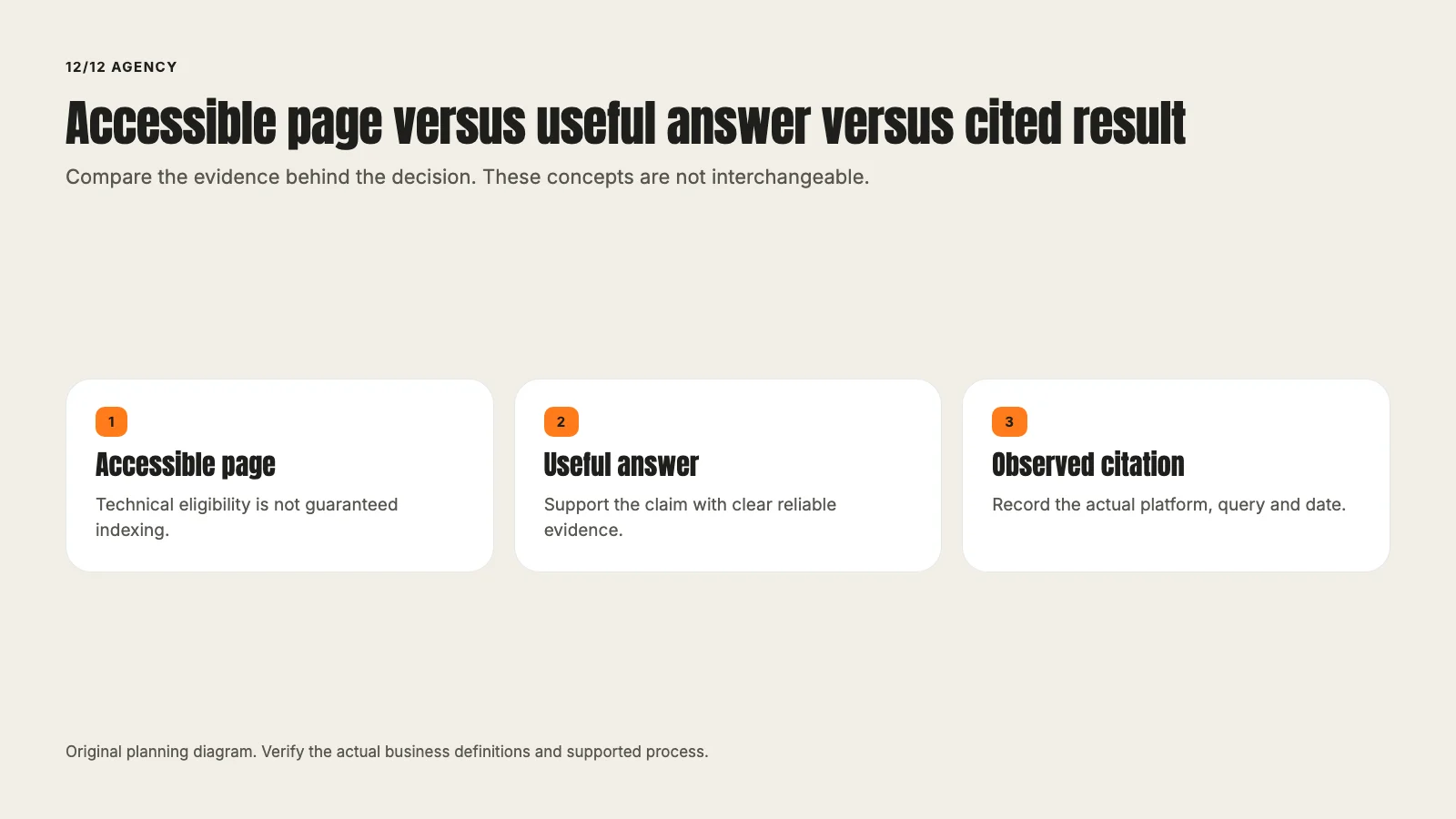
Answer-engine optimization within useful content
An answer-oriented section can state the question, give the supported answer and explain its limits. A definition, decision table or process can make the information easier for a person to use.
Do not write an answer that omits the qualification carrying the truth. A product may support one integration direction rather than a universal two-way connection. A business may serve an area without operating an office there. The concise version must preserve that distinction.
This is an editorial practice, not a guarantee that a system will extract the sentence or present it accurately. The business should still review the complete page and the source behind the claim.
How AI-search visibility relates to SEO
Technical access, useful navigation, accurate metadata and clear content remain part of the public website foundation. A page hidden behind authentication or served as an error needs a different repair from a page with a weak explanation.
The Google Ads audit guide is a useful example of a specific decision-oriented resource, while the SaaS demand-generation guide retains its distinct distribution job. These pages do not need duplicate AI-labeled versions merely to appear current.
Search work should preserve page purpose. A service page explains the engagement. An educational article helps the reader decide. A tool performs a useful defined task. A new label does not erase those distinctions.
Do not invent special technical requirements
Review actual robots controls, indexing signals, visible content and internal links. Check any platform-specific crawler or use policy against its current documentation before changing access.
Do not claim that a special text file or schema type guarantees inclusion. Structured information should accurately describe visible supported content. It should not invent reviews, product attributes or business relationships.
Changes to crawler access can have consequences beyond one feature. They need a concrete plan and the appropriate technical approval. This article does not authorize a blanket robots edit or a change to how private content is exposed.
Use comparisons without manufacturing authority
If the page compares products, use current primary evidence and explicit criteria. Do not publish self-serving best-provider lists that imply an independent ranking without a valid basis.
A fictional comparison can explain how to evaluate an approach when it is clearly labeled. It should not include invented customer results, fake reviews or unsupported market-share figures.
The same standard applies to authorship and source attribution. Use the business's real author and review process. A confident biography or a large collection of citations does not substitute for an accurate explanation.
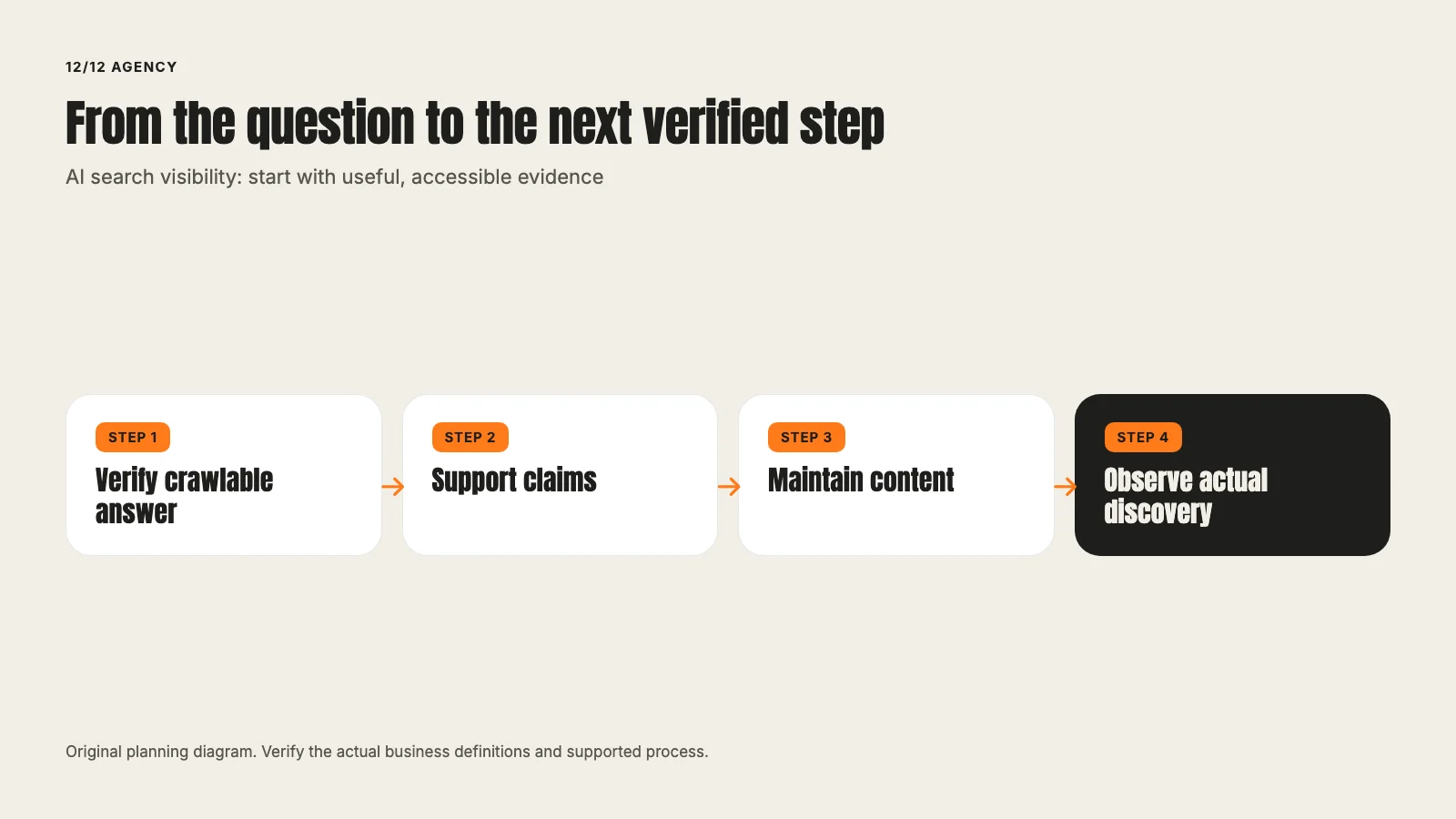
Measure what is actually observable
Record the platform, query, date and observed result when checking citations or presentation. A single observation is a snapshot, not a stable visibility percentage across every user and question.
Search Console and analytics can provide different evidence, subject to their current definitions and access. If those sources are unavailable, say so. A public crawl proves availability and content characteristics, not Google indexing or AI citation performance.
The conversion-tracking guide explains why a visit and later business outcome remain separate. A referral from an AI service does not automatically prove incremental revenue, and a citation without a click is another kind of observation.
Plan a bounded improvement
Choose one useful page and identify the actual gap. It may lack source evidence, hide the answer in a vague introduction, have broken internal links or depend on inaccessible rendering. Repair the supported problem and verify the released behavior.
Do not change several major factors and attribute every later citation to one wording edit. Platform behavior, query context, competition and time can also change. A descriptive before-and-after result should retain those limits.
The paid media overview can remain a separate distribution discussion. Buying ads and improving an organic answer are different jobs with different evidence and costs.
Maintain the answer as facts change
Assign a source and review trigger to product, policy and technical claims. An old page with a new date is not necessarily current. A material update should change the explanation and record what was verified.
Preserve the useful page map as the library grows. Merge close questions where appropriate, but obtain approval for actual deletions or redirects. Keep historical drafts and source notes so the team can understand the reasoning.
Bring one buyer question and the current answer to a content review.
Preserve the exact visibility observation
When a page is cited or omitted in a check, record the platform, query, date and visible result. Keep screenshots free of private information and avoid describing the observation as a stable ranking for every user.
If the page changes afterward, record what was actually updated and which source supports the revision. A later citation may be relevant evidence, but the timing alone does not prove that the edit caused it.
This observation log can guide the next content or technical question without becoming a fabricated visibility score. Its value is a reproducible record of what was seen and what still needs verification, alongside the business outcomes the website can actually measure.
Frequently asked questions
Want this run for your business?
Tell us where to send it and we'll follow up with the strategies that fit your market.