Google Ads vs Facebook Ads: Choose by Buyer Intent, Then Check the Lead
David A · Founder, 1212 Agency
Published October 29, 2026

Start with how your buyer finds the problem. Then compare qualified outcomes from records you trust, including what happens when a search visitor returns through social.
Your report says the lead came from social. The detail underneath says Google. Which channel gets the credit, and which one gets next month's budget?
We found that mismatch while testing a business-to-business (B2B) video software company's lead path. A fresh social visit followed an earlier Google visit. The final source category recognized social, but its detail still named Google. Separate clean Google and social tests returned the expected source details.
That did not prove either channel performed better. It showed why a channel comparison needs two decisions: where your buyer is likely to respond, and whether your records can support the conclusion afterward.
Google Ads vs Facebook Ads starts with intent, offer and creative. This guide compares Google Search with Facebook and Instagram ads, then gives you a way to judge the leads fairly. Other Google campaign types need their own comparison. Google Ads is a platform, not a synonym for search advertising.
The short answer by buying situation
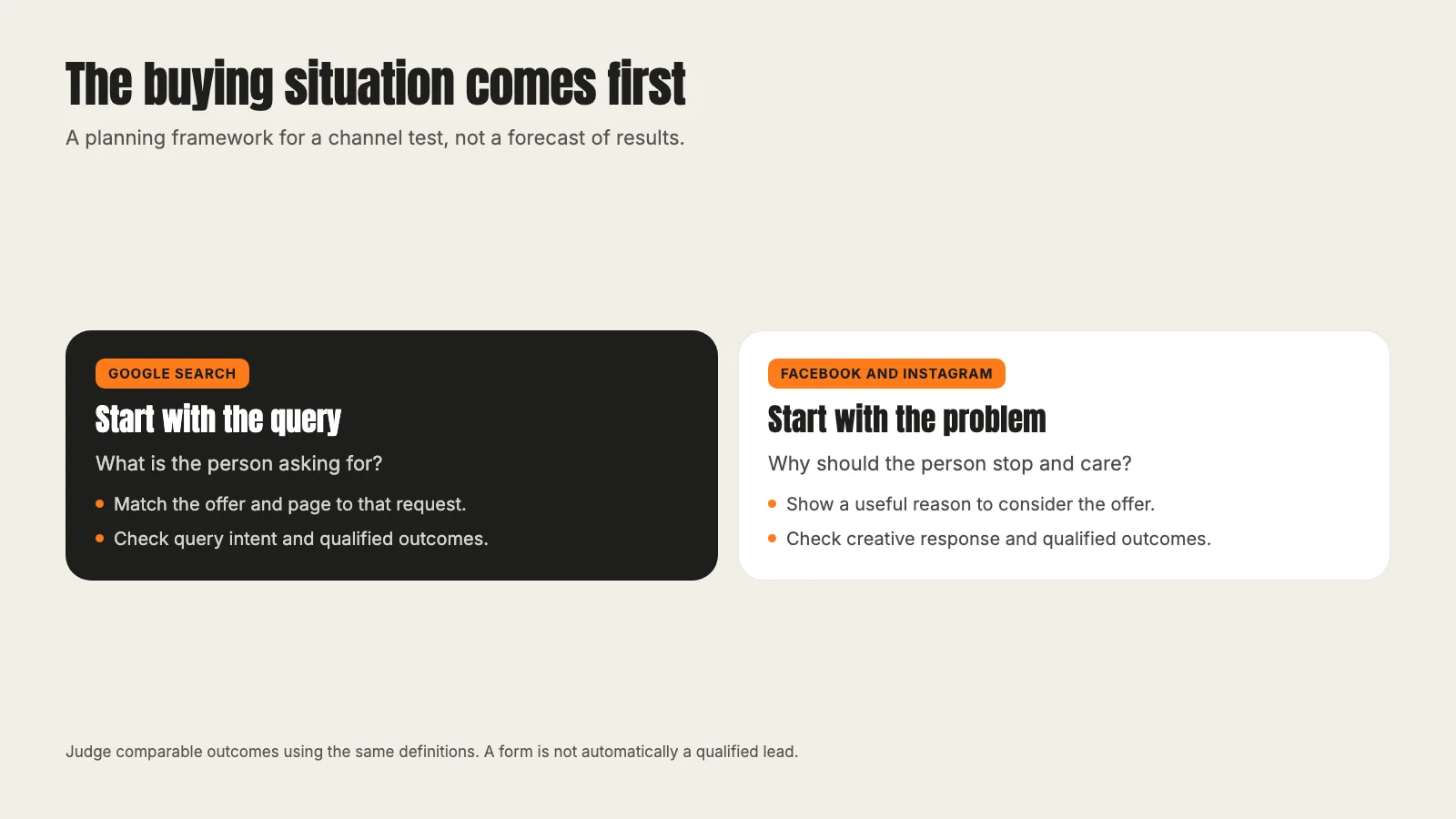
Start with Google Search when buyers already describe the service or problem in searches you can answer. A relevant query gives you something concrete to work with: the wording of the request. Your ad and landing page should continue that request rather than send everyone to a general homepage.
Google's Search campaign guidance describes reaching people actively searching for products and services. That is the capability. Whether those searches represent your customers still depends on the query, location, offer and account setup. A search for a category can come from a student, an existing customer or a buyer.
Consider Facebook and Instagram when the offer needs showing before somebody knows what to search for. A short demonstration, recognizable problem or useful comparison can introduce the reason to care. Your working hypothesis is that the audience will recognize that problem. The campaign must test it.
For a small team, start with the channel you can support properly. Search needs relevant pages and query review. Social needs convincing creative and a plan to replace weak ideas. Both need someone to respond to the resulting requests. Splitting attention before either path is ready gives you two incomplete tests.
Our Google Ads management service starts with the searches and the offer. Our Meta ads work starts with the audience, the problem and the creative. The shared destination is a useful commercial outcome.
Google Search and Facebook ads compared
The practical difference is the situation in which you ask for attention. On Search, somebody has entered a query. In a social feed, your creative must make its relevance clear without that same explicit request.
| Decision | Google Search | Facebook and Instagram |
|---|---|---|
| Starting signal | The search someone entered | The problem your creative asks them to recognize |
| Main writing job | Answer the query with a relevant offer | Make the reason to care clear quickly |
| Useful destination | A page matching that search and offer | A page or lead path continuing the creative |
| Review focus | Query intent and qualified outcomes | Creative response and qualified outcomes |
| Common comparison mistake | Treating every search as buying intent | Treating every form as buying intent |
These are planning distinctions, not rigid boundaries. A search can be early research. A person seeing an ad in a feed may already be evaluating suppliers. Do not infer readiness solely from the platform name.
Keep the scope of each test explicit. A Google brand campaign reaches people searching for you by name. Comparing it with a social campaign introducing you to unfamiliar buyers answers a different question from comparing two prospecting programs. Label brand, returning visitors and new-audience campaigns separately where the data allows it.
Also record what the campaigns actually include. A report labelled Google may combine Search with other campaign types. A report labelled Facebook may include Instagram. If you cannot explain the inventory behind each row, narrow the comparison before interpreting the totals.
Match the offer and creative to the channel
Write one sentence describing the buyer's next useful action. It might be comparing a technical requirement, seeing a workflow, requesting an estimate or booking a product demonstration. Then ask whether the ad gives enough reason to take that step.
For Search, connect the query to the page. Someone comparing two approaches needs a useful comparison. Someone searching for a specific service needs to see that service, where it is available and what happens after the request. An ad that promises an answer and lands on a generic contact page breaks the connection.
For social, show the problem rather than assuming the audience already wants the product. An illustrative software example would demonstrate a repeated handoff that creates duplicate work, then explain what the product changes. That example is a creative hypothesis, not a claim about a client's results.
Keep the next action proportionate. An educational checklist and a live sales demonstration ask for different commitments. If the offer is a checklist, do not count every recipient as somebody who asked for a demo. If it is a demo, the page should explain what the person will see and who will contact them.
For a product whose value depends on another system, education may begin with the integration. Our SaaS demand generation playbook covers that earlier work: explaining the shared buyer problem before asking for a sales conversation. That content can support either channel without turning every visit into a lead.
Compare qualified outcomes using the same definitions
A cheap form submission and an attended sales meeting are different outcomes. Before choosing a channel winner, agree which one matters for the decision and what qualifies it.
Write the definitions with sales. A qualified request should meet the fit and intent criteria your team can apply consistently. A booked meeting needs a booking record. An attended meeting happened. An opportunity meets the team's agreed sales-stage requirements. Use those names in the report instead of calling every stage a conversion.
In another B2B software engagement, the channel-budget discussion explicitly called for feedback from the sales team on the quality of the extra opportunities. The request was for end-to-end accountability, including filtering out opportunities that were unlikely to close. A higher form count alone could not answer it. That was a measurement requirement, not proof that a channel had met a target.
Choose the same counting unit across channels. One person can submit twice and book later. Several people can evaluate a product for one company. If one report counts forms and another counts unique companies, their costs do not describe the same thing. Our B2B lead generation guide explains those handoffs in more detail.
Allow time for the outcome you chose. Compare people acquired in a defined period and follow what happens to them. Label recent groups as incomplete while meetings and sales decisions are still developing. Adding both platforms' attributed conversions is also not a count of unique customers: the same journey may appear in both reports.
Test a Google visit, a Meta visit and a returning visitor
The returning visitor is the check that exposed our mismatch. A clean browser test can pass while old data breaks the next visit. Test both conditions before trusting a source-based budget comparison.
Our recent controlled tests covered a Google-only visit, a social-only visit, an older Google visit followed by a social submission, and a completed signup path. After the delayed processing, the clean visits had the expected source details. The mixed-source case had a social category paired with Google detail. The signup case had a Google source but had lost campaign information.
Those were findings to repair and retest. They did not establish that all attribution was fixed, or prove advertising-platform credit from real clicks. The tests used synthetic click identifiers, which can check storage and routing without representing actual ad clicks.
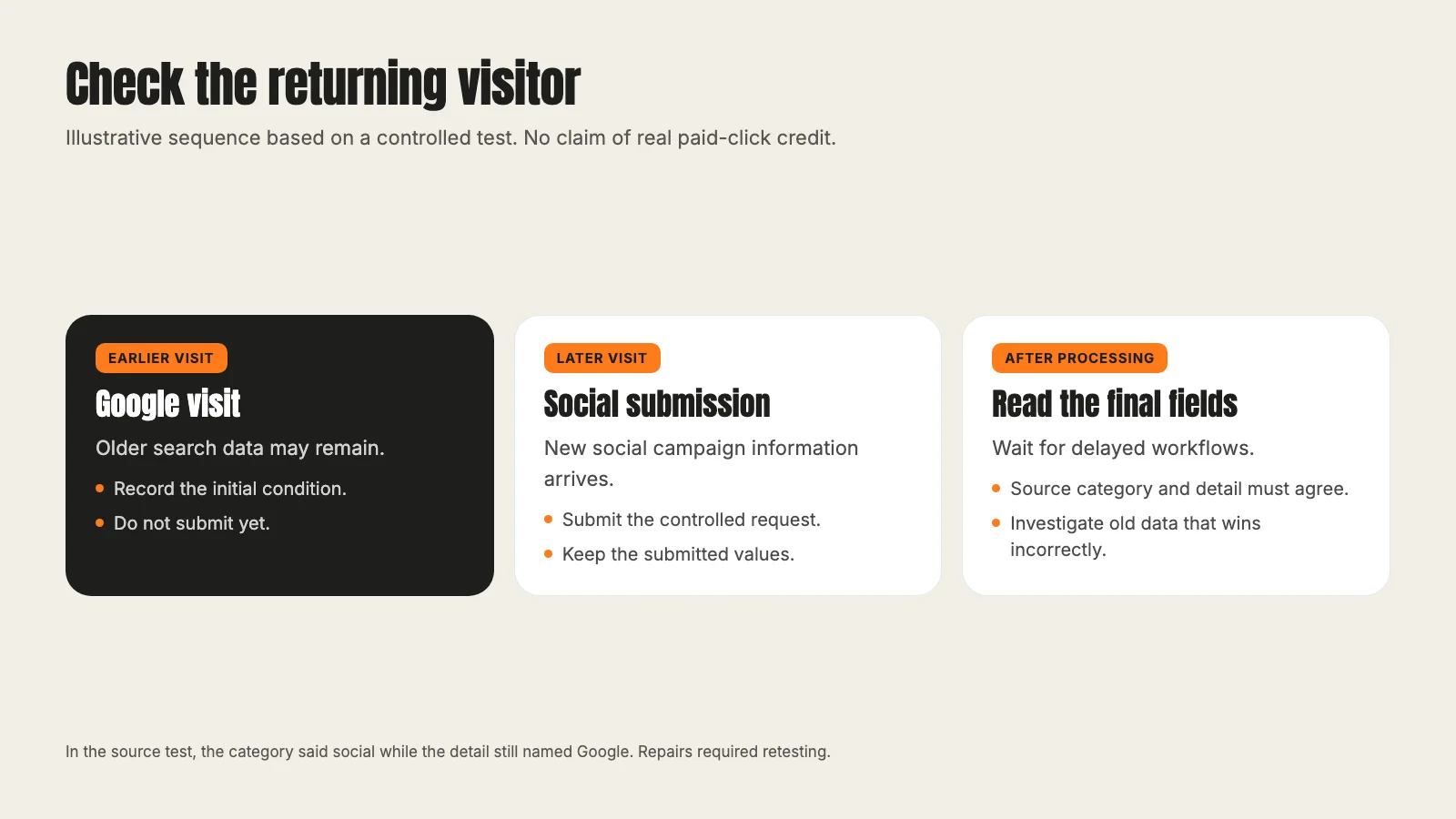
Use a small written matrix for your own system. Record the visit condition, submitted campaign information, expected source and actual final fields. Inspect the customer relationship management (CRM) record after the relevant workflows finish. A field that looks right immediately after submission may change later.
Google's auto-tagging documentation explains how its click identifier is added to landing-page URLs and why redirects need to preserve it. That identifier is one piece of evidence. Your CRM still needs a deliberate policy for first visit, latest visit and the submission being classified. Those can legitimately differ; a mismatched source category and detail needs investigation.
For the implementation checks, use our conversion tracking guide. Here, the decision is whether your records are trustworthy enough to compare channels. If they are not, report the gap and fix it before treating the attribution totals as a winner.
When to start with one channel or use both
Start with one when you can state a clear hypothesis and support the full path. For Search, that could be relevant non-brand queries leading to a useful demonstration request. For social, it could be a visual explanation reaching people who recognize the problem. Define what would make that first test worth continuing.
Use both when each has a distinct job and you can measure the overlap sensibly. Social might introduce the problem while Search captures a later request for a solution. That is a plausible journey to investigate, not proof that every later search was caused by the social ad.
Keep the reading specific. Look at qualified requests, follow-up and cost at the chosen stage, with uncertainty labelled. Our Facebook ads cost guide covers the ad-level review on Meta. Use it for creative and cost decisions without assuming its account examples predict your results.
Do not choose an automatic equal split simply to make the test look fair. The useful allocation depends on reachable demand, creative supply and the amount of evidence your decision requires. Write down the proposed split, the reason and the review point before committing it.
A decision checklist for your next test
Before you fund the next channel, answer these questions:
- Which buyer problem are we answering, and how does the buyer encounter it?
- What offer does the ad make, and does the destination continue it?
- Are we comparing similar audience conditions, or labelling the differences?
- Which qualified outcome matters, and who confirms its quality?
- Do fresh and returning-visitor tests preserve the expected source information?
- Are duplicate records and overlapping platform claims handled explicitly?
- Has the acquired group had time to reach the outcome we are judging?
- What evidence would lead us to continue, change or stop this test?
Choose the channel whose job you can explain and whose result you can verify. If the source category says social and the detail says Google, resolve that record before using it to justify the next budget decision.
Frequently asked questions
Want this run for your business?
Tell us where to send it and we'll follow up with the strategies that fit your market.