
Facebook Ads Cost: What We Check Before Raising a Budget
David A · Founder, 1212 Agency
Published October 21, 2026

Benchmark averages will not tell you what Facebook ads cost your business. Your cost per result, ad by ad, against a target you set first, will.
Many answers to "how much do Facebook ads cost" give you an average cost per click from someone else's accounts. Then you launch, and your numbers look nothing like it.
That is not because the averages are wrong. It is because what Facebook ads cost you is set less by the market average than by which ad you judge, and when. Meta often sends most of an ad set's delivery to one ad. New ads need time and spend before their numbers mean anything. And budgets that jump too fast reset the learning that made the results good.
This guide covers what we check every week before we raise a Meta ads budget. It comes from a weekly routine we built for our Meta clients on 16 Oct 2026 and first ran on 19 Oct, with real numbers from two of them: a sales training company running a free assessment funnel, and a luxury driving event company.
Why published averages rarely match your account
You set the budget on Meta, so the budget is never the mystery. The mystery is what you get for it.
Meta runs an auction every time it can show someone an ad. Its ad auction documentation says the winning ad has the highest total value, which combines three things: your bid, the estimated action rate (how likely this person is to act on this ad) and ad quality. It also says a more relevant ad can win against ads with higher bids.
That means two businesses with the same budget can pay very different amounts for a lead. Your offer, your audience, your creative and your landing page all change the estimated action rate. An average across thousands of accounts flattens all of that out.
So skip the question "is my cost normal?" Ask "is my cost per result below the number that makes this profitable for me?" That needs a target you set before you look at results.
Judge cost per result, per ad, against a target you set first
Write the target down before launch. For a lead funnel, that is a cost per lead you can afford given how many leads turn into customers. For a purchase funnel, it is a return on ad spend (revenue from ads divided by what the ads cost) you need to stay profitable.
Our two examples had different targets:
- The sales training company aims for $10 per lead from its free assessment.
- The luxury driving event company aims for a 5x return on purchases. Because its purchases are few and lumpy, we read it over 14 days instead of 7.
Then read the results at the ad level, not just the campaign total. A campaign average can hide one strong ad carrying two weak ones, or one weak ad dragging down a winner.
In the week of Oct 12 to 18, the sales training company's best ad brought in leads at $7.71 per lead, under its $10 target, with a click through rate of 3.34% and a frequency of 1.39 (the average number of times each person saw it). That is the number that matters, not the account average and not an industry table.
If you want to work out a target from your own close rate and deal value, our cost per lead calculator does the arithmetic, and our ad budget calculator works it back to a monthly budget.
Meta concentrates spend on one winner
Here is the part that often surprises owners. Put three ads in one ad set, and Meta will often not split the money evenly.
In that same week, the sales training company's ad set had three ads. The winner took almost all of the delivery. A short video ad brought in 5 leads. The third ad was barely served at all.
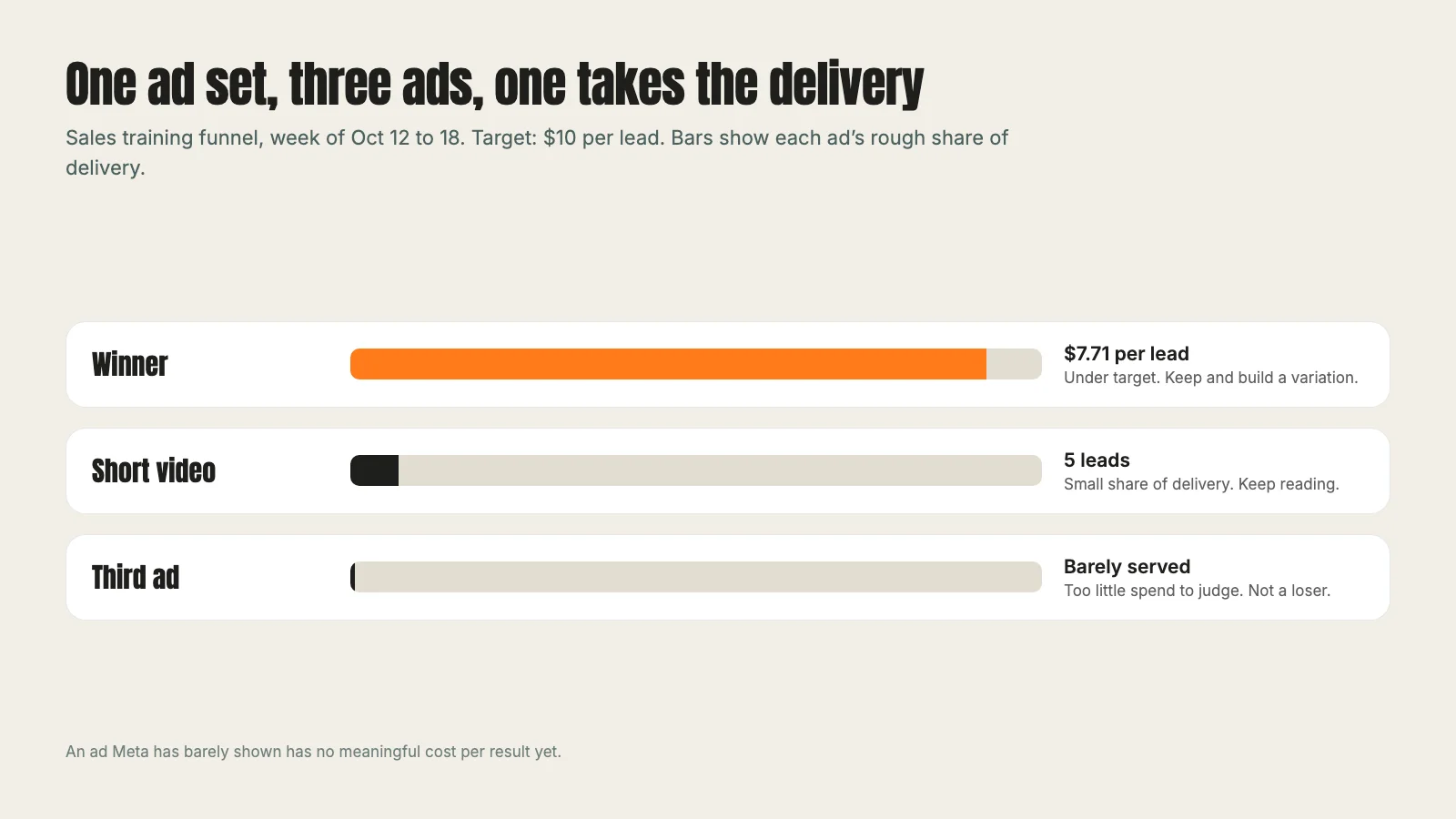
It is tempting to call that third ad a failure and switch it off. We did not. An ad Meta has barely shown has no meaningful cost per result, good or bad. It has not been tested. Pausing it tells you nothing and costs you a possible future winner.
The luxury driving event company shows why you judge each ad, not the campaign. Over Oct 5 to 18, its best carousel ad returned 35.6x on purchases, far above the 5x target, and a video ad for the same event came a close second. Meanwhile an older carousel that had not produced a purchase in 14 days was marked for pause.
So when you look at what your Facebook ads cost, look at each ad's share of delivery first. An ad's cost is only worth judging once Meta has actually spent on it.
Give a new ad seven days and a minimum spend
Our rule: an ad is too new to judge if it is under 7 days old or has spent under $50. No verdict either way until it passes both.
Meta's own guidance supports waiting. Its learning phase documentation says ad sets usually leave the learning phase after about 50 results in the week after their last significant edit, and that performance during learning is less stable and usually has a higher cost per acquisition. It also says editing an ad, ad set or campaign during learning resets it.
Two habits follow from that:
- Do not edit a live ad's creative. If an ad needs a new image or headline, add it as a new ad in the same ad set. That keeps the original ad running unchanged instead of resetting it with an edit.
- Do not pause the old ad before the new one is live. And never pause the last ad running in an ad set.
Once an ad is past the too new line, we sort it into one of three groups:
| Label | What it means | What we do |
|---|---|---|
| Winner | Best cost per result that meets target | Keep it, and build a variation of it |
| Tired | Frequency 2.5 or more, click through rate down 25% from its first two weeks, or cost 30% over target | Add a fresh variation before it fades further |
| Loser | Spent twice the target cost with no result | Pause it once its replacement is live |
These are judgement aids, not autopilot. The luxury driving event company had a video ad at a frequency of 2.79, past our tired line. We kept it running because it had brought a purchase at 8x in that window. A rule flags the ad. You still decide.
Raise budgets in steps of about 20% a week, only under target
This is where the question of what Facebook ads cost turns into a decision. You have a winner under target. How much more do you spend?
Our rule is one step of 20% at most, once a week, and only when all of these hold:
- The ad set met its target over the reading window, with enough results to trust it.
- It is spending at least 85% of its current budget, so more budget will actually be used.
- It is out of the learning phase.
- Nothing changed in the last 7 days.
The step is small on purpose. Meta's learning phase page warns that frequent budget changes can send an ad set back into learning, which brings back the unstable, higher cost period you just got out of. A modest step lets you see whether cost per result holds at the new level. If it does, take another step next week.
The opposite rule matters too. If cost runs 50% over target, we cut the budget by 20% rather than waiting for it to recover on its own.
In our two examples, the rules gave different answers the same week. The sales training company qualified for a 20% step, and it waits on the client's written OK before it goes live, because a budget change is the client's money and the client's call. The luxury driving event company did not get a budget change at all, despite its strong return. Both of its ad sets were still learning, so the budget held.
Add a new creative every week to keep frequency down
Even a winning ad gets tired. As the same people see it again, frequency rises and the click through rate tends to slide. The cost per result follows.
So we add new ads every week instead of waiting for the winner to fade. Each week gets two: one variation of the current winner (same idea, new image, opening line or format) and one new angle that tests a different reason to act. New ads go in as new ads, not edits, and the tired ones come out only after the new ones are running.
This also answers part of what Facebook ads cost over time. A budget that keeps working is a budget fed with fresh creative. Without it, the same spend tends to buy less over time.
A weekly cost review you can copy
Here is the loop we run, once a week, for every Meta account.
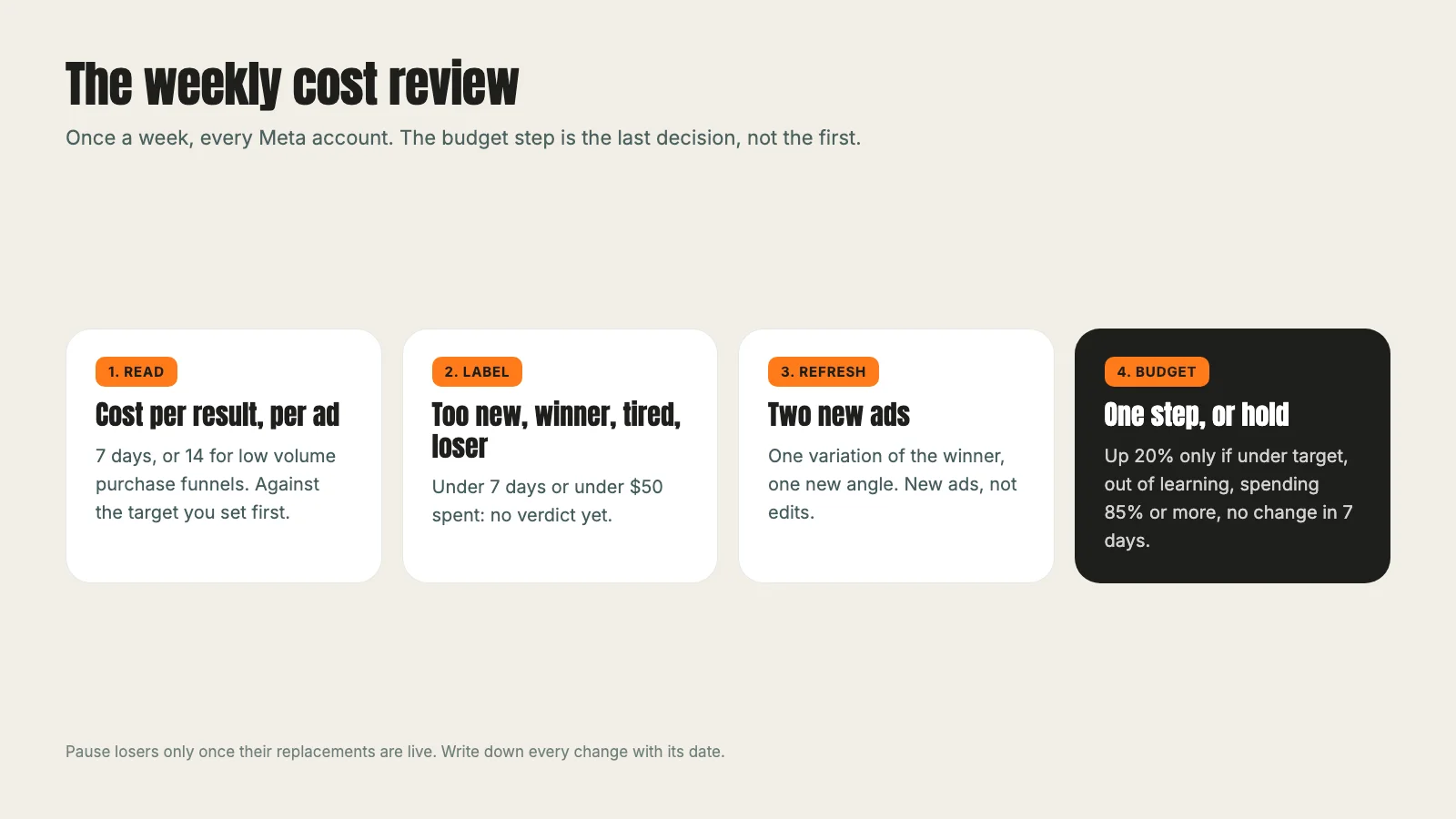
- Read cost per result per ad for the window (7 days, or 14 for low volume purchase funnels).
- Label each ad: too new, winner, tired or loser.
- Add new creative: one variation of the winner, one new angle.
- Pause losers only once their replacements are live.
- Decide the budget: up one step of 20% only if every condition holds, down 20% if cost is 50% over target, otherwise hold.
- Write it down, with the date, so next week's read starts from what you changed.
None of this needs special software. A spreadsheet and a fixed day of the week will do.
For a full view of how this works on a purchase funnel, read our luxury events case study. If your funnel ends in a demo rather than a purchase, our guide to B2B lead generation covers what happens after the form. The same habit of reading the setup before the spend applies on Google too: see our Google Ads audit guide. And if you would like us to run the weekly loop for you, start with our Meta ads management service and our pricing page.
Frequently asked questions
Want this run for your business?
Tell us where to send it and we'll follow up with the strategies that fit your market.