
Meta instant forms or landing pages: compare the whole lead path
David A · Founder, 1212 Agency
Published November 16, 2026

Compare Meta instant forms and website pages using accepted leads, contact, bookings and quality. Build a fair test with clear definitions and a shared offer.
One campaign produces cheaper forms. Another produces fewer requests that sales prefers. Calling a winner from the form cost alone skips the part the business actually needs to understand.
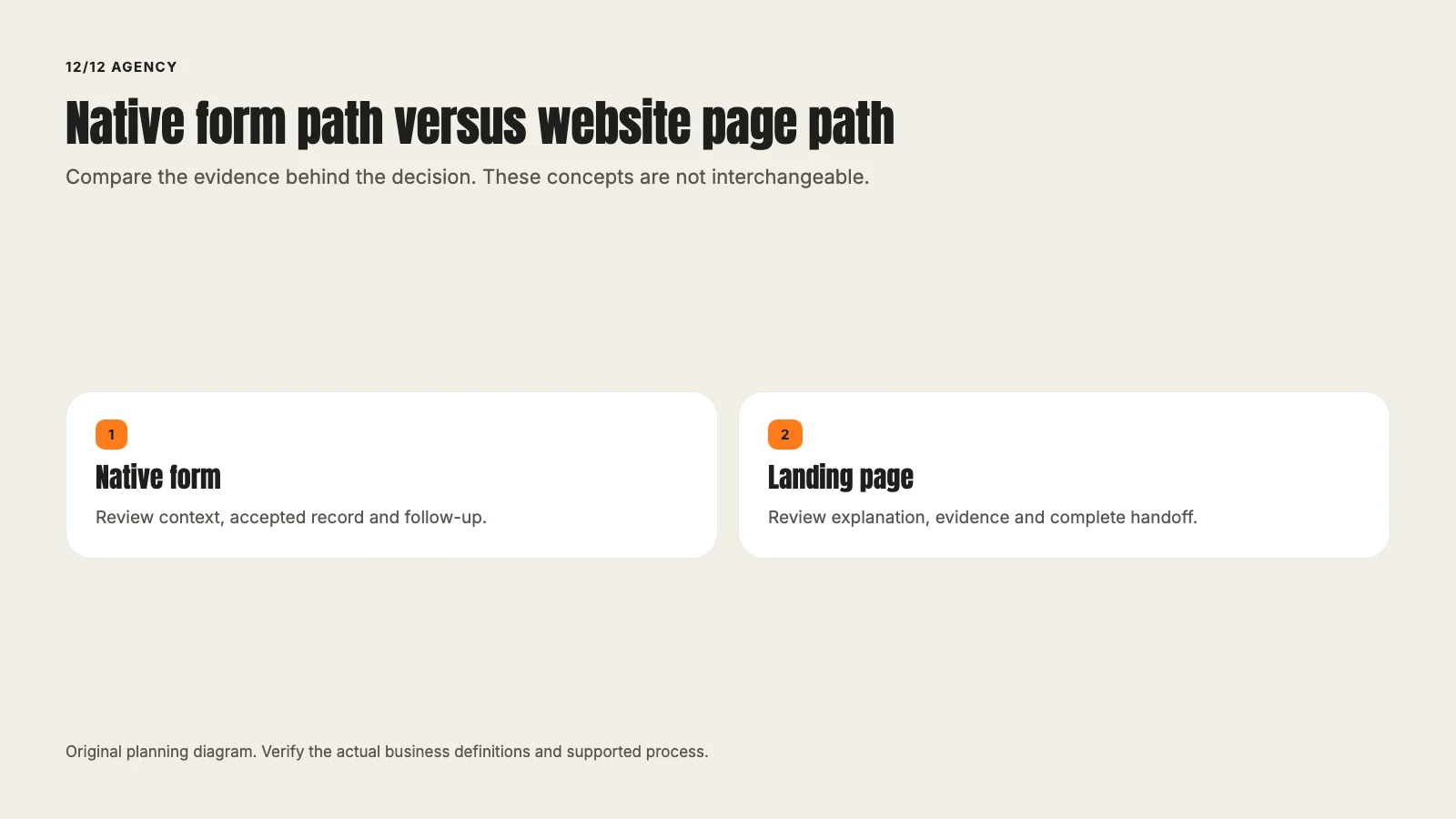
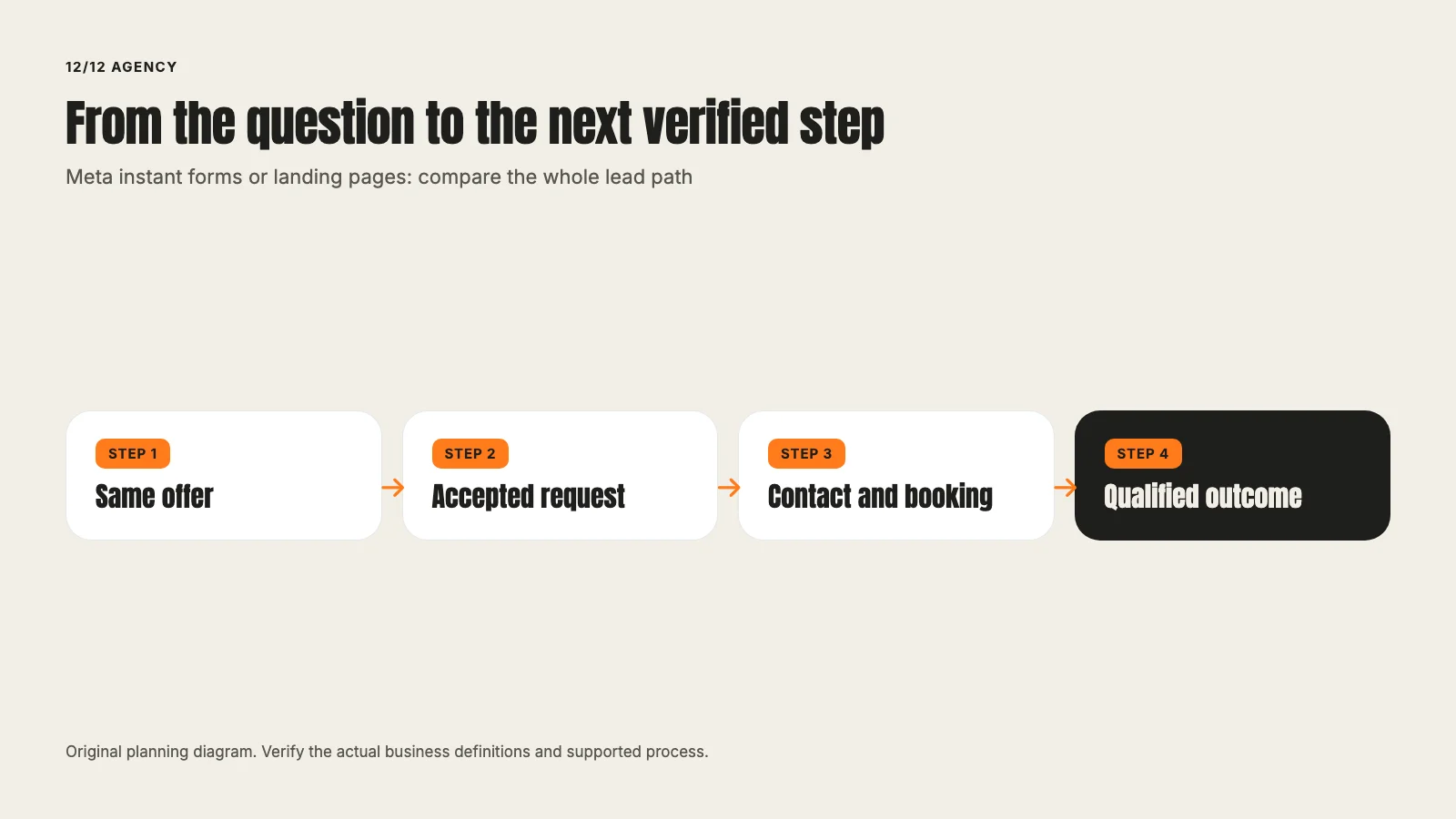
Meta instant forms and website landing pages create different paths. The useful comparison follows each path from the offer to an accepted record, contact and the later outcome. It also checks whether the two groups were given a fair comparison in the first place.
The numbers in this guide are fictional illustrations. They are not Meta benchmarks, client performance or a prediction that either destination will win.
Understand what changes between the paths
An instant-form path and a website path give buyers different places to consider and submit the offer. A website page gives the business a separate place to explain the offer and collect a submission. Review the actual form configuration rather than assuming which information will be prefilled.
That difference affects more than the number of fields. The buyer may see different context, loading behavior, proof and next steps. The tracking and CRM handoff can also differ.
Do not assume that easier submission automatically means worse quality, or that a longer website form guarantees stronger intent. Those are questions to investigate with the actual offer and records.
Keep the offer comparable
Before testing destinations, write one offer and one definition of a suitable response. If the instant form offers a guide while the website asks for a sales meeting, the experiment is comparing offers as well as destinations.
Review the audience, creative, eligibility and period. Some differences may be unavoidable, but they need to be recorded. A comparison with several simultaneous changes can still be useful operational evidence without proving that the form location caused the result.
Also confirm that the offer is accurate on both paths. A consultation, quote, application and download are different promises. The confirmation and follow-up should deliver what the ad describes.
Define the stages before looking at cost
Use plain labels that sales can apply consistently:
| Stage | What it means in the comparison |
|---|---|
| Accepted record | The agreed system accepted a completed submission |
| Eligible request | The person or business meets the offer's fit requirements |
| Contacted | The team completed the defined contact attempt or conversation |
| Booked | A real appointment was confirmed |
| Attended | The meeting or appointment actually happened |
| Qualified | The business applied its agreed qualification rule |
Your journey may use different stages. Define them explicitly. Contacted should not alternate between an automated email and a completed sales conversation depending on which campaign is being discussed.
The B2B lead-generation guide covers the larger handoff. The SaaS cohort guide explains why bookings, attendance and qualification should remain separate.
Verify the record arrives where someone can use it
For an instant form, check the approved retrieval and CRM route. For a website, check the page, accepted submission, confirmation and destination record. Having a connector configured is not proof that a particular lead arrived with the right owner.
Use a bounded, approved QA plan when a test can notify staff or create records. Label the test and keep it out of business results. Do not submit repeated fake leads simply because a report has not updated yet.
Our conversion-tracking article discusses handoff evidence from another platform perspective. The same distinction matters here: a technical receipt, a CRM record and an attributed business result are different claims.
Compare matched cohorts rather than unrelated totals
Choose requests accepted during the same defined period and allow enough time for the relevant later outcomes. Keep duplicates and test records visible in the exclusions.
Do not compare this week's instant-form leads with website customers who first inquired months ago. The later group has had more time to mature. If the periods differ, state that limit before interpreting the cost.
Record missing information too. An unreviewed request is not automatically unqualified. A meeting with no attendance status is not automatically a no-show. The report should expose gaps rather than convert them into convenient zeros.
Work through a fictional comparison
Suppose two illustrative groups each use $1,000 in media. Group A creates 100 accepted records and five qualified outcomes. Group B creates 40 accepted records and eight qualified outcomes.
Group A's media cost per accepted record is $10. Group B's is $25. At the later stage, Group A is $200 per qualified outcome and Group B is $125.
The arithmetic shows why the cheaper form does not settle the business question. It does not prove that website pages always win. The sample, offer, audiences, review consistency and outcome window still matter.
If qualification definitions changed between groups, the table would need correction before a destination decision. If too few later outcomes exist, report the uncertainty rather than treating the apparent difference as a stable future result.
Look for the reason behind the quality difference
Review the actual unsuitable requests. Are people outside the operating area? Did the offer attract the wrong customer type? Are contact details unavailable? Did the page or form make an unsupported promise? Did the business fail to respond?
Different problems need different changes. A missing product explanation calls for clearer context. A broken routing rule calls for a workflow repair. A weak offer does not become stronger simply because another field is added.
The existing Meta Ads for contractors guide focuses on job quality in a specific sector. Keep that article as the contractor-specific guide. This comparison serves the broader destination decision across lead-generation businesses.
Review the question before adding qualification fields
Ask what decision each field supports. A useful eligibility question can prevent a mismatch or route the request. An unnecessary question can add effort without teaching the business anything. For the website path, web.dev's form-accessibility guidance explains the importance of clear labels and understandable controls. Check the implemented form as well as its field count.
Required information should fit the offer and the relevant privacy obligations. Do not collect sensitive data because it might someday help targeting. Confirm the permission and data-handling requirements with the appropriate owner.
Current platform form options can change. Before preparing a configuration guide or screenshot, verify the available controls in the actual account and current official documentation. A strategy comparison does not require inventing a settings path.
Choose a next action the evidence supports
A useful review may conclude that one path currently produces more suitable opportunities. It may also conclude that a routing repair is needed before another comparison, or that the sample is not ready for a destination decision.
Write the observation, the limitation and the next test separately. A lower observed qualified-outcome cost is different from proof that the destination alone caused the improvement.
Budget, goal and campaign-status changes should be reviewed with the account owner. The comparison is evidence for that discussion, not automatic permission to switch delivery or increase spend.
Review the promise as well as the form length
A shorter path can make submission easier while leaving the person with less understanding of the offer. A longer page can add useful evidence or unnecessary friction. The relevant comparison is what the buyer understood and what the business received afterward.
The FTC's advertising guidance provides a primary reference for truthful claims. The offer and visual should not imply an eligibility, price or result the business cannot support. A form's convenience does not repair a misleading promise.
Keep the final asset and destination together in the review. That makes it possible to identify whether a quality difference concerns the source, the explanation, the necessary fields or the later handoff rather than declaring one format universally better.
Bring the two paths and a defined request cohort to a strategy session. Our Meta Ads service overview explains the campaign work around that decision.
Frequently asked questions
Want this run for your business?
Tell us where to send it and we'll follow up with the strategies that fit your market.