
A Meta creative test needs one buyer question
David A · Founder, 1212 Agency
Published November 16, 2026

Build a Meta creative brief from a verified claim, one planned variable and a defined outcome. Separate platform delivery, engagement and accepted business actions.
Changing the image, offer, audience and landing page at once may produce a different result, but it does not tell you which change mattered. A useful creative test starts with one buyer question and a plan for interpreting the evidence.
The goal is to improve the next decision, not to manufacture a winner from a small set of impressions. This guide provides an original briefing and review process for Meta creative. It does not claim that ordinary ad delivery is randomized or that a platform label proves a causal effect.
Define what the buyer needs to understand
Write the problem in the buyer's language. A fictional scheduling product may need to explain how separate rooms keep separate availability. A contractor may need to distinguish repair from replacement. Those are different message jobs.
The Meta service page can support the commercial engagement. A SaaS page or home-services page supplies the relevant business context. Creative should reflect the actual supported offer rather than a generic promise to save time or grow faster.
Ask what the viewer should understand after the first few moments. If the answer is unclear, adding more formats will multiply the ambiguity. Start with the explanation before selecting a visual trend.
Establish the claim and its proof
A creative brief should identify the exact statement, source and reviewer. A product demonstration can show a supported workflow. A customer result requires a verified definition, period and permission. A testimonial has its own truthfulness and disclosure considerations.
The FTC's advertising guidance emphasizes evidence-based truthful claims. Its endorsement guidance is relevant when people or reviews appear in promotional material. A generic disclaimer does not make an unsupported result accurate.
Do not use an illustrative mockup as if it were a live product screen. Do not imply that a stock scene is a real customer case. The visual and voiceover can make claims even when the caption avoids explicit wording.
Choose the variable deliberately
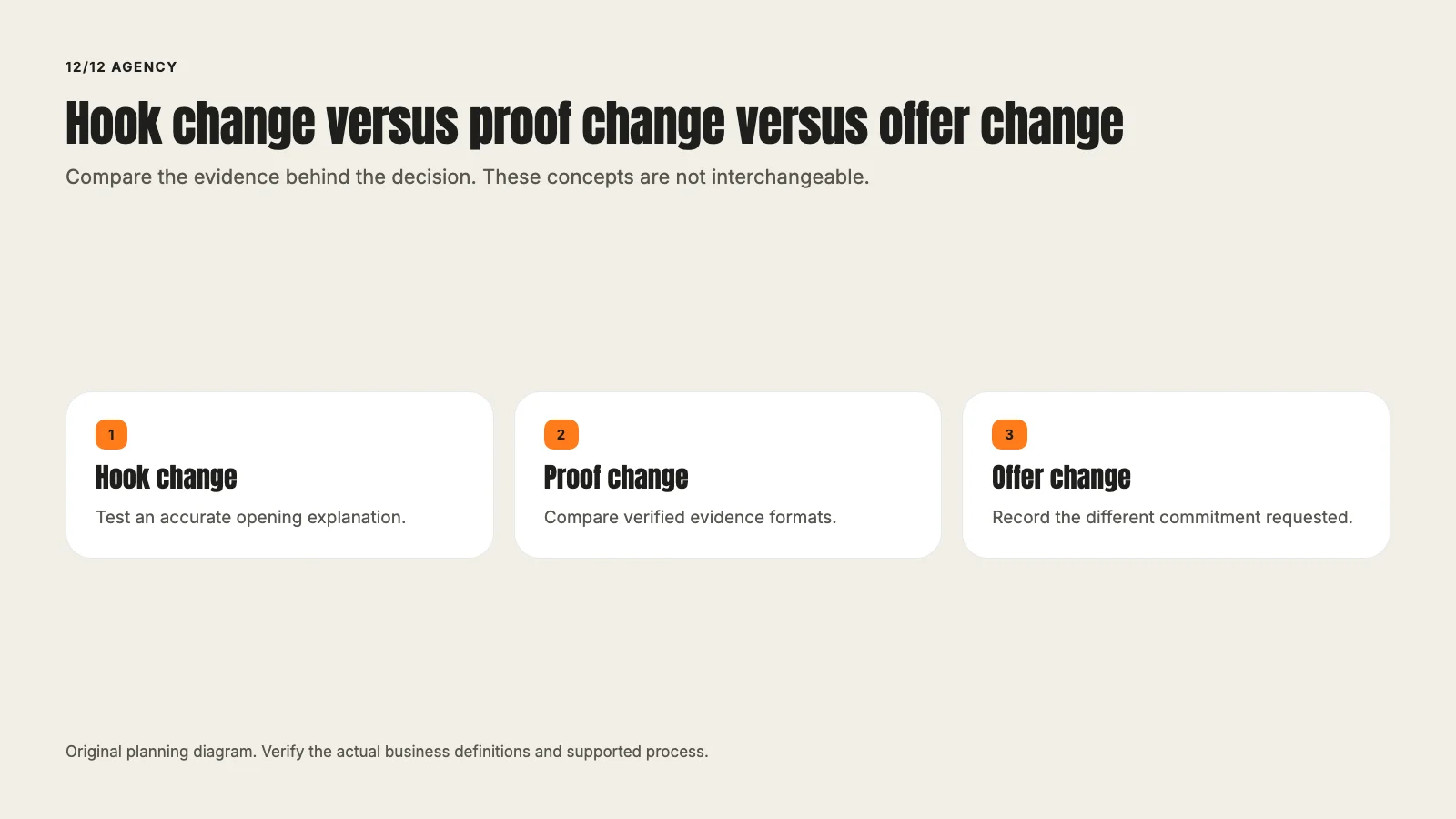
A message test might compare two accurate openings. A proof test might compare a process demonstration with a verified example. A format test might compare a static explanation with a short video while preserving the same offer.
Name the intended variable and what stays stable. If production constraints require more than one change, record that honestly. The result can still be useful as a combined creative comparison, but it cannot isolate a single cause.
Avoid creating near-identical versions solely to reach a quantity target. Each version should represent a meaningful hypothesis about what the buyer needs to understand.
Write a concrete fictional brief
For the scheduling product, the buyer question is whether several bookable spaces can have separate availability. The approved proof is a verified workflow demonstration. The intended action is an accepted demo request from a suitable operator.
Control opening: manage the schedule for each bookable room. Variant opening: see which room is available before accepting a booking. Both require product verification before use. Neither promises a capability merely because it would make a strong hook.
The planned variable is the opening explanation. The offer, supported workflow, destination and outcome definition remain stable where the actual test setup allows. The hold condition is any evidence that the product demonstration implies unsupported behavior.
This is sample planning copy, not an ad approved for launch. The business must review the final creative and exact destination before media is spent.
Design the visual around the explanation
Use framing, labels and sequence that make the verified idea understandable. A process diagram may clarify a relationship better than decorative footage. A real interface recording can provide evidence only when it is current and safe to show.
Check text on the actual mobile crop. The first frame, subtitles, end card and button context all affect what the viewer sees. Avoid tiny disclaimers that carry the real limitation while the large headline implies something broader.
Review every state the asset touches. An export that looks right in an editing canvas may have cropped text or unreadable contrast in the placement. A complete production check includes the final media file, not only its source.
Keep the destination in the test
The ad promises a next step. Open the actual landing page or form and verify that the promise continues. A creative that generates clicks to an unrelated or broken page cannot be judged only by its engagement rate.
The existing contractor Meta guide supplies contractor-specific context, while the conversion-tracking guide explains the accepted-action handoff. Use the actual platform and site definitions rather than treating every form-open or button click as a qualified lead.
If a live test creates a notification or booking, agree on it first and label the record. Preserve QA separately from business counts. Do not create repeated outcomes simply to obtain a dashboard signal.
Plan the interpretation before launch
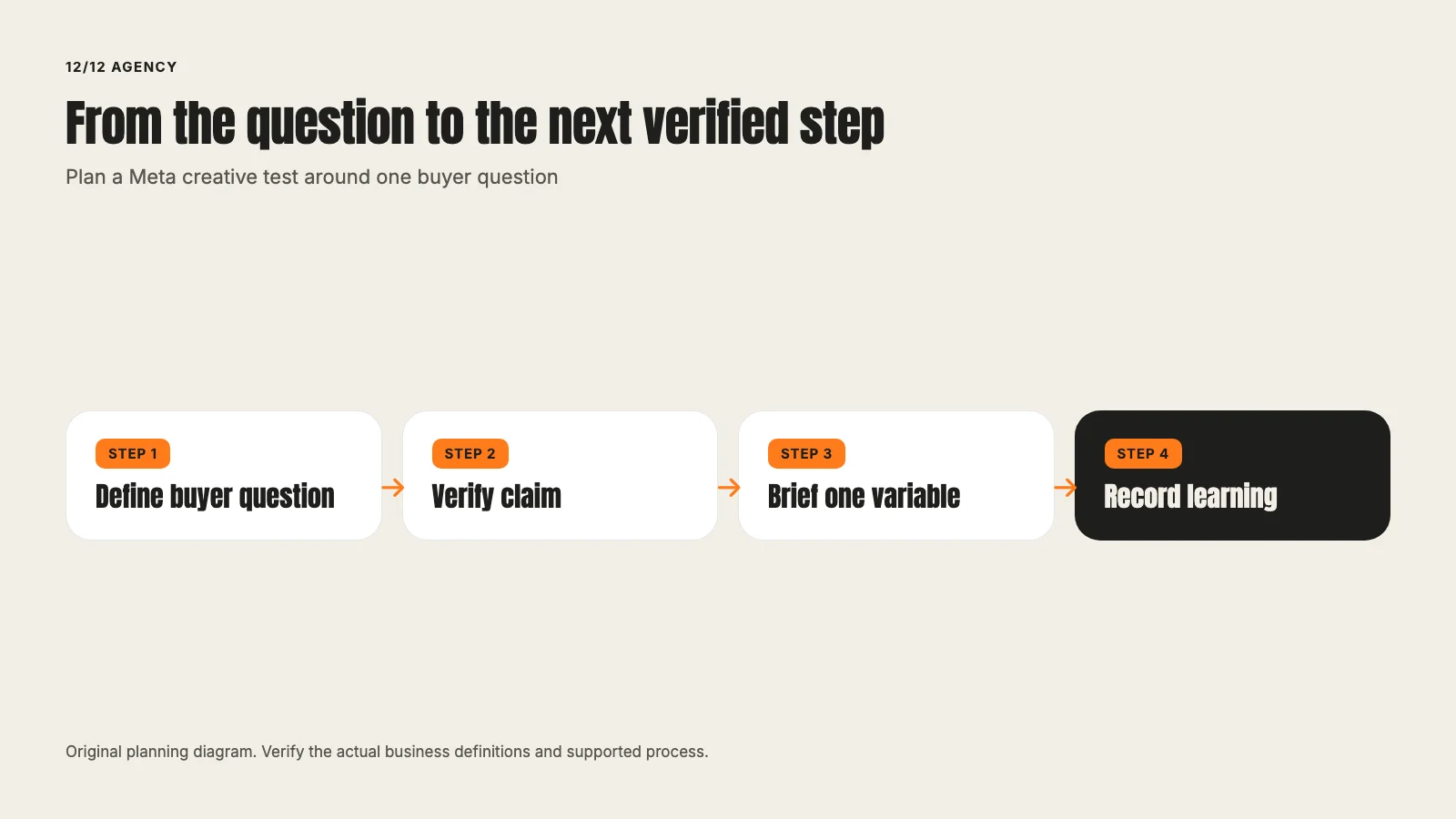
Name the primary business action and the supporting diagnostics. Impressions, video views, clicks, accepted requests and later qualification answer different questions. A high click rate can accompany a misunderstood offer.
Record the population, observation window, spend boundary and known delivery differences. Ordinary platform allocation may favor one creative and is not automatically a fair randomized comparison. A formal experiment requires the appropriate design and review.
Sparse results should remain descriptive. Do not declare a winner because one version has a single additional request. Do not keep checking an inferential test and stop only when the result becomes attractive unless a valid sequential design was planned.
Use a learning log rather than a trophy board
For each review, record the original hypothesis, what ran, what was observed, what changed elsewhere and the next decision. Include negative or inconclusive evidence. A test that prevents an unsupported claim or reveals a destination problem can still be valuable.
Keep the outcome labels accurate. A platform-attributed request is not proof of an attended meeting or incremental sale. If later business records are available, follow a defined cohort with the sales team.
The paid media overview and Google Ads comparison context can help place the result within the larger acquisition plan. They should not turn one creative observation into a universal verdict about a channel.
A practical review card
Include the buyer question, claim source, reviewer, control, variant, planned variable, destination, primary action, guardrails, hold condition and review date. Attach the actual final files and the limitations on interpretation.
The next decision may be to revise the explanation, keep a useful asset, repair the page or prepare a more controlled test. Budget, targeting, status and launch changes remain approvals.
Bring the buyer question and verified proof to a creative review.
Check the final export against the claim source
Review the actual first frame, crop, subtitles, final screen and destination together. A source file can be accurate while an export hides a qualification or crops away the evidence. The publishing reviewer needs the media that will actually run.
If a generated image is used as editorial illustration, keep that provenance and avoid presenting it as a client or product record. The image should support the explanation without inventing a testimonial, real event or feature state.
Record which version was approved and which later changes require another review. A new hook, number or implied capability is more than a formatting correction. Keeping that distinction visible makes the learning log and approval history useful when the asset is reused.
Frequently asked questions
Want this run for your business?
Tell us where to send it and we'll follow up with the strategies that fit your market.