
Retargeting should offer a useful next step
David A · Founder, 1212 Agency
Published November 16, 2026

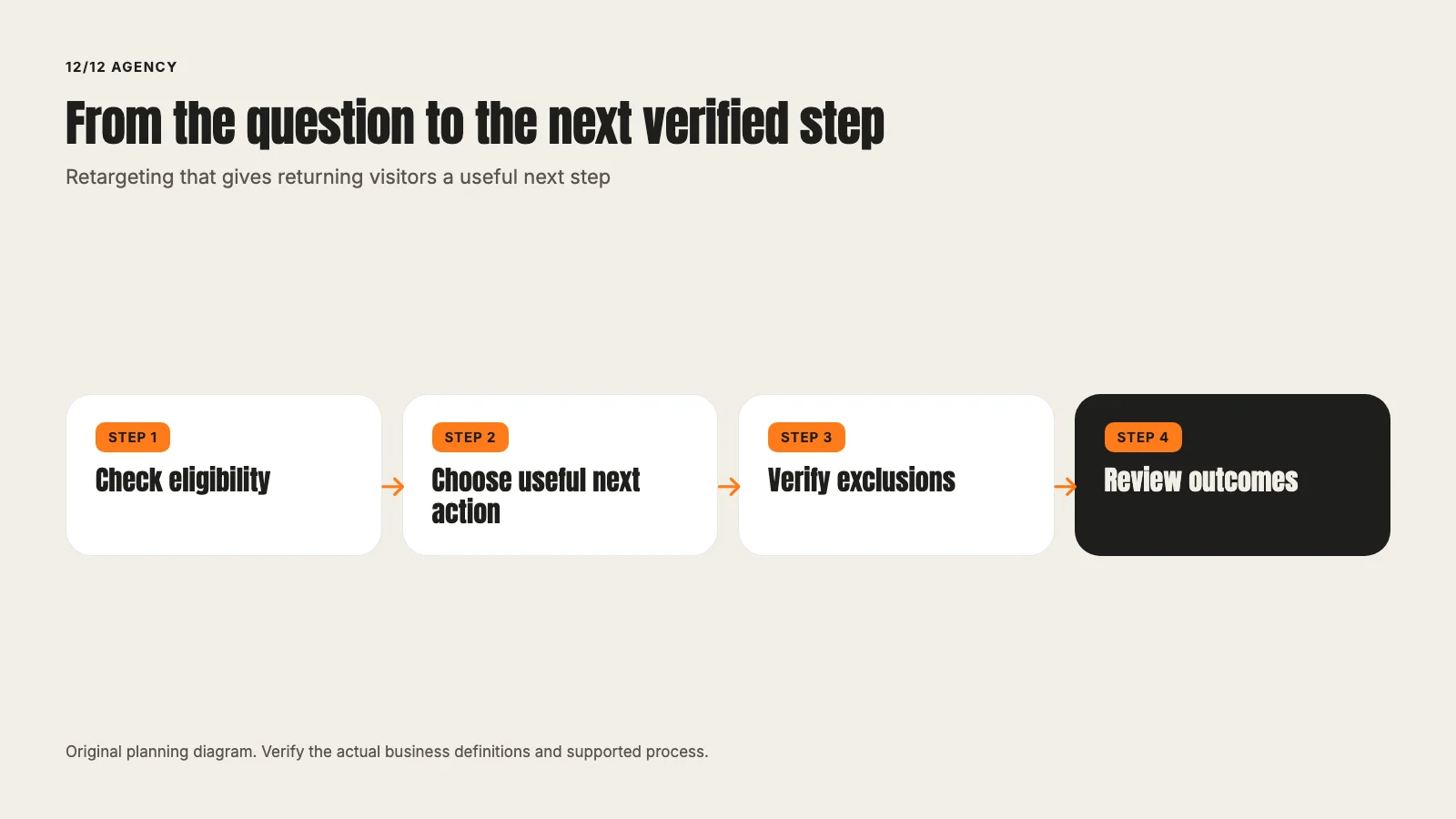
Plan retargeting from eligible audiences and a useful next action. Review exclusions, privacy, destination fit and verified outcomes before expanding spend.
A returning visitor does not necessarily need to see the same advertisement again. They may have completed the action, become a customer, found the product unsuitable or simply need a different explanation.
Retargeting planning should begin with a useful next step and an eligible audience. It should not assume that repeated exposure causes a sale. This guide addresses the business and evidence decisions around Meta retargeting without inventing current audience thresholds, fixed windows or universal performance claims.
Define the next action before the audience
Ask what a suitable returning person still needs to understand or complete. A software evaluator may need a supported workflow explanation. A project buyer may need an accurate estimate process. Someone who already booked should not be treated as if the first request is still unfinished.
The Meta service page supplies the commercial context. The SaaS overview and home-services overview can help identify the buyer journey. The actual offer determines which next action is useful.
Write that action in plain language. Read a current comparison, review a verified workflow or complete an eligible request are different jobs. We miss you is not a complete value proposition.
Review eligibility and data handling
Identify the source of the audience and the evidence of permitted use. The account, website, region, offer and platform policies all matter. Do not upload customer information or create sensitive-interest assumptions because the interface accepts a list.
Google's personalized-advertising policy illustrates why offers can carry different audience restrictions on a specific platform. It is not a substitute for checking Meta's actual current rules for the intended campaign. Use the appropriate qualified review when sensitive or regulated contexts are involved.
Keep the data map concrete: source, collection purpose, permitted destination, suppression and responsible reviewer. A general statement that the campaign is privacy-friendly does not explain what information is used.
Separate intent evidence from certainty
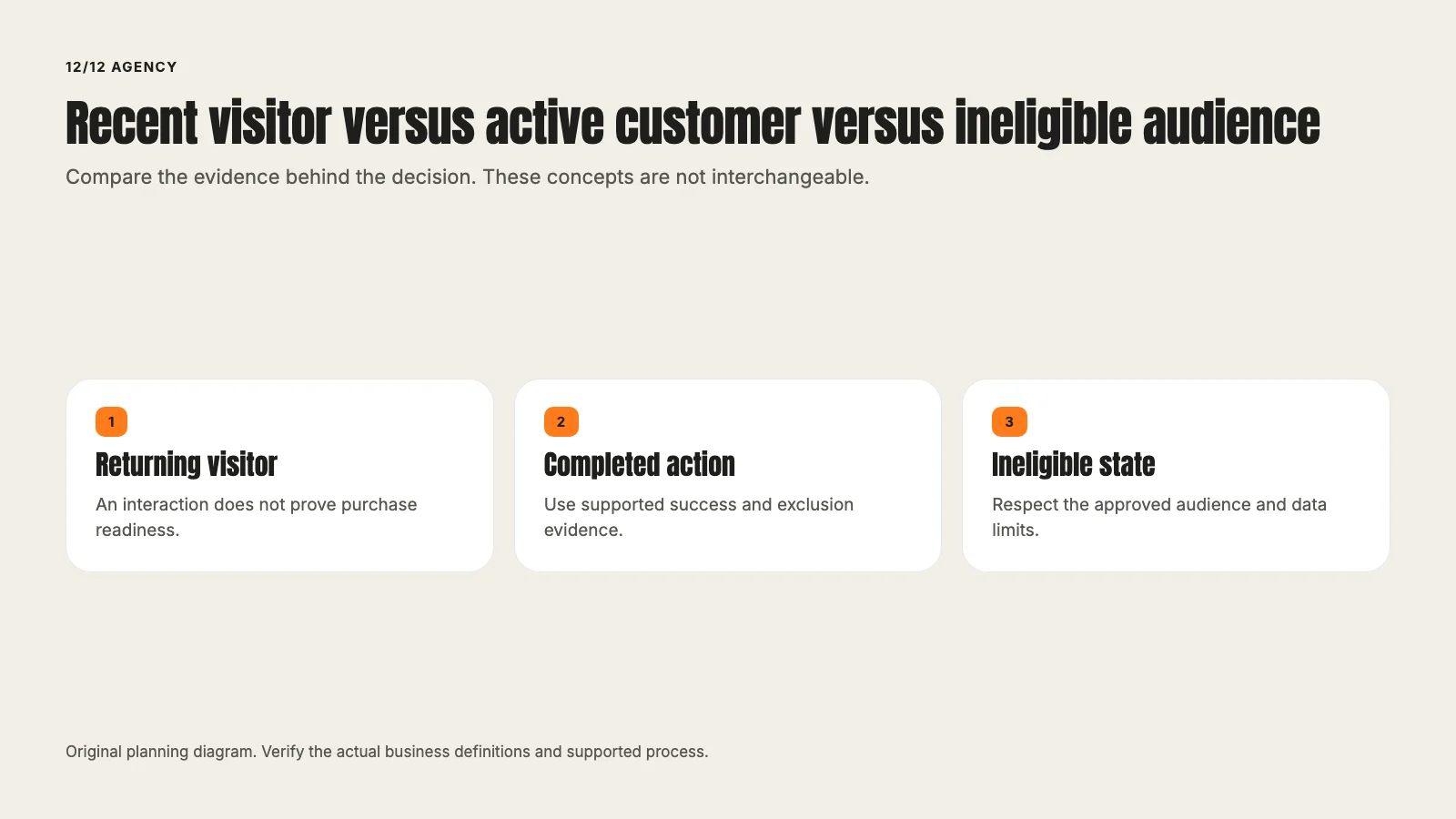
A page visit can indicate interest, but it does not prove purchase readiness. A video view, resource download and accepted inquiry have different meanings. Their definitions depend on the actual systems and setup.
Avoid building a precise-sounding buyer story from sparse behavior. A person may have opened the page accidentally, researched for someone else or already completed the task through another route. The plan should acknowledge those possibilities.
Use a small set of meaningful journey states where evidence supports them. The goal is relevance, not an elaborate segmentation chart that the business cannot maintain or verify.
Make exclusions part of the plan
Define who should not receive the particular unfinished-action message. Recent completers, existing customers, unsupported audiences, opt-outs and closed accounts may require different handling depending on the actual approved setup.
Exclusions are not perfect knowledge of every person's status. Review source timing and update delays. If the system does not receive a completion event reliably, the campaign may continue showing an outdated message.
The conversion-tracking guide explains why event evidence matters. A hidden field, tag label or CRM status should not be assumed correct without checking the actual contract and receipt.
Match creative to the reason for returning
A useful asset adds information. It might explain a process, answer a comparison question or show a verified demonstration. Repeating a broad benefit may be less useful than clarifying the specific uncertainty.
The FTC's advertising guidance provides a primary reference for truthful evidence-based claims. A testimonial or result also needs its own verified basis. Do not invent social proof or imply that an illustrative scene is a client case.
For a fictional scheduling product, one message could explain how a supported room-availability workflow operates. It should not claim that every visitor can implement the same setup instantly or that the product supports unverified integrations.
Keep the destination and account state aligned
Open the actual route from the creative. Does it reach the intended explanation? Does it preserve necessary destination settings? Can a signed-out person understand how to continue through a supported path?
An existing customer may need a product destination rather than a sales form. A person who already requested a demo may need confirmation or preparation, not another request. The system must support the actual role and state before the message is promised.
Our contractor Meta guide retains one sector-specific acquisition context. The Google-versus-Meta guide can support the broader channel discussion. Neither replaces verification of this exact returning-visitor path.
Review frequency as a diagnostic
Repeated exposure can reveal a planning question, but there is no useful universal frequency number that proves success or failure for every offer. Review the actual audience, time window, creative and outcomes.
Do not interpret a high frequency in isolation as permission to increase reach, change targeting or pause the campaign. Those are account changes requiring approval. The report should propose a specific action with its evidence.
Also inspect creative repetition and audience updates. A narrow eligible group with stale exclusions may need a different repair from a healthy audience that simply has a longer evaluation cycle.
Separate attribution from incremental effect
A platform can credit an outcome under its rules even when the person might have converted without another ad. Attribution answers which interaction the system credits; incremental effect asks what changed because the advertising occurred.
A credible incremental claim needs a suitable design and evidence. A lower attributed acquisition cost alone does not establish causality. Ordinary before-and-after comparisons can be affected by season, other channels, offer changes and the existing demand of the audience.
Report the narrower observed measure honestly. The paid media overview can connect it to the broader acquisition plan without presenting every attributed return as new business created by retargeting.
Build a concrete review packet
Record the eligible state, data source, useful next action, exact creative claim, destination, exclusion contract, update timing, primary outcome and interpretation limits. Identify which part is independently verified and which is a user-entered assumption.
A fictional packet might target an approved returning-visitor group with a workflow explanation, exclude confirmed request completers where the actual source supports it, and review accepted inquiries over a defined window. It would not promise that every eligible person sees or avoids an ad.
The next job may be an exclusion repair, clearer message, destination correction or a bounded test. No purchase, audience upload or campaign setting change follows automatically from this article.
Use an exclusion evidence card
For each unfinished-action message, record the success event, source system, update timing and supported exclusion. Ask what happens when completion occurs shortly before delivery. The actual platform and integration may not update instantly, so the message should not imply perfect knowledge of the person's state.
Review the consequence of a stale audience. A recently booked prospect may receive another request invitation, or a customer may see a generic acquisition message. Those observations can identify an update or relevance problem without proving that every repeated impression is harmful.
The next correction should name the actual source or rule at issue. Do not upload a new list, change consent behavior or broaden targeting merely to reduce the visible symptom. A useful retargeting plan needs a maintained evidence contract as well as persuasive creative.
Bring the useful next step and the audience evidence to a planning review.
Frequently asked questions
Want this run for your business?
Tell us where to send it and we'll follow up with the strategies that fit your market.