
Email metrics: follow the reader to the next action
David A · Founder, 1212 Agency
Published November 16, 2026

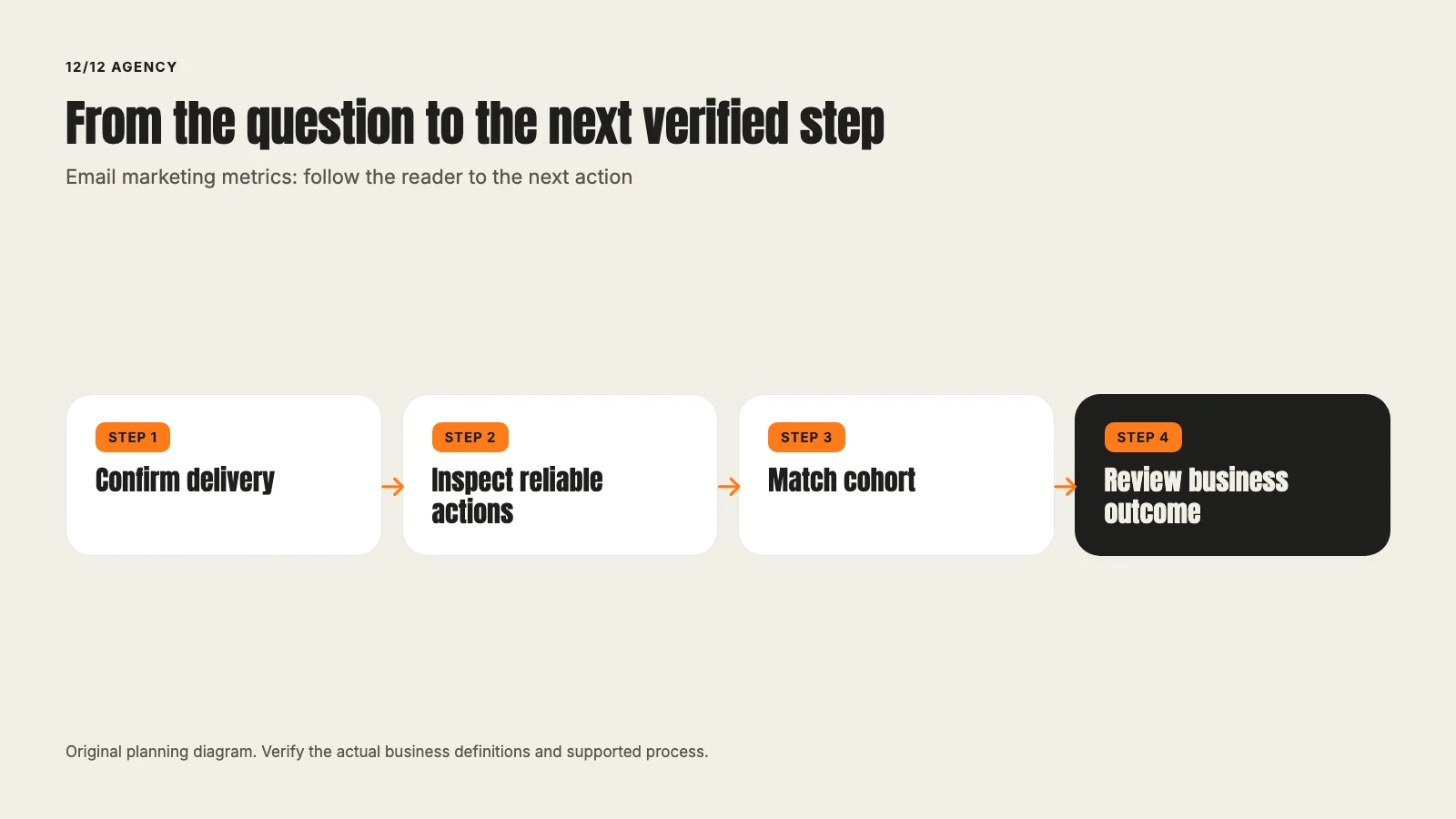
Read email reporting through delivery, measured interactions and accepted business actions. Check provider definitions and cohort timing before comparing rates.
An email report can show more opens without proving that more people read the message or completed the intended action. Metrics describe what the system recorded. The useful review asks how that evidence relates to the message's actual job.
Start with the audience, offer and next action, then define the denominator behind every rate. Keep delivery, measured interaction, accepted request and later outcome separate. This guide explains a reporting method without inventing industry benchmarks or a campaign result.
Define what the message was meant to do
A requested resource, product instruction, event reminder and promotional offer have different purposes. The report should identify the accepted next action before selecting a headline metric.
A SaaS message may help someone evaluate a workflow. An industrial resource may prepare a technical inquiry. An event message may support registration or logistics. Their useful outcomes should not be collapsed into one generic email conversion.
Write the success condition in plain language. Resource delivered, request accepted and appointment confirmed require different evidence. A click can help diagnose the path, but it does not establish every later step.
Begin with the send and delivery definitions
Identify eligible recipients, attempted sends, accepted deliveries, bounces and suppressions according to the provider's current definitions. A delivered label may represent acceptance by a receiving system rather than a guarantee that the message appeared in the primary inbox.
Google's sender guidelines are a primary reference for Gmail requirements. The actual sending setup and audience practices need technical review. A dashboard's delivery rate is not a certification of authentication, permission or inbox placement.
Keep the source and extraction time with the report. Provider definitions, filtering and delayed updates can change what a number includes. Do not silently compare an old unfiltered export with a newer filtered report.
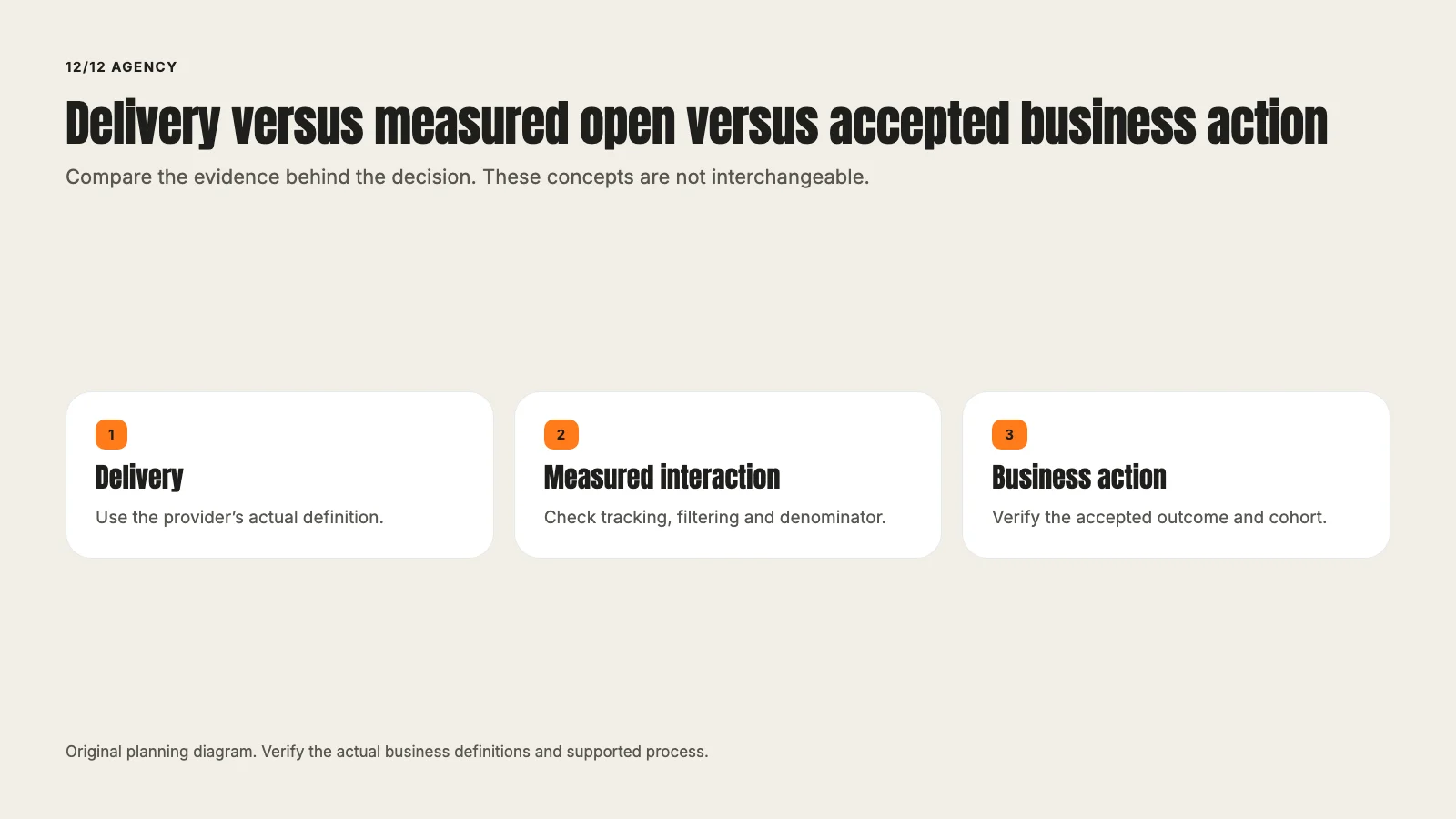
Treat opens as a limited signal
Open tracking often depends on a technical image request or another provider-defined mechanism. That request is not the same as a verified human reading the text. Image settings, proxying and automated activity can affect interpretation.
Google's Gmail image guidance describes image handling that illustrates why the client experience matters. Check the sending provider's actual tracking and filtering documentation before making a more specific claim about a reported open.
Do not segment important follow-up solely from an assumption that every open identifies intent. A person may read without loading the tracked element, or a technical retrieval may occur without the intended human action. The metric can be useful when its limit remains visible.
Read clicks with the destination
A click rate also needs a defined denominator and filtering policy. Unique recipients, total click events and clicks divided by delivered messages are different calculations. State which one the report uses.
Inspect the destination. A higher click rate can lead to an unavailable guide, unclear form or broken confirmation. The message has not fulfilled its job simply because the link received traffic.
The conversion-tracking guide explains the accepted-action evidence. Preserve the link between the email's intended action and the actual site or business record where the approved implementation supports it.
Use a fictional rate example carefully
Suppose a fictional campaign has 1,000 eligible attempted recipients, 950 provider-reported deliveries and 38 unique measured clickers after the provider's stated filtering. Clickers divided by delivered messages gives 4%.
If ten accepted requests are verified in the relevant cohort, request rate against delivered messages is about 1.05%. Request rate against measured clickers is about 26.32%, but that second ratio assumes the matching and denominator are appropriate for the question.
These numbers are illustrative arithmetic. They are not email benchmarks or evidence that the message caused ten incremental requests. People can complete the action through another route, and automated interactions or missing identifiers may limit matching.
Follow later outcomes through a complete window
A request may become a booking or qualified opportunity later. Define the stage, timestamp and outcome window. Recent recipients should not be judged against an older cohort that had more time to progress.
The B2B lead-generation guide helps preserve the distinction between stages. A person who clicks, requests and books is not three customers. A CRM opportunity amount is not collected revenue.
Keep missing evidence and still-open outcomes visible. Do not turn an absent CRM update into a no-response or unqualified conclusion. The reporting gap itself may be the next operating task.
Review relevance and negative signals together
Unsubscribes, complaints, delivery problems and irrelevant replies can reveal a mismatch. Review them in the context of audience source, expectations, message purpose and frequency. Do not hide an adverse signal because one engagement rate improved.
The exact permission and message classification require the responsible review. This reporting framework does not authorize reactivation of opted-out contacts or a new send to an unrelated list.
Qualitative replies can be useful evidence when handled appropriately. Aggregate the themes and protect private details. A customer's personal situation should not become an unapproved public marketing example.
Separate reporting from causal claims
An attributed outcome can describe a system's rule without proving what would have happened without the email. A comparison between recipients and nonrecipients may also be biased if the groups differ in intent or eligibility.
A credible experiment needs a suitable design and method. A before-and-after change in the open rate is not enough to establish incremental revenue. Keep descriptive results and inferential conclusions separate.
The paid media overview can help coordinate the larger acquisition context. Email may support a journey that also includes search, sales and product interactions. Do not add each channel's attributed value into a duplicated revenue total.
Make the report actionable
Record the message job, audience, send definition, delivery evidence, interaction definitions, accepted action, later cohort and limitations. Then identify the next decision.
The useful next step may be a sender review, a clearer promise, a destination repair, a suppression correction or a better outcome contract. It does not have to be a new campaign. Sending, account changes and customer communications still need approval.
A concise report can include counts and rates together, one paragraph explaining material changes and a specific proposed action. More charts do not compensate for an undefined denominator.
Write the denominator beside the recommendation
If the report recommends a change because a click rate moved, show whether the rate uses delivered messages, unique recipients or total events. Preserve the provider's filtering definition and the observation window.
A fictional comparison can otherwise reverse meaning. More total clicks may come from repeated events by a smaller group. A lower open rate may coincide with better accepted actions if tracking or audience composition changed. The useful question is which evidence supports the message's intended job.
Keep the original extraction time and any later revisions. Email and business systems can update at different speeds. A refreshed total should not silently replace the earlier evidence without explaining what changed.
The recommendation should identify the observed issue and the next verification. A subject-line hypothesis, sender investigation and broken destination need different work. None follows automatically from the most visually dramatic percentage in the report. This discipline makes the analysis useful even when privacy, filtering and missing identifiers limit how precisely the journey can be reconstructed.
Bring the message purpose and provider definitions to a reporting review.
Frequently asked questions
Want this run for your business?
Tell us where to send it and we'll follow up with the strategies that fit your market.