
Dealership marketing keeps the vehicle and inquiry connected
David A · Founder, 1212 Agency
Published November 16, 2026

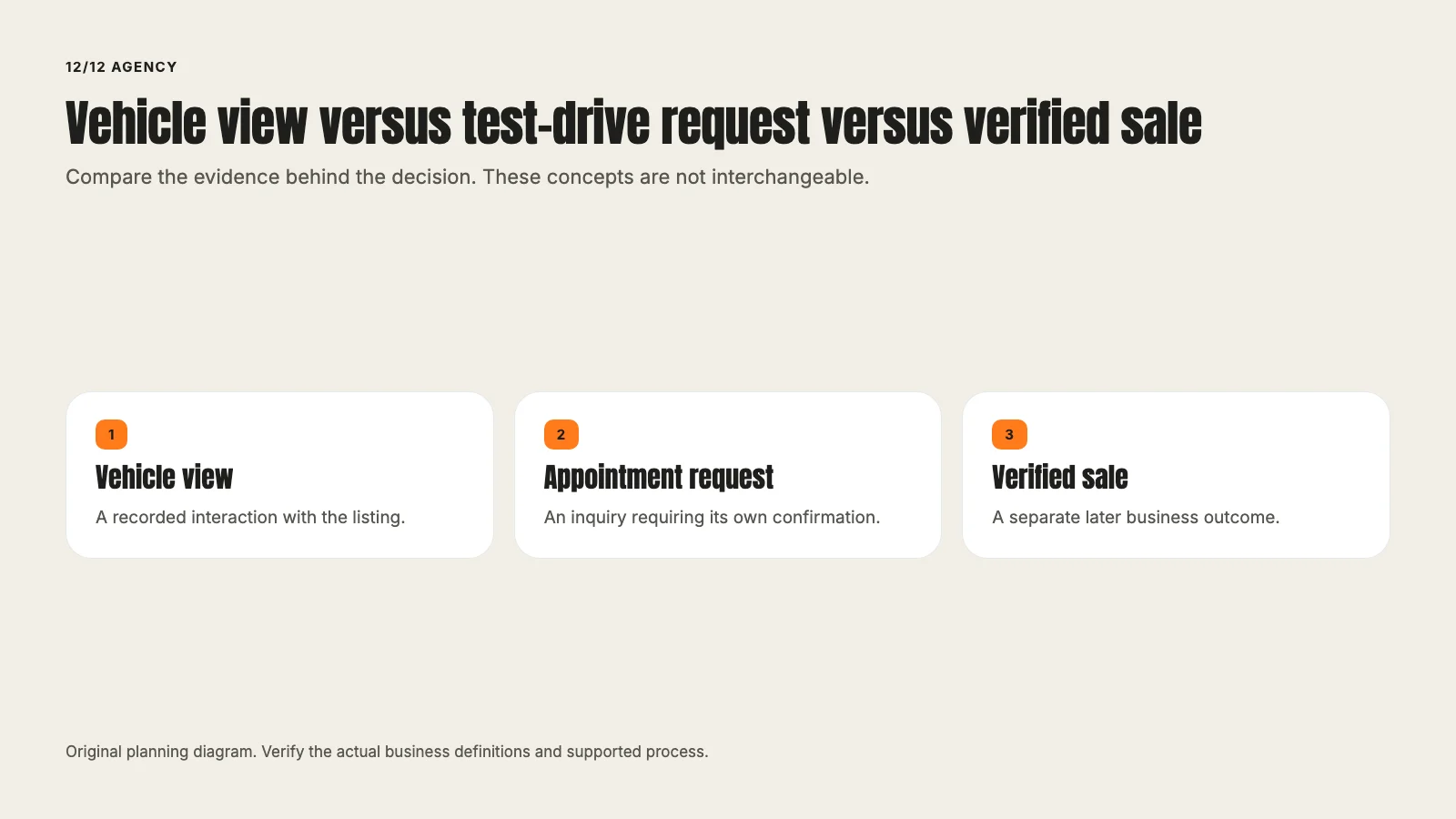
Plan dealership acquisition around verified vehicle information and a clear sales handoff. Separate listing views, test-drive requests, appointments and sales.
A person can click a vehicle ad and arrive at a page that no longer matches the vehicle, availability or next step. More traffic will not repair that expectation gap. Dealership marketing should keep the vehicle context connected to the inquiry and the sales team.
The first task is to identify what the business can verify and fulfill. This guide outlines that process with fictional examples. It does not assume a live inventory feed, a specific CRM integration or a guaranteed cost per sale.
Define the actual acquisition job
A campaign may support a vehicle inquiry, a test-drive request, a general dealership conversation or another approved service. Those are different actions. A vehicle-detail view is not a sales lead by itself.
The dealership service page can retain the commercial explanation. The local-business overview can connect the broader engagement. Avoid creating a second generic dealership-agency page for a close keyword variant.
Ask sales which information makes the first conversation useful and what happens after each request. The page and button should describe that process accurately rather than promise a confirmed appointment when the team still needs to review availability.
Verify the vehicle information source
Identify who controls the current vehicle facts and how changes reach the marketing destination. A general feed feature on a vendor website does not establish that the dealership has implemented it correctly.
Review the actual source for availability, specifications, images and any approved price or terms. Record update timing and what happens when a vehicle becomes unavailable. Do not keep an outdated promise active because the campaign link still works.
Any pricing, financing, warranty, condition or eligibility statement needs the responsible qualified review. A marketing page should not infer financing approval or a consumer's suitability from an inquiry form.
Keep images and claims accurate
Use approved images that represent the vehicle or clearly labeled illustrative context. A representative image should not imply the exact available trim, condition or features unless that is verified.
Check visible plates, people and private details before publication. Do not use a customer's purchase or trade-in story as public proof without permission. A photograph does not establish a typical sale price or finance outcome.
The creative brief should identify the claim, source and reviewer. This is more useful than an instruction to make the ad more exciting while leaving factual boundaries undefined.
Choose a destination that answers the click
If the ad concerns a specific vehicle, the destination should preserve that context or accurately explain the supported alternative. If the vehicle is unavailable, the site should not silently present another listing as if it were the original offer.
A general model or inventory inquiry may use a different page, but the promise should remain clear. The Google Ads service page and Meta service page can support distinct acquisition discussions without assuming the same buyer context.
For local identity and visits, Google's representation rules provide a baseline for accurate business information. Use the real dealership location, public contact path and operating details.
Ask for the context the sales team needs
A useful initial request can preserve the vehicle reference and the person's intended next action. The exact contact fields and permission wording belong to the business's reviewed process.
Avoid collecting unnecessary sensitive financial details in a marketing form. A finance application is a different process with its own systems and review. Do not turn a test-drive inquiry into an unreviewed credit-screening tool.
Inspect the mobile experience, errors and confirmation. A hidden vehicle identifier that drops during navigation can make the sales team ask the same questions again. That is a concrete handoff issue to investigate.
Review policy before targeting and follow-up
The exact campaign may involve product, financial or sensitive-data considerations that need current qualified review. Google's personalized-advertising restrictions are one relevant platform reference, depending on the actual offer.
Do not assume a plan from another retail category is suitable. The responsible team should review the concrete ad, destination, audience, form and data flow. A visible targeting feature is not a blanket permission to use it.
Follow-up should match the actual request and approved contact process. Publishing a vehicle guide or collecting a download does not automatically authorize every later sales message.
Follow the inquiry through verified stages
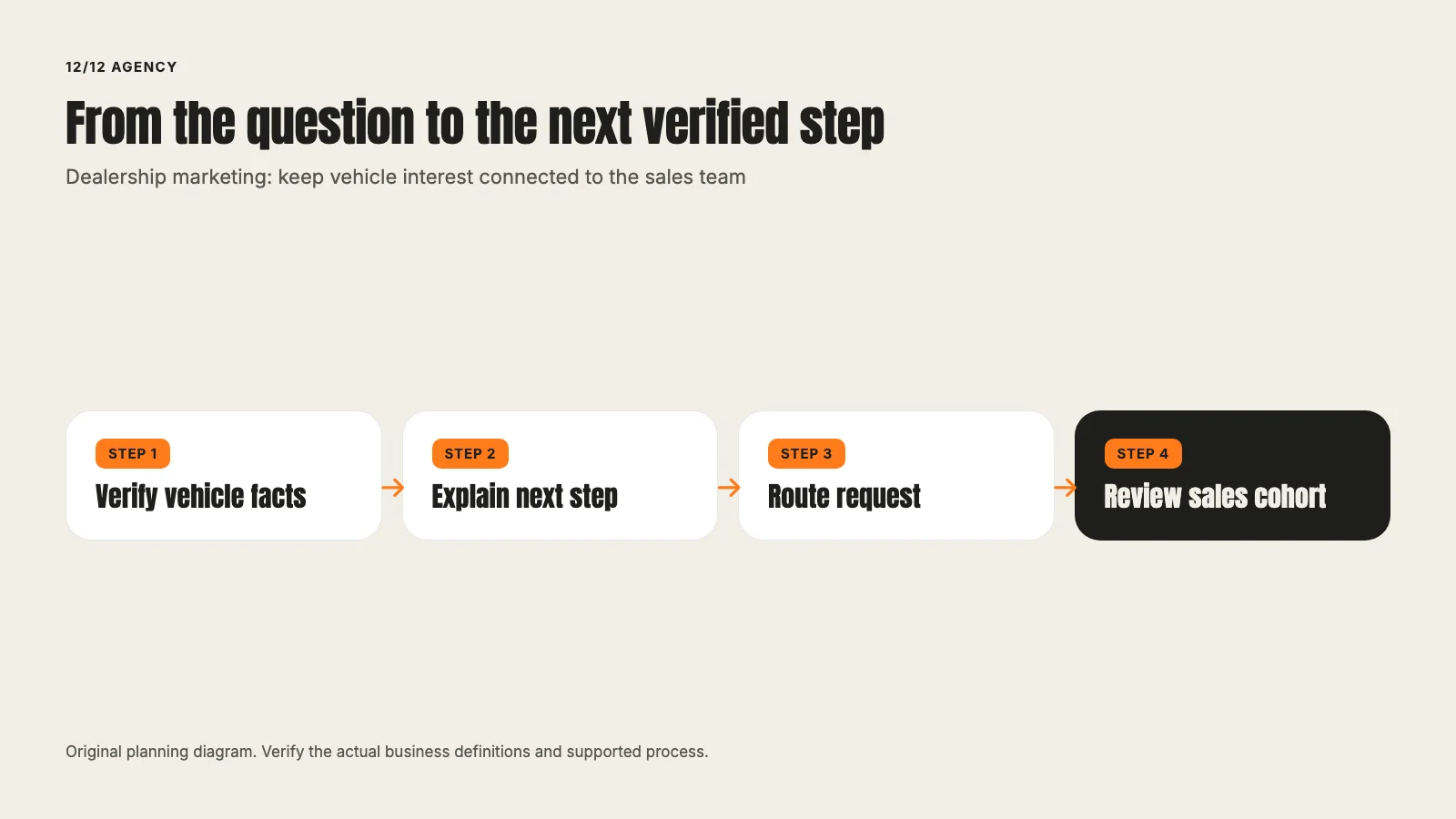
Define accepted request, contacted prospect, appointment booked, appointment held and verified sale. A test-drive request may not be a booked appointment. A booking may not have happened. A quoted amount is not collected revenue.
The conversion-tracking guide explains the general event and business-record distinctions. Actual CRM or offline import support must be checked for the dealership's systems. Do not promise a connection because two products advertise compatibility.
Use stage timestamps and a clear vehicle or opportunity identity where supported. Preserve unknown and still-open records. A report should not turn missing attendance data into a no-show conclusion.
Compare a complete cohort and cost boundary
Use one entry period and enough time for the relevant sales process. Review differences in vehicle availability, offer, source and operating conditions before comparing results.
In a fictional example, $4,000 of media plus $1,000 of included management and creative work equals $5,000 of acquisition cost. If the completed cohort contains 25 accepted inquiries and five held appointments, the included costs are $200 per inquiry and $1,000 per held appointment.
Those numbers do not predict sales or margins. They are a calculation example. Any later cost per sale needs verified sale records and the same cost boundary, with duplicate platform attribution addressed.
Verify the path without creating unnecessary activity
If a live test is required, agree on the labeled identity, vehicle reference and consequences. A test may notify a salesperson or reserve an appointment. Do not create extra bookings or alter customer records without approval.
Check the accepted request, permitted technical receipt and receiving record separately. Keep QA out of business totals. Preserve the record rather than deleting it quietly to make the pipeline appear clean.
A useful next change may be an availability correction, vehicle-context repair, clearer form or bounded message test. Record the observation and acceptance check. Budget, targeting and status changes remain approvals.
Use an availability exception in the test plan
Check what the destination does when the original vehicle is no longer available. The supported behavior should preserve an accurate explanation rather than silently replacing the promise. If alternatives are offered, the visitor should understand that they are alternatives.
Record who controls the source, how the marketing team learns about a material change and which final page or asset must be checked. A vendor's general feed capability does not establish that this exact exception is handled.
The receiving salesperson also needs the original inquiry context. If the vehicle reference disappears, the office may have to ask the person to reconstruct the request. That is a specific handoff defect with a verifiable acceptance check.
Keep this review separate from finance or suitability decisions. The first marketing inquiry should not become an unreviewed application process. A useful acquisition path is accurate about the vehicle, clear about the next step and explicit about the evidence it actually records. It does not need to imply that every visitor is already approved or ready to purchase.
Bring the vehicle source and current inquiry path to a review.
Frequently asked questions
Want this run for your business?
Tell us where to send it and we'll follow up with the strategies that fit your market.