
A social content strategy starts with useful questions
David A · Founder, 1212 Agency
Published November 16, 2026

Build a social plan from verified sources, buyer questions and appropriate formats. Connect review, distribution and reporting to the job each post serves.
A calendar can show that content is planned without explaining why anyone should care. A useful social strategy starts with questions the audience needs answered and evidence the business can provide.
The work is to turn that source into an appropriate explanation, get it reviewed and distribute it in the right context. Publishing frequency follows the team's capacity to do those jobs. It is not the strategy by itself.
Define the audience's decision
Ask what the reader needs to understand before taking the next useful step. A software buyer may need to see a workflow. A contractor prospect may need to understand a project boundary. A technical evaluator may need an accurate process explanation.
The SaaS, home-services and industrial contexts should inform that choice. Do not use the same generic motivation post for every audience simply because it is easy to produce.
Write the reader question and intended action together. The next action might be a useful reply, a resource visit or a relevant inquiry. Not every post needs a sales request, and a like is not automatically a business opportunity.
Establish the source before selecting the format
Use approved product knowledge, a documented process, current primary references or a cleared example. Identify who can verify the claim and what information must remain private.
A real project can suggest a lesson without exposing the client's name, account weakness or private records. A fictional example can explain a process when it is clearly labeled. Do not invent a result to give a post a stronger hook.
The FTC's advertising guidance provides a primary baseline for truthful evidence-based commercial claims. Its endorsement guidance matters when testimonials or relationships affect how the audience interprets a recommendation.
Choose the format that carries the answer
A short demonstration can show a supported workflow. A diagram can explain a handoff. A comparison can clarify decision criteria. An on-camera explanation can make a technical idea easier to follow when the speaker can accurately support it.
Do not choose a carousel merely to divide one sentence across many slides. Do not add animated footage that implies a product feature or customer experience that was not verified. The format should reduce the reader's work.
A longer article can hold the complete explanation while a social piece introduces one useful question. The website destination needs to exist and support the promise. A proposed future page should remain a production note until it is implemented.
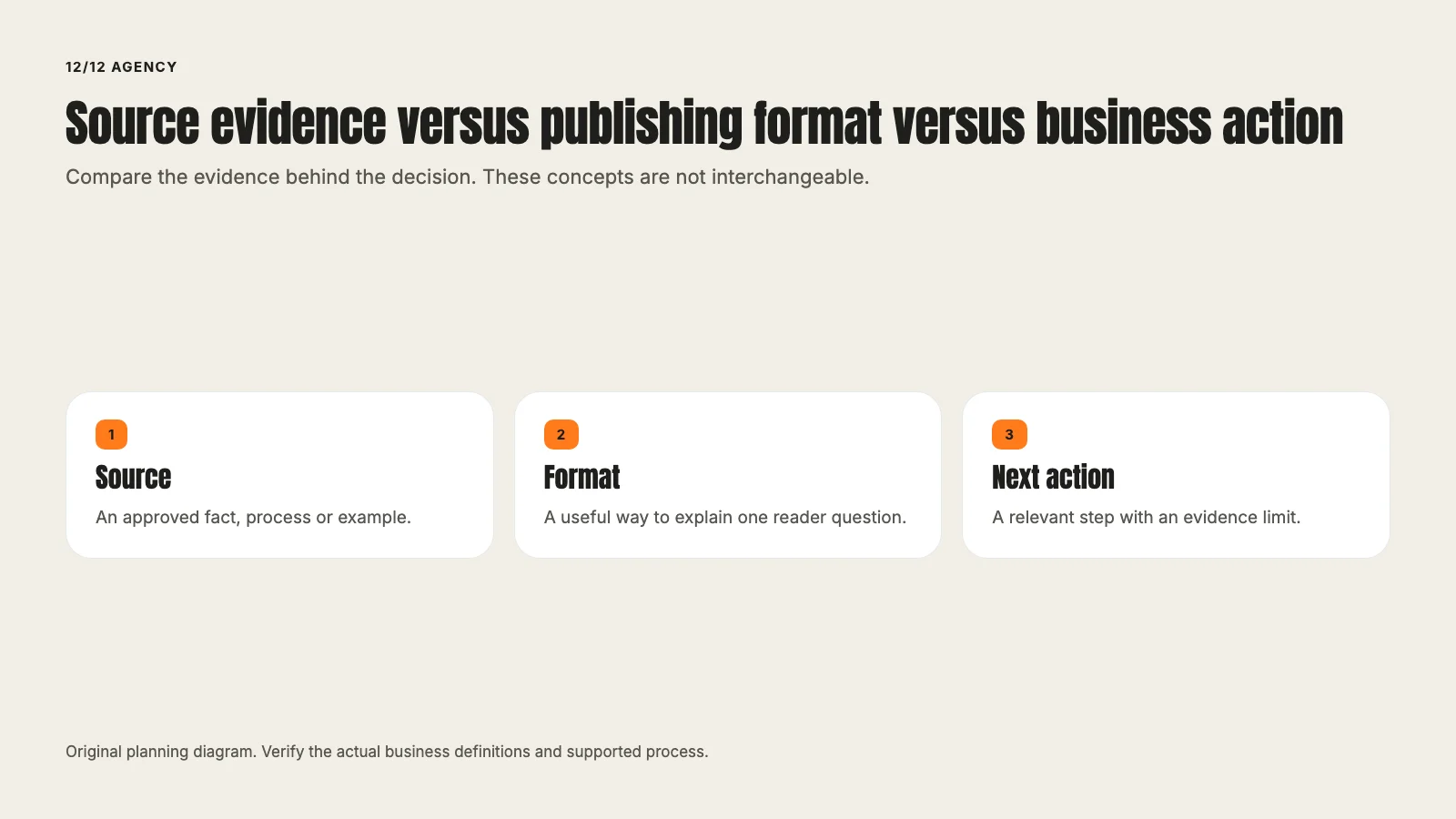
Build a source-to-format map
For each piece, record the audience, question, source, claim, format, reviewer and next action. This makes reuse deliberate rather than repetitive.
A fictional software team could use one verified workflow source in three ways: a short demonstration of the action, a diagram explaining the roles and a longer evaluation guide. Each version serves a distinct task while preserving the same supported facts.
The existing SaaS demand-generation guide retains its distribution context. A content strategy should connect to that work without rewriting the same article under a new keyword.
Keep approvals close to the claim
The product expert checks capability. The business approves commercial terms. The relevant specialist reviews regulated or technical statements. The publishing approver reviews the actual final asset, caption, destination and schedule.
A draft approval is not permission to publish every later variation. A revised number, claim or image can require a new review. The workflow should make changes visible rather than treat all edits as formatting.
Use a complete review packet. Tiny preview images or source files that the reviewer cannot open are not enough. Show readable final images and paste the full copy where the person reviews the work.
Plan a maintainable production cycle
Choose a number of pieces the team can source, create, review and support. A backlog is useful when it records actual dependencies. It becomes misleading when every idea is labeled ready despite missing evidence or assets.
For a fictional week, the plan might contain one process explanation, one supported product demonstration and one buyer-question comparison. The sequence is an illustration, not a universal posting cadence or an authorization to schedule.
Record what happens if a source is not ready. Substitute another verified topic or hold that piece. Do not fill the gap with an invented milestone, unreviewed case or unrelated trend simply to meet a quota.
Separate organic and paid jobs
An organic explanation can help existing or new readers understand the business. Paid distribution adds a defined audience, offer, budget and measurement plan. The same asset may need different context in each role.
The Meta service page and LinkedIn service page can support a scoped paid discussion. Do not describe an organic post's reach as paid attribution or assume a successful organic piece is automatically approved as an ad.
A campaign also needs the actual destination and accepted-action path. The conversion-tracking guide explains why clicks, accepted requests and later outcomes remain separate evidence.
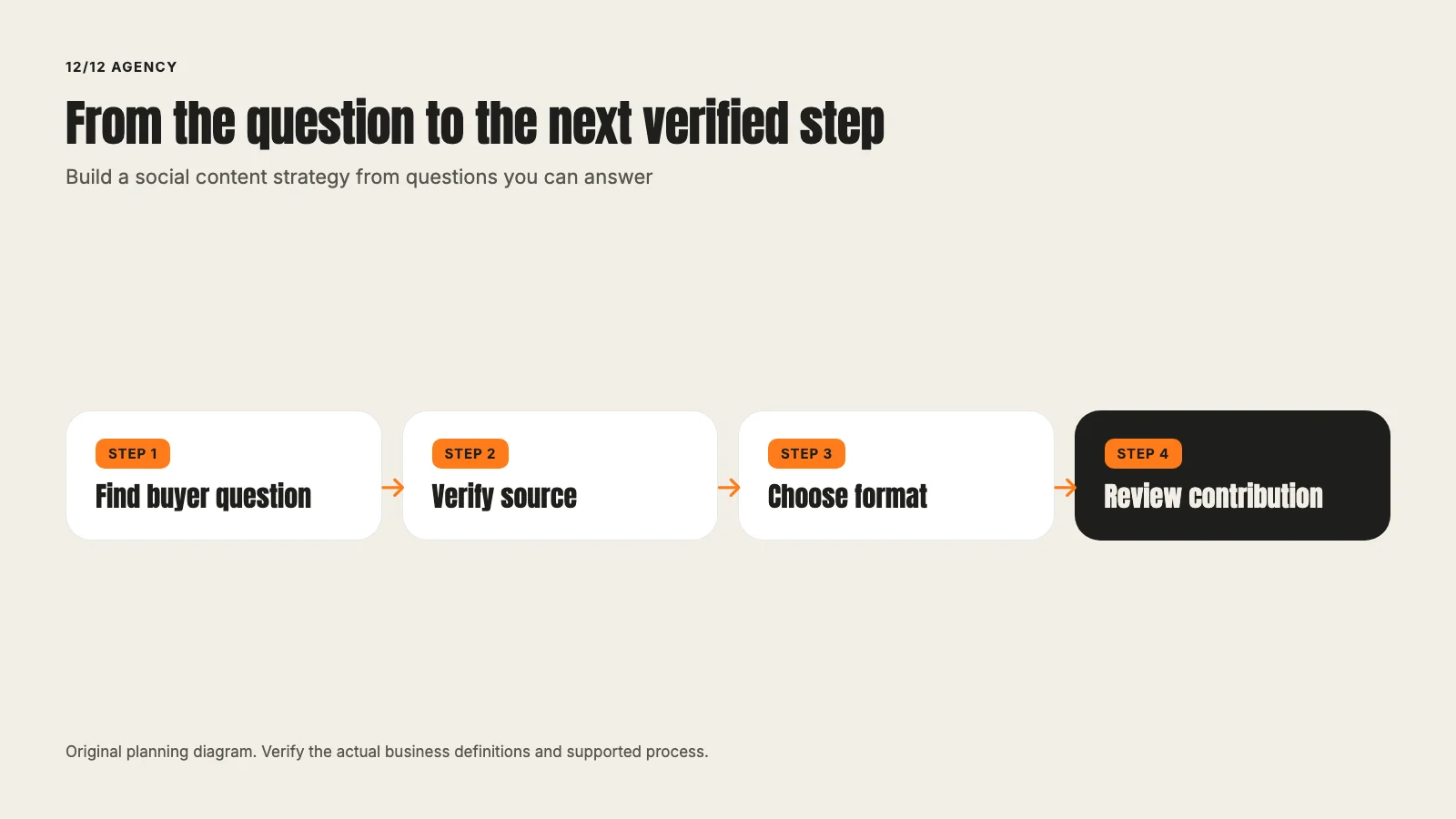
Report on the job each post was given
A demonstration might be reviewed for whether the intended workflow was understood. A resource post might be reviewed for relevant visits and useful questions. A direct-response asset might be followed through accepted inquiries and later fit.
Use the platform's current definitions for reach, impressions, views and engagement. Do not combine them into a universal audience score. A repeated view is not necessarily another person, and a comment is not automatically a sales lead.
Qualitative evidence can be valuable. Which question did readers ask? Did the post reveal an unclear claim? Did sales need a different explanation? Aggregate the lesson without exposing private conversations.
Keep attribution and contribution distinct
A buyer may encounter social content, search, a sales conversation and a product demonstration. One post can contribute without being the recorded source of the final request.
Do not assign every later sale to social because a customer follows the account. A platform-attributed result also has its own rules. A credible causal claim requires a suitable design beyond an attractive engagement graph.
The useful report states what was observed, what it suggests and what remains uncertain. It connects that evidence to the next content or distribution decision.
Refresh the source, not only the design
A product change, revised service boundary or outdated statistic can make an asset inaccurate. Record a maintenance trigger and preserve the original source. If a live correction is needed, obtain the specific approval rather than silently deleting or reposting content.
A new visual style does not make an old claim current. Recheck the actual statement and destination before reuse. Keep historical drafts as records so the team can understand what changed.
Keep the source and final asset together
A production record should identify the exact claim, its supporting source, the final image or video, complete caption and destination. If the design changes the meaning, return to the source review instead of treating it as a harmless visual revision.
The record also helps reuse. A short explanation can be adapted to another format while preserving its limits. A new number, feature statement or customer implication needs verification before it appears in the new version.
This makes the calendar a working system for producing useful content, rather than a list of dates detached from evidence. An item can be ready for review while still awaiting the actual publication approval.
Bring the audience questions and source material to a content planning session.
Frequently asked questions
Want this run for your business?
Tell us where to send it and we'll follow up with the strategies that fit your market.