HVAC Marketing Strategies: The Complete Playbook for Contractors
David A · Founder, 1212 Agency
Published March 4, 2026 · Last updated August 31, 2026
Consistent demand in HVAC comes from a system of channels, not a single campaign. Here is the whole playbook, from emergency search to maintenance plan renewals.
Most HVAC contractors do not have a marketing problem. They have a system problem. One channel works for a season, a competitor outbids them, the phone goes quiet, and the response is to try a different tactic rather than fix what broke.
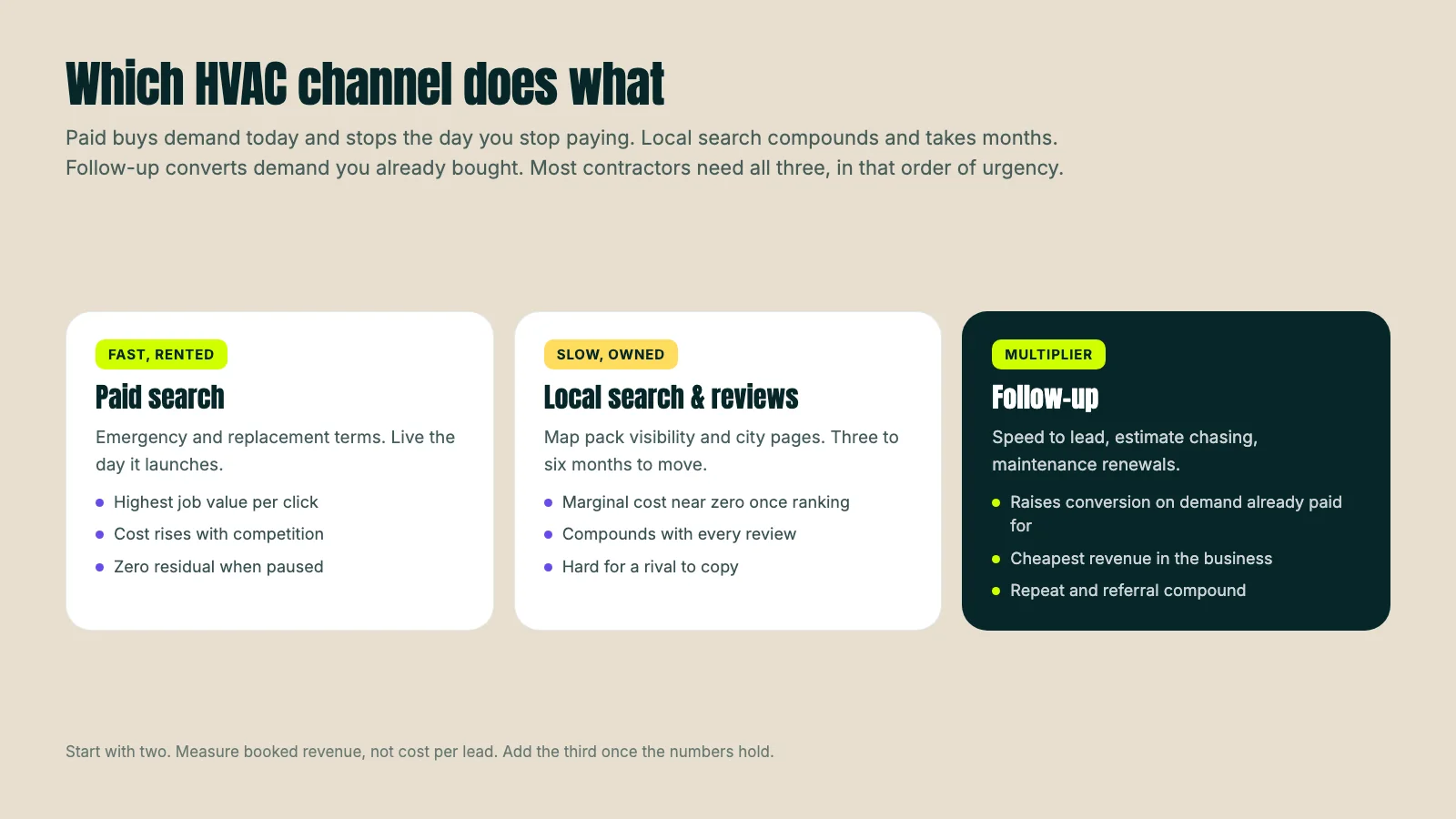
Consistent demand in HVAC comes from a set of channels that reinforce each other. Paid search covers you the day a heat wave hits. Local search and reviews compound underneath it. Follow-up turns the estimates you already paid for into revenue. Miss one and the others get more expensive.
This is a practical guide for contractors who want more calls, booked jobs, and replacement leads. It covers the channels, the tactics that still work, the advertising principles that separate profitable campaigns from expensive ones, and what changes once you run more than one location.
If you want the strategy applied to your accounts rather than read about, that is what our HVAC marketing services do.
HVAC digital marketing, channel by channel
The channels below are the core of HVAC digital marketing. Most contractors do not need all of them at once. Start with two, prove the numbers, then layer in the rest.
Local search and Google Business Profile. Optimize your profile, publish city and service pages, collect reviews consistently, and earn local links so your company shows up when homeowners search "AC repair near me" or "furnace repair [city]". Google's guidelines for representing your business are worth reading before you touch categories or service areas, because getting those wrong is a common cause of a suspended profile. This channel deserves its own treatment, which is why we wrote SEO for HVAC companies separately.
Google Ads and paid search. Run search campaigns on high-intent keywords like emergency AC repair, furnace replacement, and HVAC installation. Use call-only ads during business hours, tight negative keyword lists, and location bid adjustments to protect budget.
Meta Ads for demand generation. Use Facebook and Instagram to promote seasonal tune-up offers, financing on new systems, and maintenance plans. Retarget site visitors who did not call or submit a form on the first visit.
Service-specific landing pages. Send paid traffic to pages built around one service, one location, and one clear offer. Include click-to-call, a short form, real reviews, financing badges, and trust signals above the fold.
Reviews and reputation. Ask every customer for a review by text right after the job. A steady flow of five star reviews on Google lifts local rankings and improves conversion on every other channel you run.
Email and SMS follow-up. Automate estimate follow-ups, seasonal tune-up reminders, maintenance plan renewals, and reactivation for past customers. Repeat and referral revenue is the cheapest revenue in HVAC.
Service area targeting. Structure campaigns, landing pages, and tracking around the zip codes and cities where jobs are actually profitable. Exclude areas where drive time kills margin.
Call tracking and attribution. Use dynamic call tracking numbers on the site and unique numbers on your profile and directories. Push call outcomes and booked jobs back into your ad platforms so bidding optimizes for revenue, not clicks.
Seasonal campaign planning. Ramp cooling campaigns before the first heat wave, heating campaigns before the first cold snap, and use shoulder seasons for maintenance plans and system replacement offers.
HVAC marketing ideas that still work
Tactics that consistently produce booked jobs for heating and cooling contractors across service areas:
- Publish neighborhood level service pages with real photos of installs in that area.
- Record short before and after videos of installs and repairs for Meta, YouTube Shorts, and TikTok.
- Sponsor local sports teams, community events, and chamber events, then amplify with a paid social boost.
- Offer a branded maintenance plan and promote it on every invoice, email, and thank-you page.
- Partner with real estate agents and home inspectors for referral programs and co-branded content.
- Publish an annual HVAC buying guide and gate a PDF version to capture email addresses.
The thread connecting all six is that they produce proof. A homeowner choosing between three contractors is managing risk, not shopping on price. Photographs of work in their neighborhood, a named technician, and a maintenance plan they can read the terms of all reduce that risk in ways a headline cannot.
HVAC marketing and advertising tips
A short list of advertising principles that separate profitable HVAC campaigns from expensive ones:
- Bid highest on emergency and replacement keywords, where job value is largest.
- Separate brand, service, and competitor campaigns so budget and reporting stay clean.
- Add negative keywords weekly for parts, DIY, jobs, salary, and training searches.
- Use call extensions, location extensions, and lead form extensions on every Google Ads campaign.
- Send new leads a text within five minutes. Speed to lead is the single biggest lever in HVAC.
- Report on booked jobs and revenue by channel every month, not just cost per lead.
If you want the paid side handled first, our Google Ads management is usually the fastest path to booked jobs while local search matures. You can also model expected volume with the ad budget calculator before committing spend.
Build an HVAC marketing plan around capacity, not ambition
The most common way an HVAC marketing plan fails is not bad targeting. It is generating more calls than the company can answer.
A campaign that produces forty calls a week into a front office that can handle twenty does not produce twenty booked jobs and twenty missed ones. It produces twenty booked jobs, twenty homeowners who called a competitor, and a cost per lead that looks fine while half the budget is wasted.
Work backwards instead. Start from how many jobs you can install this month, how many estimates convert, and how many calls produce an estimate. That gives you a call target. Fund the channels to hit that number, then expand capacity and budget together.
Two things follow from this. First, speed to lead matters more than almost any targeting decision, because it changes the conversion rate on demand you have already paid for. Second, the metric that matters is booked revenue by channel, not cost per lead. A channel producing $180 leads that close at 40 percent beats one producing $70 leads that close at 8 percent, and a cost per lead report will tell you the opposite.
The Air Conditioning Contractors of America publishes standards and business resources worth reading here, particularly on quality installation. Marketing that promises what operations cannot deliver produces reviews that cost more than the campaign earned.
Build the year around the two peaks
An air conditioning marketing strategy that spends evenly across twelve months is leaving money on both ends of the calendar. Demand in this trade is not seasonal in the gentle sense. It arrives in two spikes, and the companies that win them are the ones already in market when the spike starts, not the ones reacting to it.
Ramp before the weather, not with it. The first genuinely hot week produces a flood of emergency searches, and auction prices climb with them. A contractor who raises budgets that Monday is bidding against every competitor doing the same thing, at the worst possible cost. Two to three weeks earlier, the same clicks are materially cheaper and the calls still convert, because the systems that are about to fail are already struggling.
Use the shoulder seasons for the things that do not sell in a crisis. Nobody buys a maintenance plan during a heat wave; they buy a repair. Spring and autumn are when maintenance agreements, system replacements, indoor air quality upgrades and financing offers actually land, because the homeowner has room to consider rather than react. Those months look quiet on a lead-volume report and are doing the most durable work on the P&L.
Split the calendar into four jobs:
- Pre-cooling ramp. Emergency and repair terms, budgets raised early, call handling staffed up before the first heat wave.
- Cooling peak. Maximum spend on the highest-value terms. Protect margin by excluding drive-time-killing zip codes rather than by lowering bids.
- Shoulder. Maintenance plans, replacements, financing, reactivation of past customers, and the review backlog you did not have time to chase.
- Pre-heating ramp. The same shape as spring, aimed at furnaces and heat pumps, starting before the first cold snap.
Every unanswered call in a heat wave goes to a competitor within minutes, and it takes the review and the referral with it.
Plan capacity alongside spend. The mistake that costs the most in peak season is not underspending, it is generating calls the front office cannot answer. Every unanswered call in a heat wave goes to a competitor within minutes, and it takes the review and the referral with it. If you cannot staff the phones, the correct move is to spend less and convert more, not to buy demand you will drop.
Set next year's budget from this year's booked jobs by month, not from an annual average. The average is the one number that describes none of your months.
Multi-location and franchise HVAC marketing
Everything above assumes one service area. Running several changes the mechanics enough to deserve its own treatment, and it is where most growing contractors lose money quietly.
Give every location its own Google Business Profile. A single profile with a wide service radius does not rank across a metro. It ranks near the pin and fades with distance. Each location needs its own verified profile, its own address, its own phone number, and its own review flow.
Give every location its own page. Not a template with the city swapped. Real installs from that market, technicians who work there, the permitting quirks that apply, and reviews from homeowners nearby. A page that could describe any market ranks in none of them.
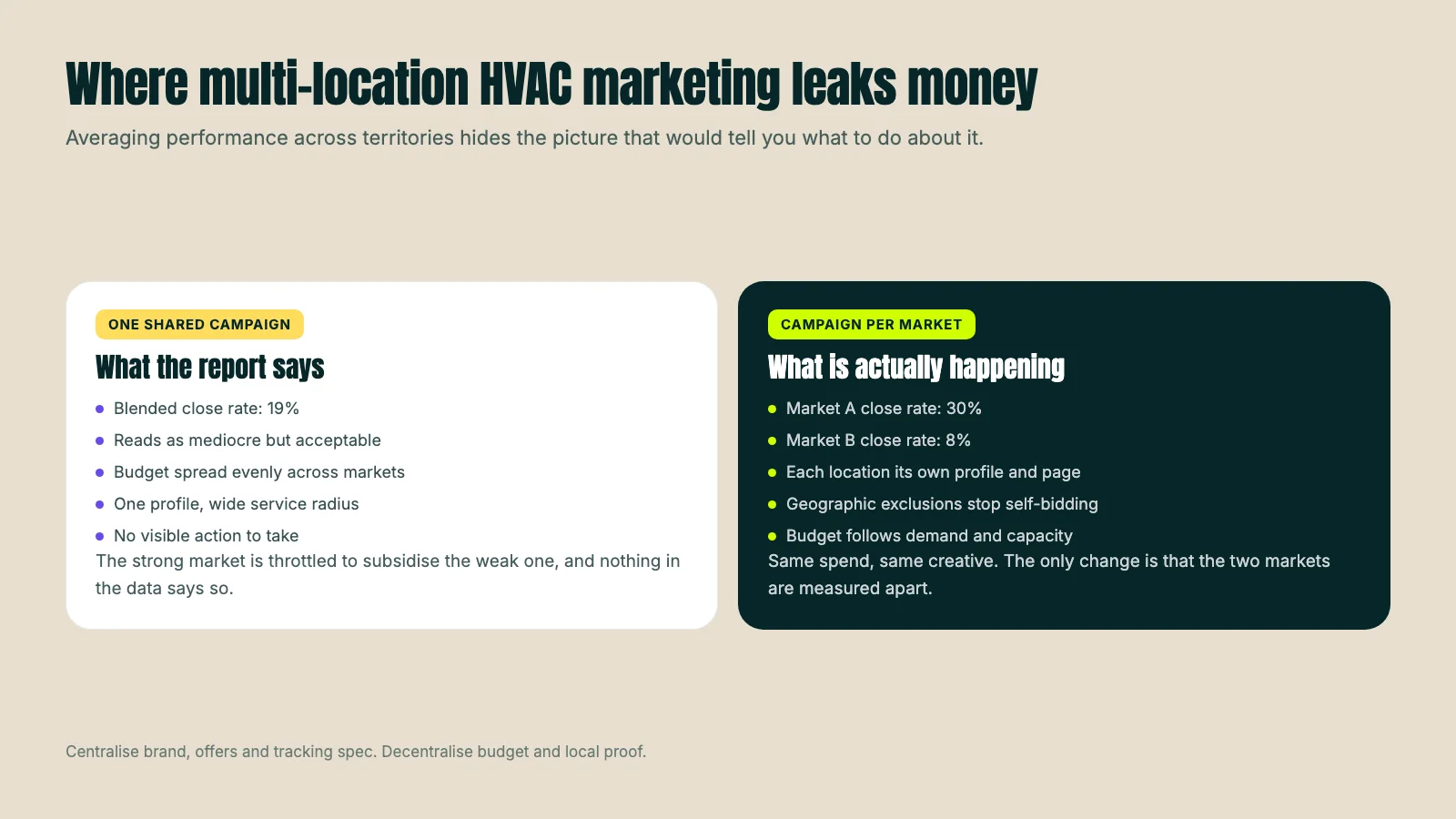
Separate campaigns by market, always. Averaging performance across territories hides the whole picture. One market carrying a 30 percent close rate and another at 8 percent report as a mediocre 19 percent, and the correct action, which is to move budget, never becomes visible. Separate campaigns cost a little more management time and pay for it immediately.
Centralize creative, decentralize budget. Brand, offers, landing page templates, and review request flows should be built once. Spend should follow demand and capacity market by market. Winter arrives at different times in different territories, and a shared budget cap means your strongest market gets throttled to subsidize your weakest.
Watch for cannibalization. Two locations bidding on the same metro keywords bid against each other and raise your own costs. Geographic exclusions between campaigns are unglamorous and save real money.
For franchises specifically, the tension is brand consistency against local relevance. The resolution is usually that brand owns the look, the offer structure, and the tracking spec, while each franchisee owns local proof: their reviews, their photos, their community presence. Both halves are required.
This is the same structure we use across home services marketing generally, and you can see it applied in our home improvement case study.
Takeaway: build a marketing system, not a campaign
The HVAC companies that grow predictably treat marketing like operations: consistent local pages, consistent reviews, fast lead response, and monthly reporting tied to booked jobs.
Pick two channels. Measure revenue, not leads. Expand only once the numbers hold. Then do it again in the next market.
Frequently asked questions
Want this run for your business?
Tell us where to send it and we'll follow up with the strategies that fit your market.