
Build a SaaS SEO strategy around buyer intent
David A · Founder, 1212 Agency
Published November 16, 2026

Decide which SaaS pages to improve, create or combine. Map buyer questions to useful pages, verify product evidence and measure meaningful next steps.
A SaaS keyword list can become a large content backlog without explaining why any page should exist. Product, use-case, integration and comparison terms sit beside broad educational searches. Several articles answer the same question. The team writes more while the important product pages remain vague.
Start with a clear page map. Every useful buyer question needs a page that can answer it well. Close keyword variations can share that page. A new URL needs a reason beyond having a different phrase in its title.
This guide uses a fictional workflow product. Its features, buyers and examples are planning illustrations, not a description of a client or a live software offer.
Define the product's actual boundaries
Before researching keywords, list the jobs the product supports and the customers it can serve. Include limitations. Which workflows are supported? Which integrations exist? What requires a particular plan or setup? Which teams are outside the offer?
The product expert should be able to approve these statements. A marketer cannot infer a feature from the fact that competitors use a popular keyword.
For the fictional product, the team might verify recurring scheduling, multiple resources and a supported calendar connection. If payment processing is absent, a page should not imply that the product handles payments simply because the search volume is attractive.
Inventory live and planned content together
Export the important URLs and record what each page does. Review the visible page, not only its title. A product page may contain a brief use-case section without answering the full question. An old article may already own the problem a new brief proposes.
Include approved drafts and the current editorial board. A scheduled article can conflict with a new idea even when it is not live yet. An old planning document is different: it records an idea, not a publication commitment.
Our SaaS demand-generation article already owns the partner-launch workflow. A separate SEO strategy article can refer to that distribution job without rewriting it under another title.
Sort terms by the decision they represent
Use practical intent groups. A category search asks what kind of product solves a job. A use-case search asks how it handles a particular workflow. An integration search asks about a real connection. A comparison asks the buyer to evaluate alternatives. An educational search may explain the problem before a product choice is sensible.
Do not assume the wording gives a complete answer. Inspect current search results and the pages they return. A query may be commercial, educational or mixed. The format you create should serve that actual reader job.
The Google guidance on helpful content is a useful test: does the page leave the reader with a satisfactory answer, supported by relevant expertise? A different keyword does not make a repetitive page useful.
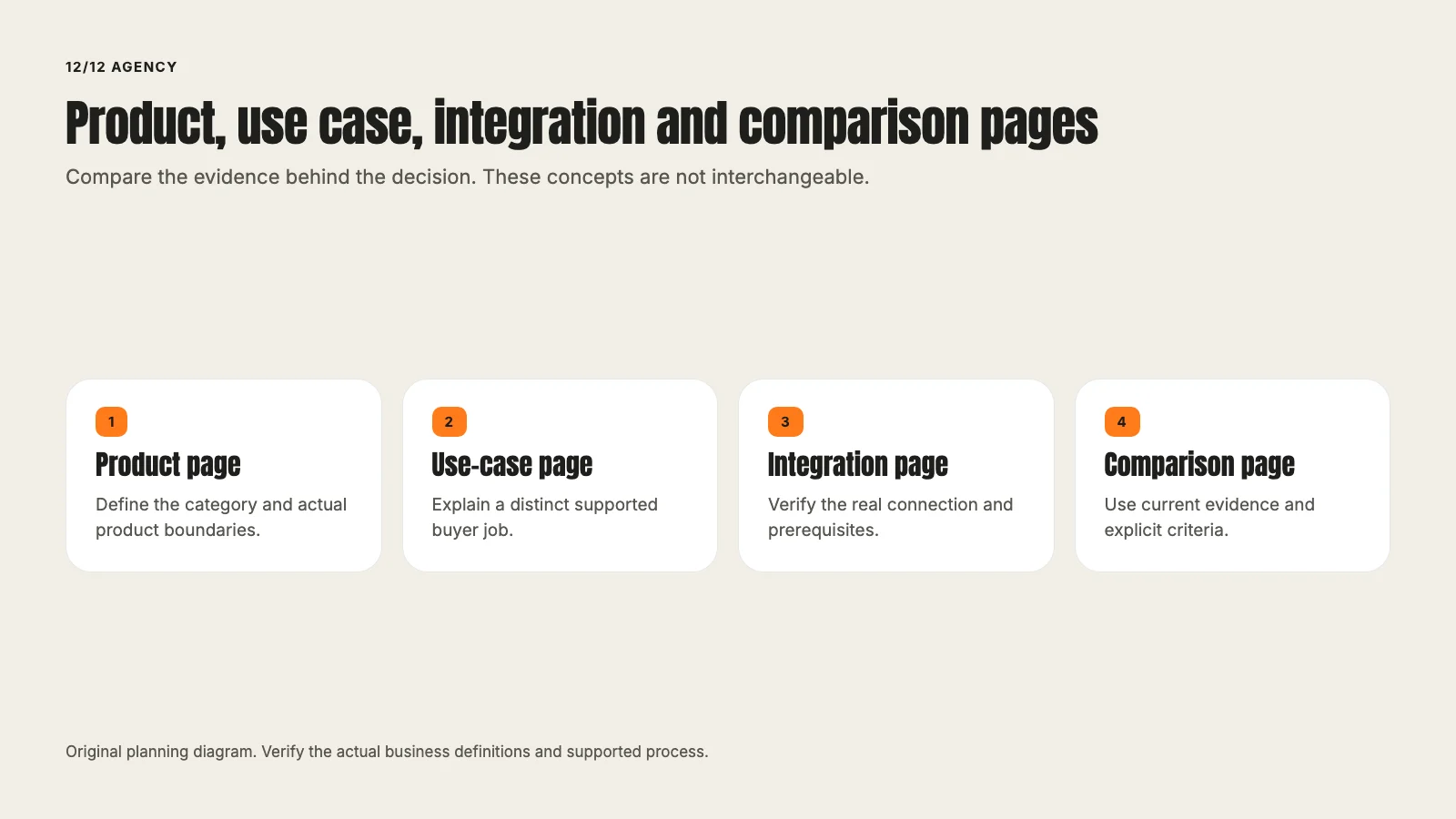
Assign one useful page to each question
Build an intent map before a production calendar. A simple fictional example might look like this:
| Buyer job | Page | Evidence needed |
|---|---|---|
| Understand the product category | Main product page | Accurate scope and suitable customer |
| Schedule several resources | Use-case page | Verified workflow and original example |
| Connect a supported calendar | Integration guide | Current setup, prerequisites and limitations |
| Compare two approaches | Comparison page | Current, fair criteria and product review |
| Learn how to plan availability | Educational article | A useful process and illustrative worksheet |
The map should also say when to merge. If two use-case proposals share the same reader, explanation, screenshots and next action, they probably need a stronger shared page before they need two URLs.
Choose improvements before assuming net-new work
An existing service or product page may need a clearer fit section, a real example, an accurate FAQ or a better internal link. That can be more useful than publishing an article that competes with it.
Record the action for each page: retain, refresh, expand, combine or create. Combining or redirecting live pages requires a separate reviewed implementation decision. The research map itself is not approval to remove a route.
Also keep utility intent separate. Someone who wants a calculator or template should be able to use it. A page describing a tool without providing a useful working result does not finish that job.
Check whether the site can deliver the explanation
Review the important content in the initial HTML, internal navigation, response codes, canonicals and sitemap. Technical discovery should identify a concrete problem and acceptance check, not produce a generic score without consequences.
For example, a useful integration guide is difficult to discover if every route is an empty application shell for a crawler. A page in the sitemap still needs crawlable internal links and a coherent place in the site.
Google's Search Essentials describes the foundation for eligibility. Eligibility is not a guarantee of crawling, indexing or ranking. Keep those states distinct in the report.
Plan the original evidence before assigning the writing
A good brief names the product reviewer and the material the page needs. That might be a verified setup sequence, an original workflow diagram, an accurate comparison table or a sample built with fictional data.
Screenshots should match the product being described. Remove customer details and other private information. If a source cannot be shown, explain the concept with an original illustration rather than manufacturing a screenshot that looks like proof.
A writer should also know what the page does not claim. No guaranteed ranking, invented customer result, unsupported integration or blanket promise of AI-search visibility belongs in the draft.
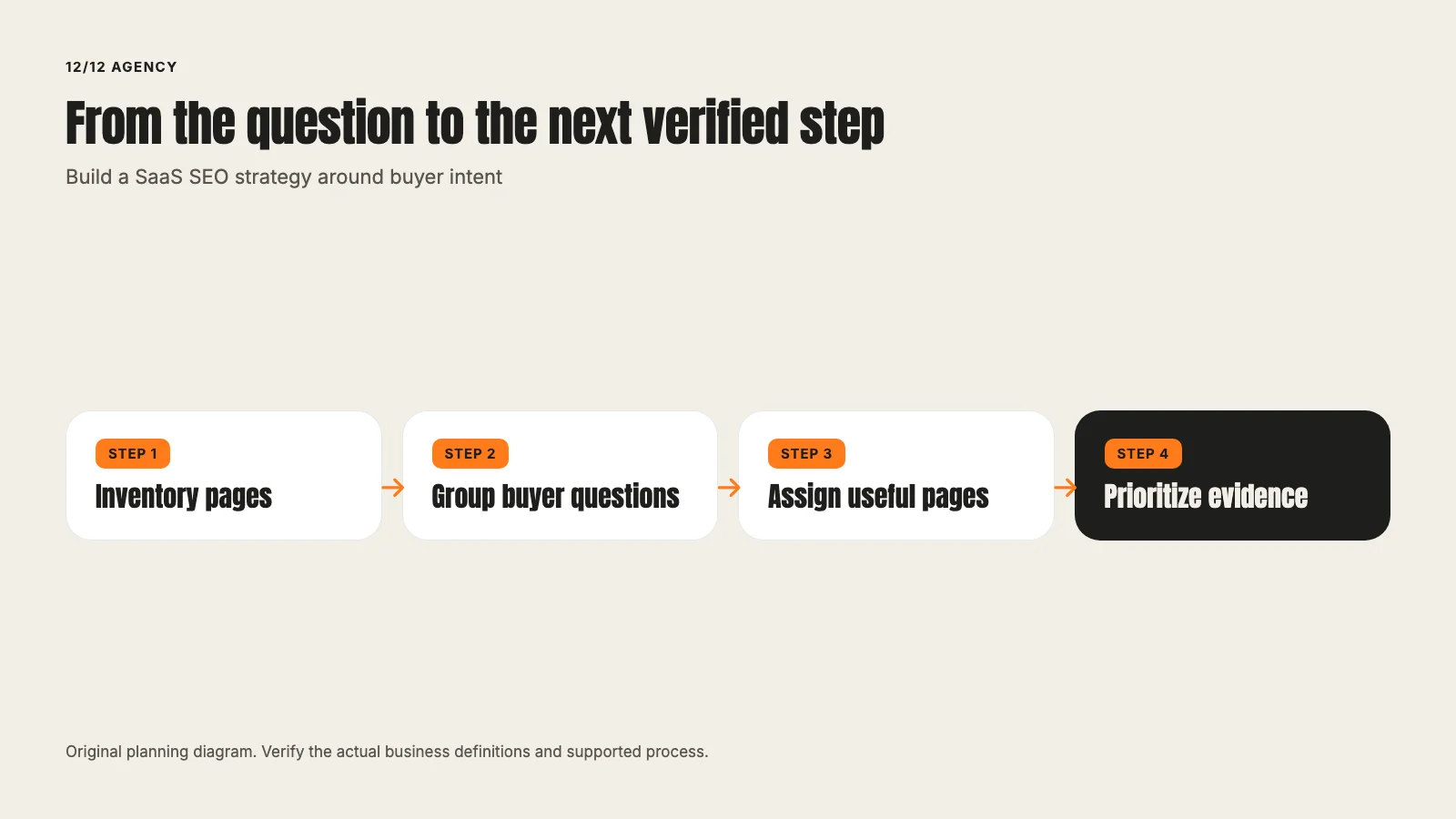
Prioritize using business fit and production reality
Search volume is one input. It is not expected traffic. Related keywords overlap, and the top result can be difficult to displace. Paid competition and cost per click are not organic difficulty scores.
Compare the buyer fit, evidence available, service or product value, current page quality and effort needed. A low-volume integration question may matter to a suitable buyer. A large generic term may be a poor first production choice.
Then identify dependencies. A comparison needs current feature review. A technical guide needs an expert. A new tool needs formula and interaction QA. A page with no credible evidence can stay in the backlog while a more useful one moves forward.
Connect the cluster with links a reader can use
The category page should make relevant use cases and integrations findable. An educational guide should offer the next explanation when the reader is ready. Avoid forcing the same sales CTA into every paragraph.
Use descriptive links that explain the destination. A link from the SaaS marketing overview to a detailed service page helps a buyer evaluate the work. A guide can link to paid acquisition when the next question is how to capture existing demand.
Links should reflect a reading sequence, not a quota. The purpose is to help the buyer continue and make the site's content structure clear.
Measure several states, then choose the next work
Start with whether a page is published and technically available. Check indexing separately. Then review relevant queries, impressions, visits and accepted actions using the available systems.
For a sales-led product, request-to-meeting measurement needs a defined cohort and later stages. An article visit is not a qualified opportunity, and an attributed opportunity is not collected revenue.
Review old and new pages together. If a query is reaching the wrong page, improve the map and content before adding another URL. The next cycle should be based on what the site and buyers actually show, not on using up an arbitrary number of keywords.
Check the map against the next commercial step
An intent map should identify how the reader continues after understanding the answer. A product comparison can lead to the relevant supported workflow or a conversation request. An educational guide may lead to another useful explanation rather than a sales form immediately.
Use the existing paid media overview only when acquisition distribution is the next question. This keeps the content architecture connected to the business without forcing every page to serve the same stage. The map is useful when its links reflect reader decisions, not when every available URL appears in every row.
Bring the current site, planned content and product questions to a strategy session. The first useful deliverable is a page map the team can act on.
Frequently asked questions
Want this run for your business?
Tell us where to send it and we'll follow up with the strategies that fit your market.