
Build a marketing budget from the work and capacity
David A · Founder, 1212 Agency
Published November 16, 2026

Build a marketing budget from defined outcomes, full acquisition costs and operating capacity. Use explicit scenarios and a review rule before account changes.
A percentage of revenue can be a planning convention, but it is not a complete marketing budget. It does not say which buyer the business can serve, what the campaign must learn, which work is required or how sales will handle the resulting demand.
Build the plan from those decisions. Separate the media account from the production and operating costs around it, then model the stages using observed evidence or clearly labeled assumptions. This guide uses fictional scenarios and makes no financial recommendation or new agency price.
Define the business job and accepted outcome
Write the service, product or audience the budget supports. The plan might seek suitable estimate requests, software evaluation conversations or a clearer test of one buyer question. Growth alone is too broad to calculate.
Define the accepted action and later stages. A form, booked appointment, held meeting and won customer need different evidence. The B2B lead-generation guide and tracking guide can support those definitions.
Do not use a single conversion rate that mixes several journeys. A self-serve purchase and a sales-led opportunity may share an entry page but require different costs, timing and capacity.
Inventory the work the plan needs
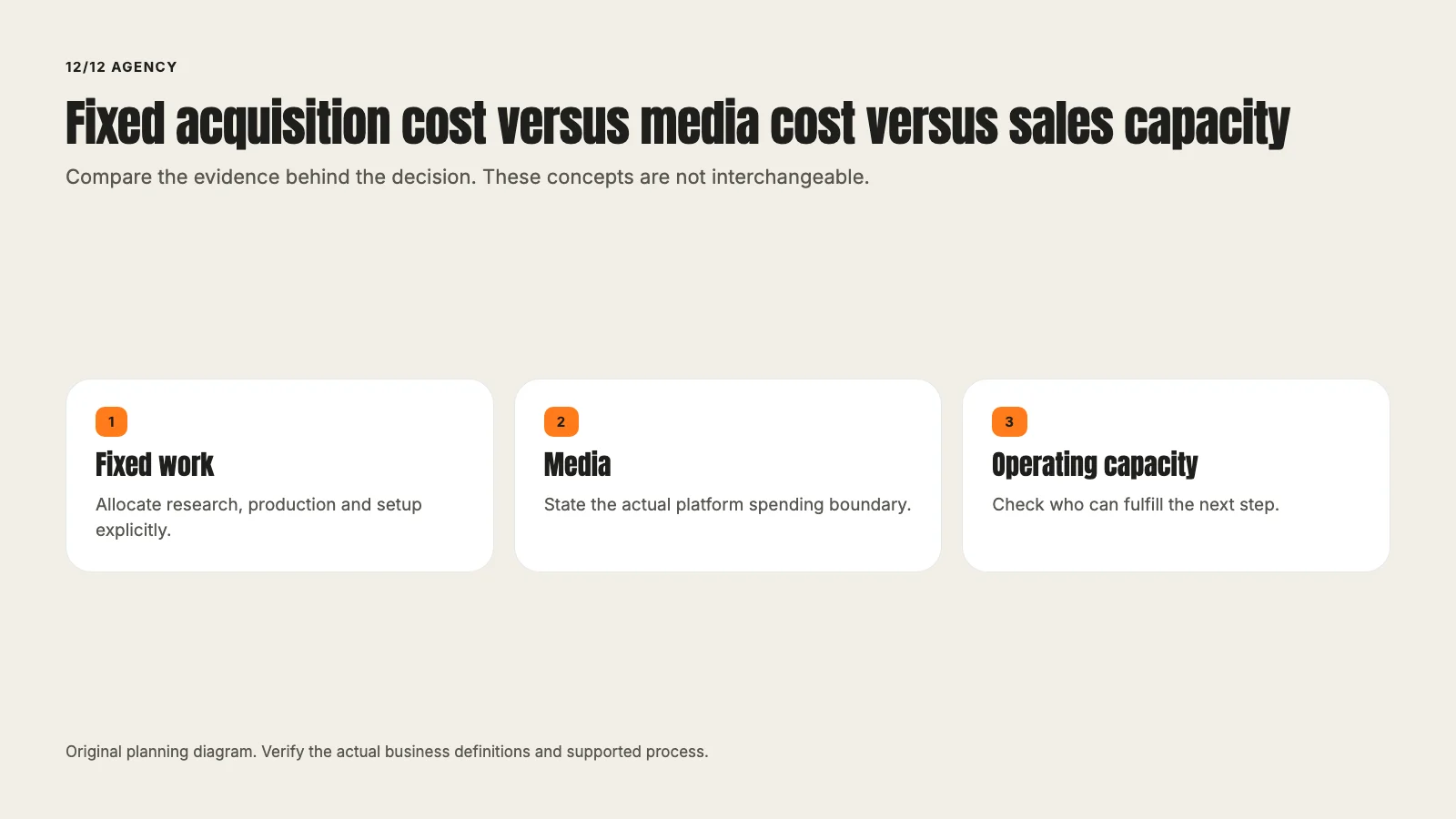
List research, strategy, media, creative, copy, landing pages, measurement, specialist review, reporting and sales handling. Mark what already exists and what must be produced or repaired.
The paid media overview supplies the broader engagement context. A Google Ads plan or Meta plan should still identify its specific destination and production needs.
A working page may need a focused correction rather than a rebuild. A broken accepted-action path may need repair before media. A campaign budget that ignores those dependencies can buy activity the business cannot interpret.
Set a consistent cost boundary
Separate media spend, management, creative production, page work, tools and any included sales-handling cost. Use one currency and planning period. If a reusable asset serves several periods, state the allocation.
Avoid double counting. A production expense included in a management fee should not appear again as a separate cost. An employee's time already allocated to the plan should not be added a second time under coordination.
The existing budget resource can support arithmetic planning, but its inputs and benchmark context must be reviewed. A calculator's output is not permission to change a live campaign or a quote for services.
Build a service-business scenario
Suppose a fictional service business plans $4,000 of media, $1,000 of management and $500 of allocated page and creative work. The included acquisition cost is $5,500.
At an assumed $8 click cost, media models 500 clicks. An assumed 4% accepted-request rate models 20 requests. If 25% become booked estimates, the model gives five estimates. Included cost per modeled estimate is $1,100.
Those values are arithmetic illustrations, not contractor benchmarks. They do not predict won jobs or project profit. If the office can handle only three additional estimates in the period, the plan also has a capacity question that more media cannot solve.
Build a B2B scenario separately
A fictional software plan includes $6,000 of media and $2,000 of other acquisition work. At an assumed $12 click cost and 4% accepted-request rate, it models 500 clicks and 20 requests.
If 20% later meet the defined qualified-opportunity criteria, the scenario gives four opportunities and $2,000 included cost per opportunity. An opportunity is not a customer, and its proposed value is not collected revenue.
The SaaS service context can help define the actual journey. Replace assumptions with a matched observed cohort where available. Keep the complete outcome window visible so recent requests are not judged before they can progress.
Test which assumption carries the decision
Create conservative, central and optimistic input sets with an explicit reason for each. Change click cost, request rate, qualification or included production cost to see which uncertainty matters most.
Do not label arbitrary scenarios industry averages. A broad range may be more honest than a precise-looking forecast. The point is to identify what the next test needs to learn before a larger commitment.
A zero modeled outcome should produce an unavailable cost-per-result, not zero acquisition cost. Fractional modeled counts are valid in a scenario but should not be presented as observed partial customers.
Account for operating capacity and timing
Ask who fulfills the next step and how much suitable demand the business can handle. Consultation slots, technical review, onboarding and project capacity can constrain the plan.
Also distinguish cost timing from economic return. Production may be paid before media runs. A contract may be signed before cash is collected. A scenario should not imply immediate payback from an opportunity or use an invented customer lifetime to justify the spend.
Choose the relevant planning horizon and review window. The budget can be sensible for a test even when long-term return remains uncertain, provided the learning question and spending boundary are explicit.
Understand platform budget behavior before approval
Google's spending-limit guidance explains why an average daily budget is not always the exact daily charge. Review the actual platform rules and account setup before translating a monthly plan into settings.
LinkedIn's pricing overview likewise shows that the billable event and auction matter. Do not use one platform's budget behavior as a universal assumption across channels.
The business should approve the exact proposed allocation, limits and intended campaign changes. A planning worksheet should never make account writes or automatically increase spend based on its own output.
Define the review rule before starting
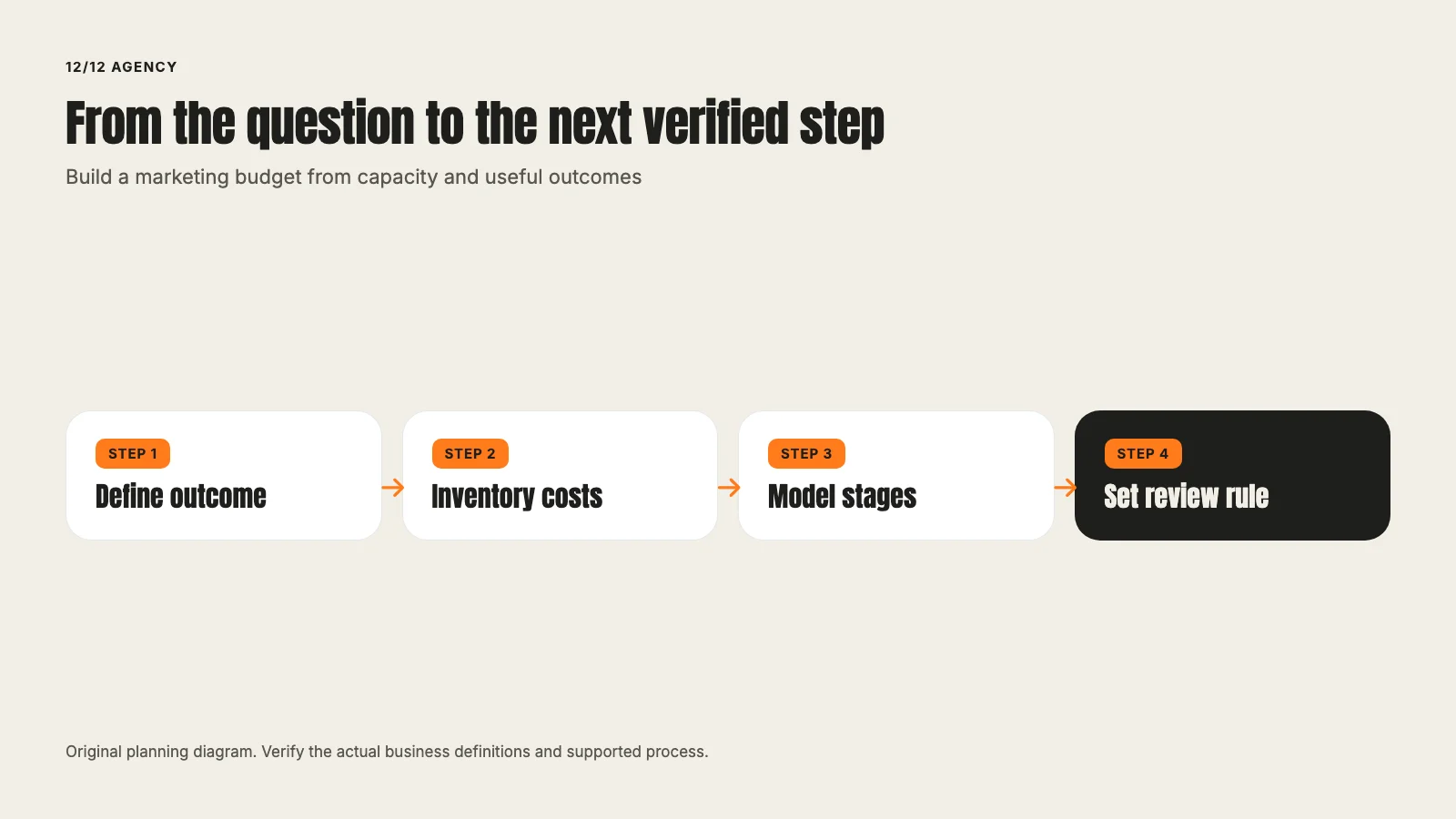
Record the entry cohort, accepted outcome, included cost, observation window and evidence that would justify the next decision. Identify material defects that should trigger investigation rather than waiting for a scheduled report.
A useful review can lead to a page repair, clearer qualification, a better source record or a revised test. It does not need to end with more budget. A test that rules out an unsuitable path can still provide useful evidence.
Keep changes and definitions in the record. If the offer, target, page and goal all change, do not attribute the later result to budget alone. Observed differences and causal conclusions are separate claims.
Keep a budget decision record
The final approval packet should show the proposed allocation, planning period, included work, media limits, accepted outcome and review rule. Attach the actual assumptions rather than only the most favorable result.
Identify what happens if the destination fails or the outcome definition changes. A material defect may require investigation before the next scheduled review. A low-volume fluctuation may call for patience and clearer uncertainty rather than an immediate setting change. The rule should distinguish those situations.
Record the actual account readback after an approved change. A saved draft or spreadsheet is not proof that the budget was applied. If authentication or a platform error prevents the change, preserve the prior delivery state and report the exact remaining job.
At the next review, compare the observed cohort with the planning assumptions. Replace the unsupported inputs carefully and keep definitions consistent. This turns the budget into a learning process the business can reconstruct, rather than a recurring request for more money based on a headline percentage that changes meaning from one report to the next.
Bring the work list and assumptions to a budget planning review.
Frequently asked questions
Want this run for your business?
Tell us where to send it and we'll follow up with the strategies that fit your market.