
Agency or in-house marketing: compare the work before the fee
David A · Founder, 1212 Agency
Published November 16, 2026

Compare agency and in-house marketing by responsibilities, capacity, access and full costs. Use a practical worksheet without invented salary or fee benchmarks.
A monthly agency fee and an employee salary are not automatically comparable. One may cover a narrow channel. The other may assume strategy, production, approvals, analytics and daily coordination. If the responsibilities differ, the price comparison starts with the wrong denominator.
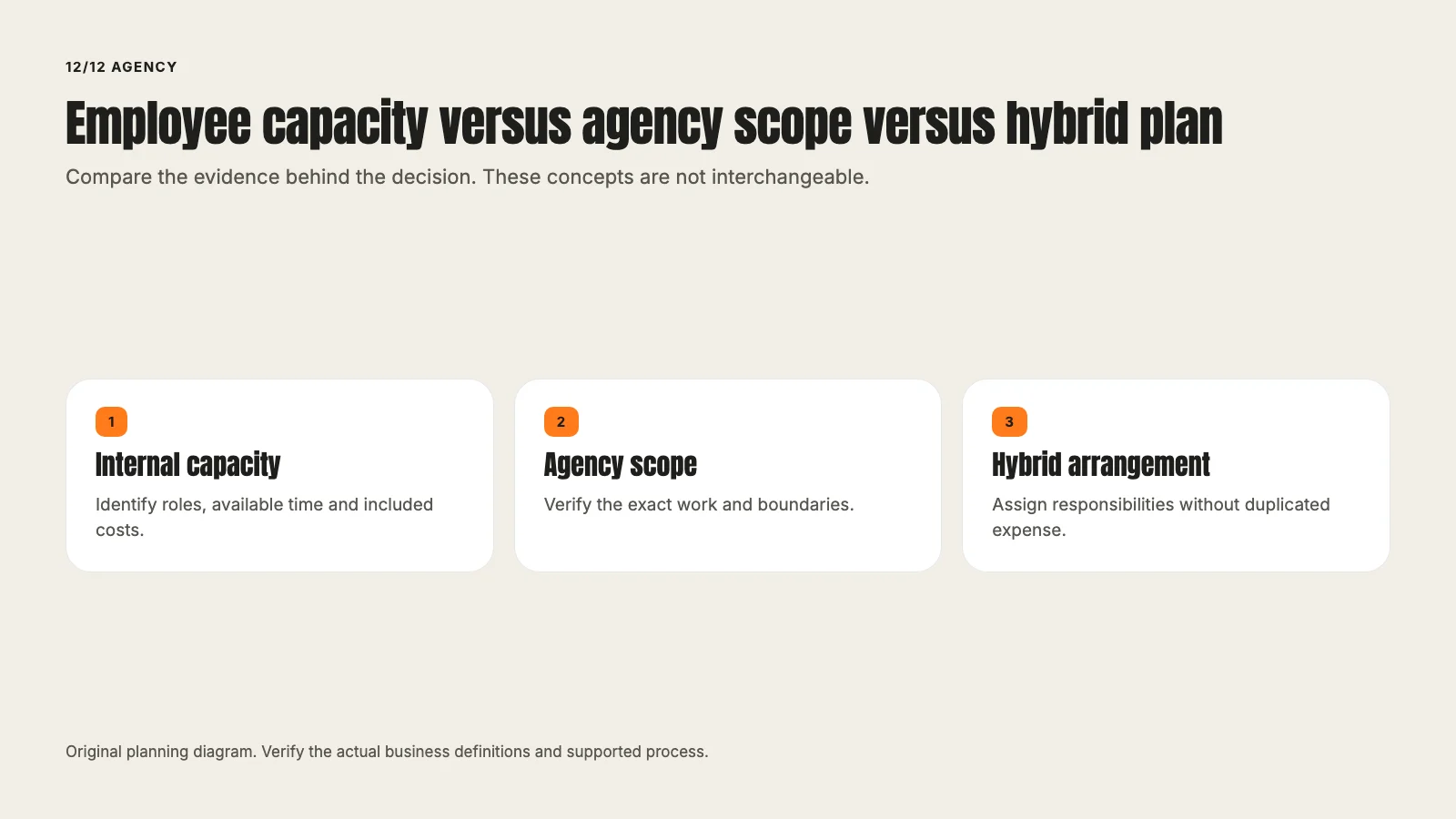
Begin with the work the business needs done. Then compare who can own it, the available capacity and the full cost of delivering it. An agency, an internal hire and a hybrid arrangement can each fit a different situation.
This article provides a decision worksheet. It does not give salary benchmarks, quote 1212 packages or claim that one model is always cheaper or better.
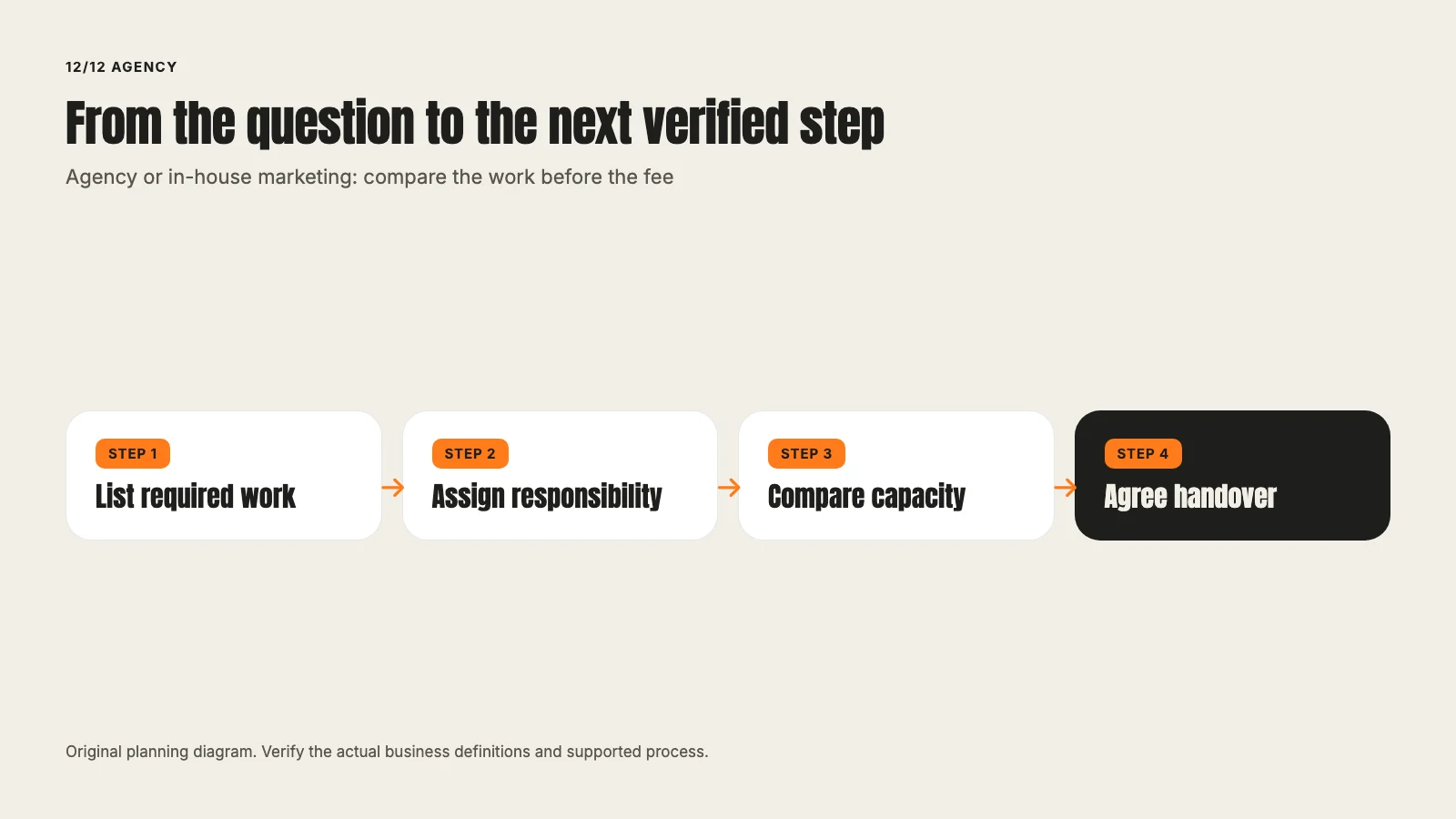
List the decisions the team needs to make
Write the marketing jobs in practical terms. Who defines the customer and offer? Who selects the channels? Who writes the ads? Who prepares the page? Who verifies the accepted action? Who reviews lead quality with sales?
Include maintenance and coordination. A campaign can need new creative, policy review, product changes and a revised sales handoff. A plan that funds only the initial launch may leave those jobs unowned.
Also distinguish decision authority from execution. The business may approve budgets and claims while another person builds the work. Those responsibilities should remain clear whether the executor is an employee or an agency.
Build a responsibility map
Use a simple worksheet before requesting proposals or writing a job description:
| Work area | Business owner | Execution need | Approval or dependency |
|---|---|---|---|
| Offer and customer fit | Leadership or product | Research and positioning support | Current product and commercial facts |
| Paid campaigns | Marketing lead | Account planning and management | Budget and targeting approval |
| Landing pages | Marketing or web owner | Copy, design and implementation | Brand, product and engineering review |
| Measurement | Marketing and operations | Events, QA and reporting | Consent, CRM and system access |
| Content | Subject-matter owner | Writing and production | Expert review and publication approval |
| Sales feedback | Sales lead | Outcome definitions and review | Consistent record keeping |
The map exposes gaps. Hiring one paid-media specialist does not automatically provide design and engineering capacity. Buying an agency retainer does not automatically include every content format or CRM change.
Compare capacity as well as cost
Estimate the recurring work and the skills required. A plan may need ongoing campaign management plus occasional technical implementation. Another may need frequent product interviews and close internal coordination.
Ask how much capacity is actually available for your account or business. A full-time employee still has meetings, reporting and other responsibilities. An agency may have several specialists but a defined delivery scope.
Do not convert a job title into an unlimited production promise. Define the expected work, review cadence and response responsibilities in terms both sides can verify.
Use user-supplied costs in the model
For an internal option, inputs may include salary, employer costs, software, recruiting, onboarding and external specialists. For an agency option, inputs may include the agreed fee, separately scoped production, software and internal coordination time.
Media spend should appear separately in both options when it is the same underlying campaign budget. Otherwise, the comparison can make one option look expensive simply because it includes costs omitted from the other.
All of these figures should come from your actual proposal, finance team or planning assumptions. A calculator can show the arithmetic. It cannot establish the market salary or the right fee for an undefined scope.
Read a fictional example carefully
Imagine an illustrative internal plan with $8,000 monthly eligible staffing and overhead costs, plus $1,000 of outside specialist work. Another illustrative plan uses a $5,000 external engagement and $2,000 of internal coordination and production support.
The modeled totals are $9,000 and $7,000 before media. Those fictional amounts do not show that an agency saves $2,000. The result is meaningful only if both plans deliver comparable responsibilities, quality and capacity.
If the external plan excludes the page and analytics work the business needs, its lower total may be incomplete. If the internal hire is also responsible for several unrelated functions, the available campaign capacity may be lower than the model assumes.
The worksheet is most useful when it makes those differences visible.
Check the evidence behind the proposal
Ask what the examples actually demonstrate. A platform conversion is not automatically a customer. A pipeline value is not collected revenue. A result from a different offer or time period may illustrate experience without forecasting your outcome.
Request clear definitions and relevant work samples. The case-study library is a starting place for discussing types of work, but the engagement still needs a scope that fits your business.
Do not require a supplier to expose private customer information to prove competence. An anonymized explanation, permitted work sample or clear verification process can be more useful than an unreviewed dashboard screenshot.
Decide who owns access and the assets
Record who owns the ad accounts, website, analytics properties, creative source files and content. Define how access is granted and removed through the business's normal process.
An engagement should explain what the team receives during the work and at handover. That can include campaign structure, source files, decision logs and the current measurement map.
Do not share passwords as a substitute for scoped access. A new vendor or employee should receive only the approved access needed for the work. Security-sensitive permissions require the account owner's review.
Consider a hybrid arrangement when the jobs differ
A business may need an internal person close to the product and an external team for a specific execution load. Another may need temporary campaign support while a role is being filled.
The hybrid model still needs boundaries. Who prioritizes the backlog? Who can approve spend? Who resolves a product question? Who is accountable when the page works but the CRM handoff fails?
Our SaaS marketing overview describes the connected acquisition work. The paid-media overview and Google Ads service page provide narrower examples of execution that can be scoped alongside an internal team.
Agree on a review and handover process
Choose the evidence each review will use. That may include completed work, relevant demand, accepted inquiries, qualified outcomes and known measurement gaps. A list of activities alone does not explain whether the original business problem is improving.
Also agree on what happens when the scope changes. A new market, product line or channel may need a different plan and additional capacity. Neither an employee nor an agency should silently inherit unlimited new responsibilities.
For handover, identify the receiving owner and the documents they need. The transition should preserve useful history and account ownership. Removing access, canceling services or deleting assets is a separate authorized action, not an automatic cleanup step.
Make the decision around the actual bottleneck
If the business lacks product direction, buying more execution may not resolve the problem. If the internal lead has a clear plan but no production capacity, a focused external scope may help. If the work requires constant product and customer coordination, a dedicated internal owner may be essential.
The useful comparison ends with the responsibilities, capacity and evidence the business needs. Price becomes meaningful after those are clear.
Compare proof without expanding the promise
The FTC's advertising guidance and endorsement guidance provide primary references when proposals rely on results or testimonials. Verify the actual definition, period and scope instead of treating a strong example as a guarantee.
For a SaaS team, the relevant proof might concern an accepted demo path or a documented product explanation. It should not be expanded into collected revenue or retention without those records.
Ask each option to explain who can verify the work after handover. The best-looking proposal can still leave a gap if no one owns product accuracy, technical changes or later sales feedback. The comparison should expose that responsibility before the fee becomes the only visible difference.
Bring your responsibility map to a strategy session. We can discuss the work without turning a planning example into a quote.
Frequently asked questions
Want this run for your business?
Tell us where to send it and we'll follow up with the strategies that fit your market.