
Choose an agency by the work and evidence
David A · Founder, 1212 Agency
Published November 16, 2026

Review a marketing agency through scope, proof, responsibilities, account access and handover. Compare what each proposal includes before choosing by the fee.
A marketing proposal can sound complete while leaving the important work unnamed. Paid media may exclude the landing page. Reporting may show leads without defining qualification. A low fee can leave the business coordinating several unpriced gaps.
Choose an agency by the problem it will help solve, the evidence behind its claims and the responsibilities it will actually carry. This guide provides a review process, not a ranking of competitors or a claim that one service model fits every business.
Write the problem before requesting proposals
Define the business constraint in observable terms. The issue may be unsuitable inquiries, an unclear product explanation, a broken handoff, limited production capacity or a new audience that needs research. More marketing is too broad to compare meaningfully.
Record the current offer, intended buyer, accepted action and later outcome. A SaaS business and a home-services company may use similar channels but require different evidence and workflows.
Give every candidate the same core context. Do not ask one agency to manage media and another to redesign the entire acquisition process, then compare only the monthly total.
Compare the scope line by line
List strategy, campaign management, research, copy, creative production, landing pages, measurement, CRM work, reporting, approval and sales feedback. Mark each Included, Separate scope, Client responsibility or Not required.
The paid media overview can illustrate the kinds of work around an account. The Google Ads and LinkedIn pages can clarify distinct channel contexts. Their existence does not mean every activity is automatically included in every engagement.
Ask what happens when the work crosses a boundary. If a campaign needs a page repair, who writes, builds, approves and checks it? If a tracking issue requires engineering, what deliverable does the agency provide and who implements it?
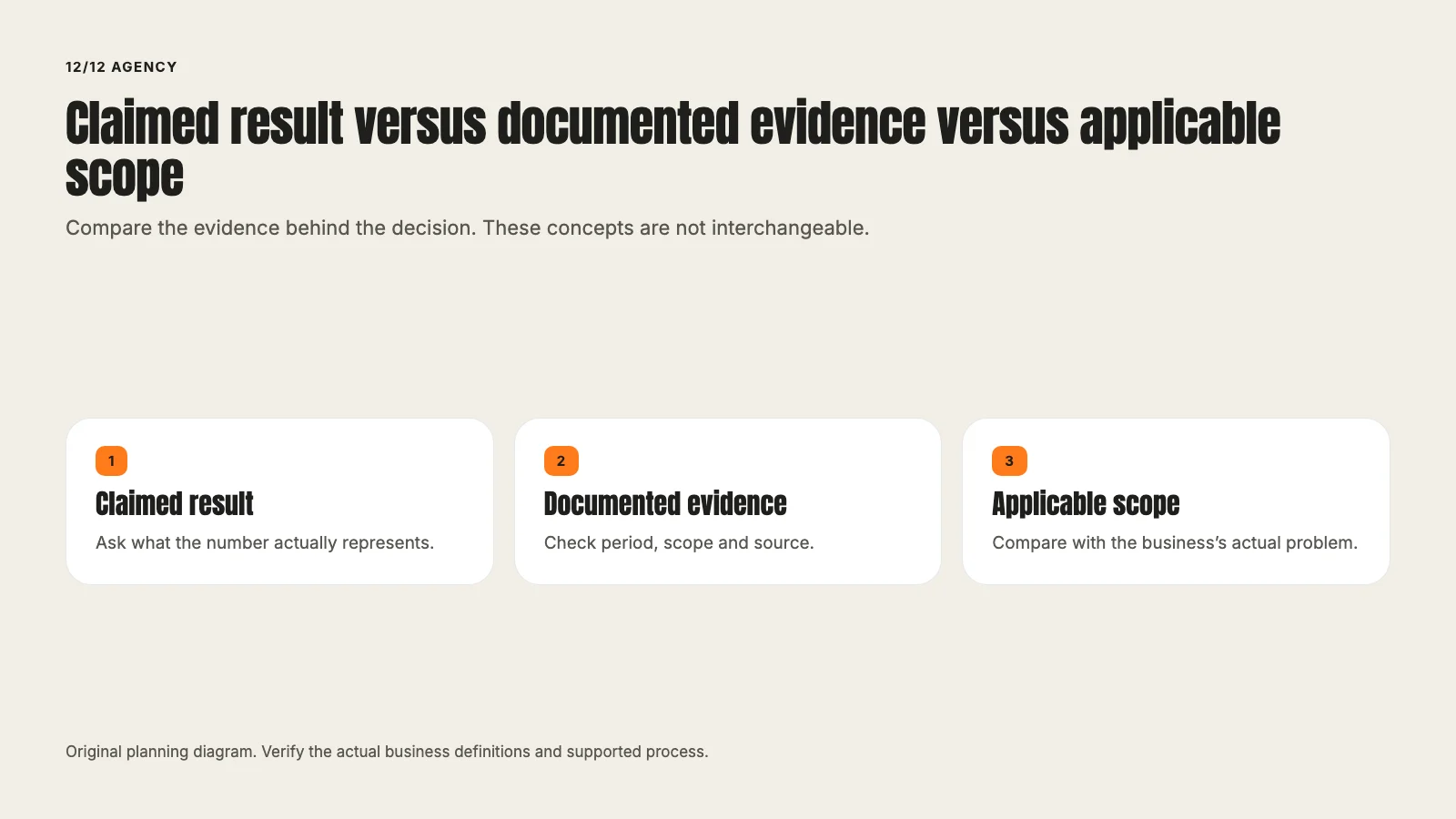
Examine proof at its actual definition
Ask what the reported result measures, over which period and under which cost boundary. Leads, booked meetings, held meetings, qualified opportunities, contract value and collected revenue are different claims.
A case study should explain the work and its evidence without exposing private customer records. Do not request raw personal data merely to make the review feel rigorous. An anonymized explanation and appropriately aggregated evidence can be more useful than a crowded screenshot.
The FTC's advertising guidance supports truthful evidence-based claims. Its endorsement guidance is relevant when testimonials or relationships are part of the proof. An exceptional example should not become an unsupported guarantee for your account.
Ask how the agency makes decisions
A useful partner can explain what it checks first, what evidence changes a recommendation and when it will say the data is insufficient. Ask for a concrete trigger-and-response example rather than a list of tools.
For a fictional account with cheap forms but few suitable inquiries, what would the team inspect? A good answer might distinguish message fit, form context, routing, qualification and selected campaign goals. An automatic budget increase would skip the diagnosis.
The Google Ads audit guide and conversion-tracking guide show how specific definitions make a review more actionable. The broader lesson is to ask for the reasoning and acceptance checks behind the proposed work.
Clarify people, access and approvals
Identify who performs the work, who reviews specialist claims and who can authorize account changes. A job title alone does not establish capacity across media, creative, engineering and analytics.
Use the platforms' normal access permissions. Do not send passwords, payment details or security codes through a proposal document. The business should know which accounts and assets it controls and how an outside team receives appropriate access.
Agree which actions require explicit approval, including spend, targeting, launches, pauses, publishing, customer communications and sensitive data changes. A service agreement should not leave those operational decisions to assumptions.
Review the reporting contract
Ask what each metric means, where it comes from and what it does not prove. A platform-attributed conversion, CRM stage and finance total can differ for legitimate reasons. Reporting should explain those definitions rather than promise perfect agreement.
The report should connect observations to proposed decisions. A dashboard with many charts can still leave the business unsure what changed, what worked and what needs approval.
Also define review cadence and responsiveness in the actual scope. Do not assume continuous monitoring or unlimited production because the proposal uses a broad phrase such as full service. Ask for the responsibilities and boundaries in plain language.
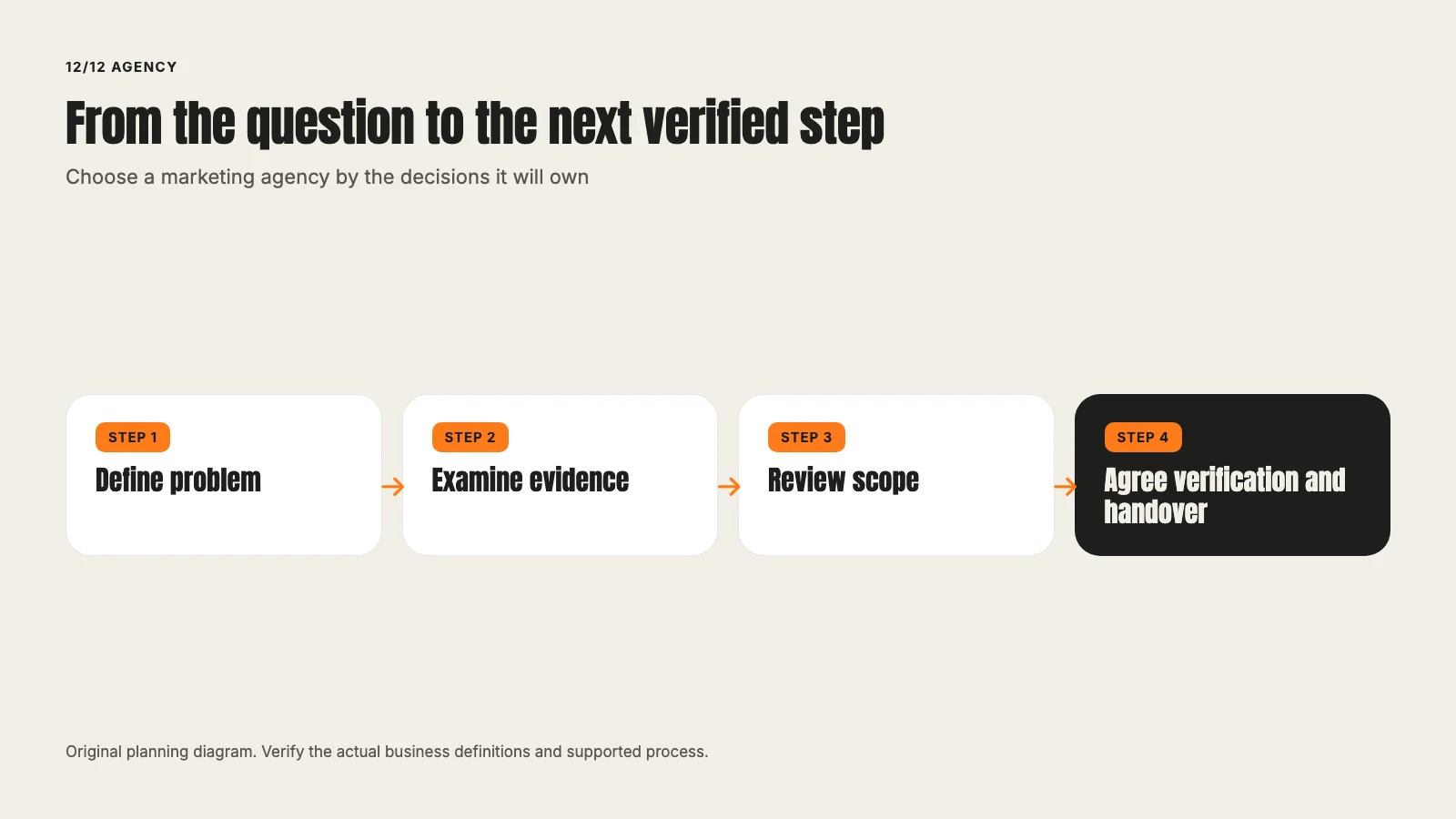
Compare complete costs and capacity
Separate media spend from management and production. Include internal coordination and specialist work when comparing alternatives. Avoid counting a shared expense twice or treating one retainer as if it covers every possible need.
For a fictional comparison, proposal A includes $2,000 of management but leaves page and creative work to the client. Proposal B includes $3,000 of management and specified production. Neither is cheaper in a meaningful sense until the missing work and capacity are defined.
These amounts are illustrative, not 1212 prices or market averages. The correct comparison is the actual scope the business can support, not a universal fee threshold.
Plan handover before it is urgent
Ask how the business receives creative files, documentation, measurement definitions and unfinished work. Identify the access and asset responsibilities at the end of the engagement.
A useful handover preserves account history and explains what is live, what is proposed and what remains uncertain. It should not depend on a former team member remembering a conversation that was never recorded.
Removing access, canceling services or deleting assets are separate authorized actions. A transition plan should name them precisely and preserve the information the business needs before any change.
Use a concrete decision sheet
For each proposal, record the problem addressed, included work, missing work, named team, source evidence, cost boundary, approval rules, reporting definitions and handover. Add unresolved questions rather than assigning a vague agency score.
Choose the arrangement that fits the actual bottleneck and capacity. A company lacking product direction may not benefit from buying more execution. A team with strong strategy but limited production may need a different scope.
A hybrid internal and external arrangement can be appropriate when responsibilities are explicit. The agency-versus-in-house context should be a work comparison, not a claim that one structure is always superior.
Ask for one concrete trigger and response
Give the candidate a realistic example: the campaign records accepted forms, but sales says many requests concern an unsupported use case. Ask what they would inspect, which evidence they need and which changes require approval.
A useful answer separates the offer, actual queries, page explanation, necessary fields and handoff. It should not jump directly to more spend or a universal targeting rule. The candidate should also identify what the available data cannot establish.
Then ask what the deliverable looks like. A proposed copy section, field-mapping specification or account-change preview is reviewable. A promise to optimize continuously is harder to assess without responsibilities and acceptance checks.
This exercise does not need private customer records or access to another client's account. It tests whether the agency can make the reasoning concrete and preserve the boundary between recommendation, implementation and verified result. That is useful evidence about the working relationship before a contract is signed.
Bring the problem and proposals to a scope review. The goal is a decision the business can explain.
Frequently asked questions
Want this run for your business?
Tell us where to send it and we'll follow up with the strategies that fit your market.