
Contractor leads: connect the source to the booked job
David A · Founder, 1212 Agency
Published November 16, 2026

Compare contractor lead sources through project fit, contact, estimates and won work. Build a clear handoff and cost model before expanding the campaign.
A contractor can receive more inquiries and still struggle to fill the right work. The requests may concern a different service, arrive outside the operating area or disappear between the form and the office. A lead-generation plan should expose those differences rather than hide them behind one total.
The useful question is which source brings a suitable project into a process the business can fulfill. Answer it by defining the job, the accepted request and the later outcome. This guide uses fictional examples and does not rank lead vendors or promise a fixed cost per job.
Start with the work the business can support
List actual services, project types, operating areas and capacity. A remodeling company seeking whole-home work has a different intake problem from a repair team handling smaller urgent jobs. A concrete contractor may separate residential flatwork from commercial projects because the evidence and estimating process differ.
Write those boundaries in plain language. They should inform both the campaign and the destination. The home-services overview provides the commercial context, while a specific remodeling page or concrete service page should explain its own project fit.
A keyword with search volume is not enough reason to advertise a service the company does not provide. An ad can attract attention while creating the wrong expectation. Correct the promise before trying to make the resulting form cheaper.
Compare sources by what they actually deliver
Organic search, paid search, social ads, referrals and third-party lead services begin in different places. A referral may arrive with context. A searcher may be choosing between available providers. A social visitor may be learning about a project they have not yet planned.
A purchased lead also depends on the vendor's actual terms. Verify delivery criteria, exclusivity, duplicate handling and credit procedures before making a commitment. Do not assume the word qualified has the same meaning in a contract and in your office.
For owned advertising, the paid media overview explains the wider engagement. The existing contractor Meta guide retains platform-specific advice. This broader article compares the business handoff, rather than reproducing every campaign setting.
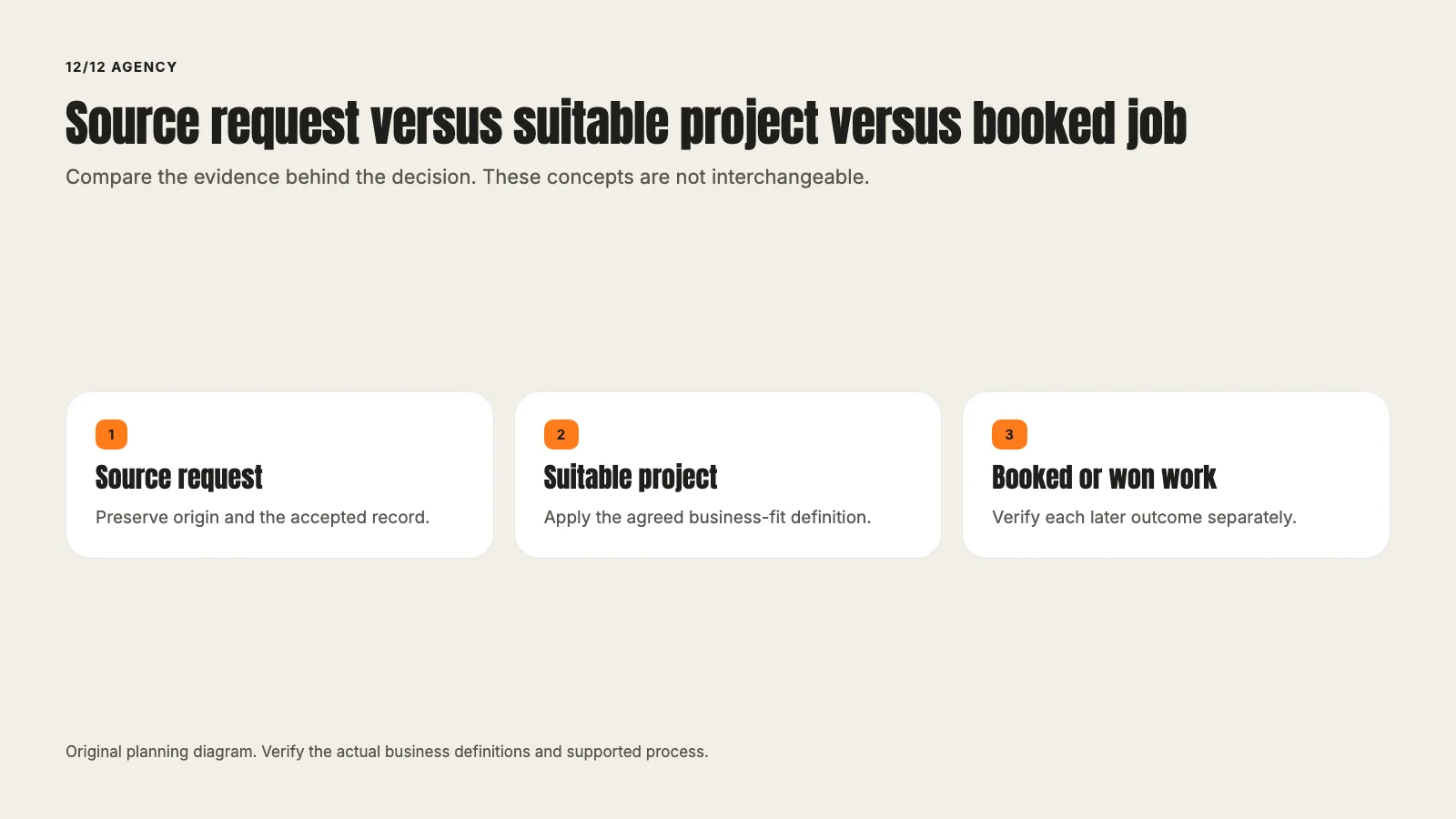
Define the stages before comparing costs
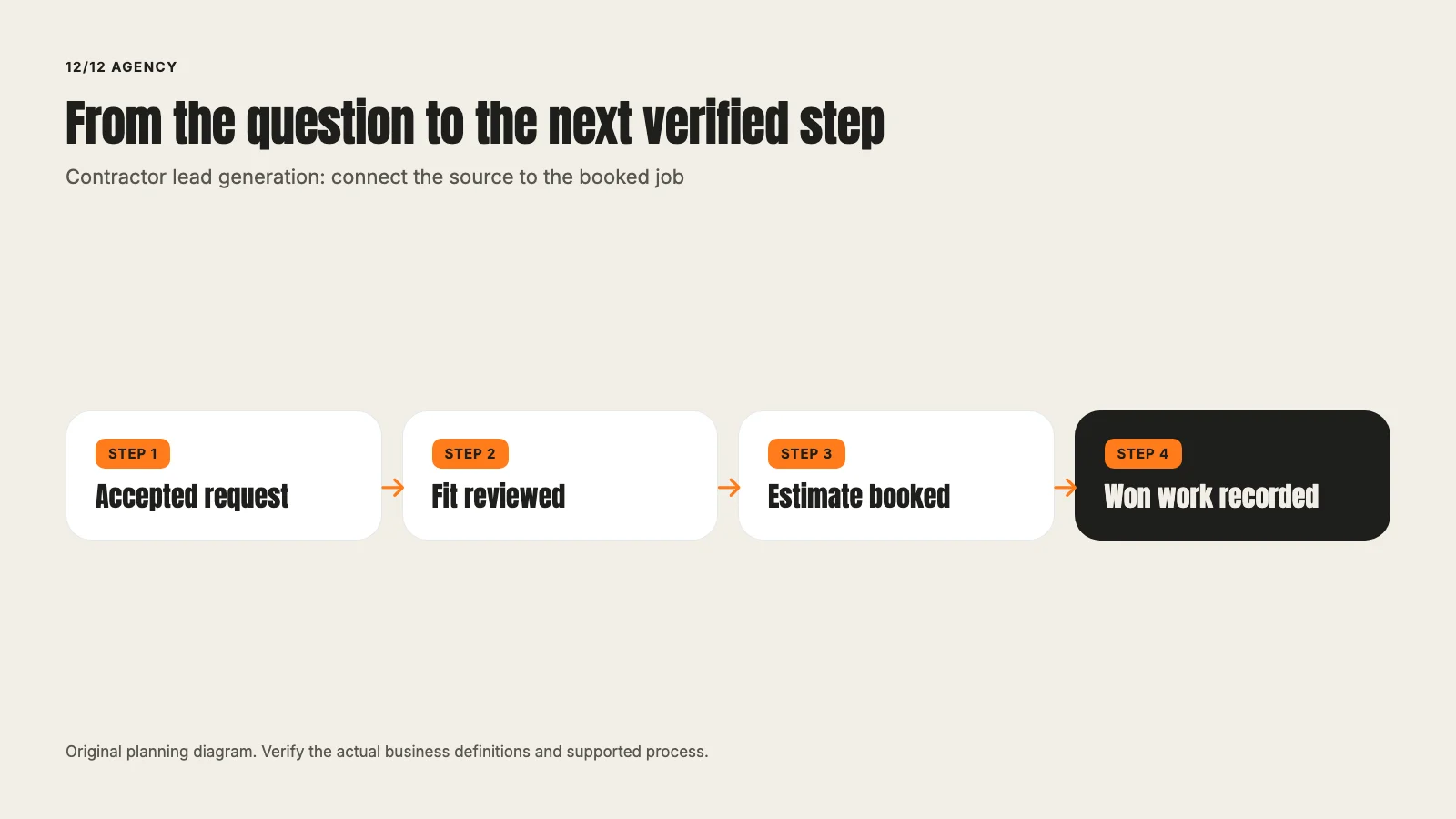
An accepted request means the system recorded the intended inquiry. Suitable project means the business's agreed criteria were met. Contacted means the team made the defined connection, not merely clicked a call button. Estimate booked, estimate issued and won job are later stages.
Decide whether records represent people, households or projects. The same homeowner can submit twice about one job. A commercial customer can have several distinct projects. The deduplication rule should reflect that business reality.
Record stage times rather than applying today's final status to every earlier date. The conversion-tracking guide explains the broader system contract. A technical event receipt and a business outcome remain separate evidence.
Build an illustrative source comparison
Suppose a fictional contractor spends $2,000 on source A and $3,000 on source B. A produces 40 accepted requests, while B produces 30. The media cost per request is $50 for A and $100 for B.
After an equivalent outcome window, A has four booked estimates and one won job. B has ten booked estimates and three won jobs. The media cost per booked estimate is $500 for A and $300 for B. Media acquisition cost per won job is $2,000 for A and $1,000 for B.
These figures are invented solely to explain the calculation. They show why the request total cannot settle the decision. They do not establish that a particular source, platform or contractor will achieve those results.
Add relevant management, creative and intake costs if the comparison is meant to be fully loaded. Keep those costs in the same period and cohort. Do not count a fee twice because it appears in both a package and a separate worksheet.
Inspect the handoff as an operating process
Follow a request from the actual landing page into the system the office uses. Check source information, project category, notification, responsibility and fallback. A form can submit successfully while omitting the field that determines which estimator receives it.
Agree on operating hours and what happens when the usual person is unavailable. Do not promise an immediate response unless the business can deliver one. Elapsed response time can be measured, but a universal percentage lift from responding faster should not be invented.
If a live test creates a notification or appointment, approve that consequence beforehand and use one labeled identity. Preserve the record and exclude it from business performance. Repeated testing is not justified merely because a dashboard has not updated.
Use exclusion reasons that lead to decisions
Ask the team to record a short, useful reason when a request cannot progress. Outside area, unsupported project, duplicate, unavailable capacity and unable to reach are different problems. Unknown should remain an honest option when the evidence is missing.
Do not let bad lead become a catch-all label that prevents learning. A source mismatch may require a targeting or message review. An unanswered request may require routing work. A legitimate buyer outside current capacity may inform a later scheduling decision.
Use aggregated reporting when sharing the analysis. Customer names, addresses, plans and private notes are rarely necessary to explain a source-level result. The public content should never turn an identifiable customer's situation into marketing proof without permission.
Keep local information accurate
For businesses that rely on local search, Google's business representation rules are the baseline for accurate public identity and coverage. They do not justify invented branches or offices.
Google also states in its local-ranking guidance that an agency cannot buy a better local position. A useful plan focuses on service relevance, evidence and the customer path while acknowledging factors outside the business's control.
Local content should help someone decide whether the team can serve the project. It should not multiply nearly identical town pages just to make the inventory look larger.
Review one completed cohort and choose the next job
Compare sources after an appropriate, consistent outcome window. Label still-open projects, missing evidence and any differences in service mix or season. A small cohort with one won job should not support a permanent verdict about a channel.
The next work item may be a tracking repair, clearer service language, a better estimate handoff or a bounded acquisition test. State the evidence and the expected decision. Changes to budgets, vendor contracts and campaign status remain business approvals.
Questions the office and marketer should answer together
Bring one service, one source and one completed cohort to a strategy session. The first goal is a comparison the business can act on.
Make source persistence a separate verification
A request can reach the office while losing the campaign information needed for comparison. Check the actual route and receiving record rather than assuming that the address bar proves the handoff.
Record which source fields are supported, when they are captured and whether later interactions can overwrite them. Preserve a destination's existing settings while forwarding approved marketing information. Personal details and credentials should not be placed in campaign URLs.
The receipt should state exactly what was observed. Parameter survived navigation, request accepted and source stored in the business record are distinct checks. None alone proves that an ad platform credited a paid result. This narrower evidence is still valuable because it identifies which part of the acquisition comparison can be trusted and which needs the next repair.
Frequently asked questions
Want this run for your business?
Tell us where to send it and we'll follow up with the strategies that fit your market.