
Industrial SEO: build a route from technical research to an RFQ
David A · Founder, 1212 Agency
Published November 16, 2026

Map industrial search to capability, material, application and specification pages. Build accurate evidence and an RFQ path a technical buyer can use.
An engineer may arrive with a material, tolerance, process or application in mind. A purchasing manager may need to verify a supplier's capabilities. A general company story may do little to answer either question.
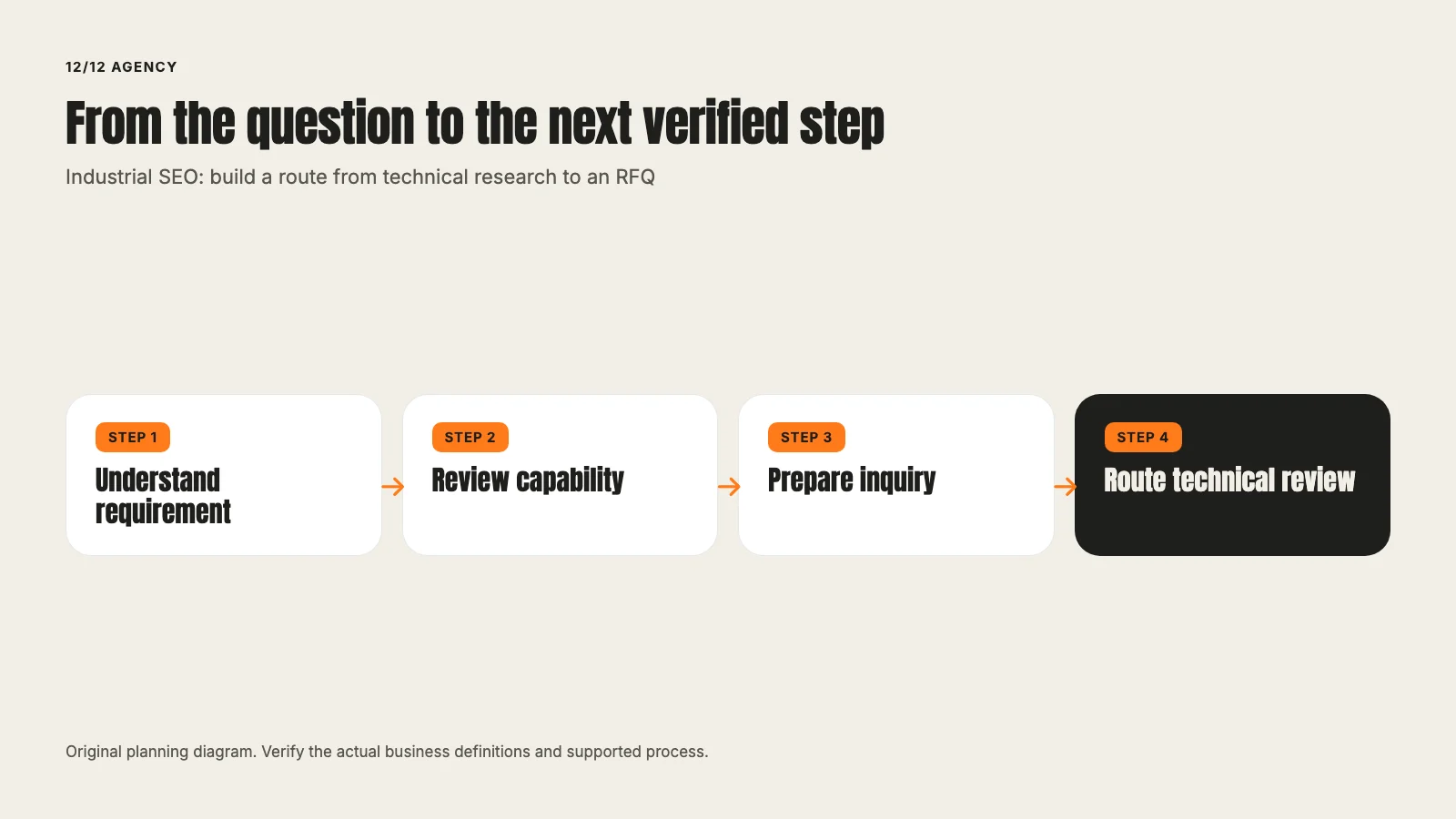
Industrial SEO needs a route from that research to a useful next step. The work starts with what the company can actually make, supply or support. It ends with a page and inquiry path that help the technical buyer continue.
The examples below describe a fictional supplier. Capabilities, quantities and workflows are illustrative. They are not claims about a client or engineering guidance for a particular application.
Begin with a verified capability inventory
Ask the technical team to list the capabilities that can be represented publicly. Include processes, materials, equipment ranges, supported applications and any meaningful limits. Record the owner who can verify each statement.
Certifications and tolerances need particular care. A marketer should not generalize a certificate's scope or turn an example dimension into a universal production promise. The page needs the exact wording the technical owner approves.
This inventory also identifies exclusions. The company may serve production runs but not consumer repairs, or supply equipment without installing it. Those distinctions affect the searches, page copy and RFQ form.
Map the technical question before choosing a page type
A useful intent map can separate several reader jobs:
| Reader job | Useful page | Essential evidence |
|---|---|---|
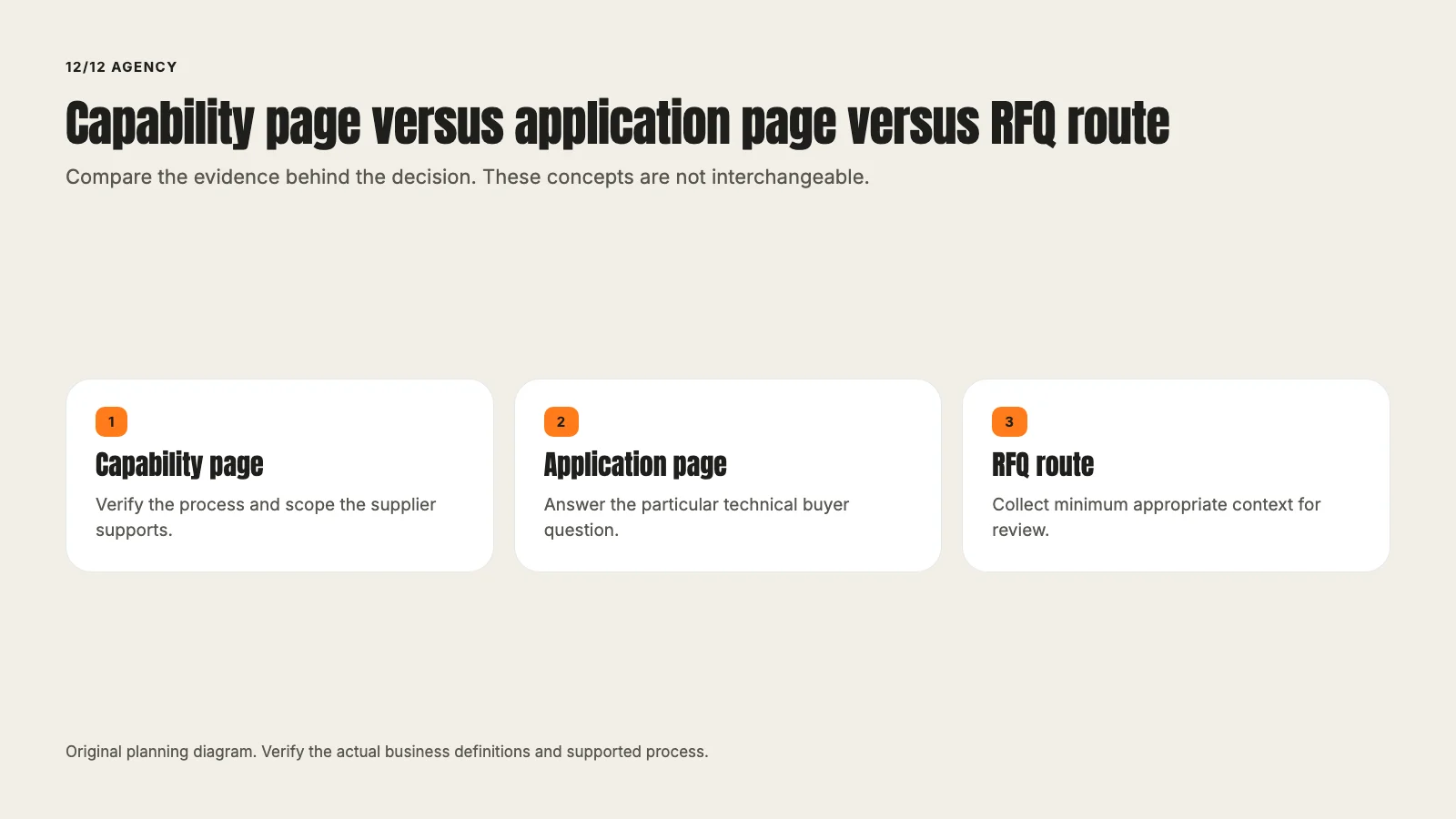
| Find a production capability | Capability page | Process, materials, limits and suitable inquiry |
| Check an application | Application page | Relevant use case and verified suitability |
| Understand a specification | Technical guide | Accurate explanation and subject-matter review |
| Evaluate a supplier | Service or company page | Verified credentials, process and relevant proof |
| Request a quote | RFQ route | Necessary inputs and clear routing |
Do not turn every material and process combination into a page automatically. A separate URL needs a distinct question and useful evidence. If the same explanation answers several close terms, one stronger page is easier to maintain.
Our broader manufacturing marketing guide covers the buying committee and commercial context. This article focuses on the page and evidence work that technical search requires.
Read current results with a technical reviewer
A term that sounds commercial may return standards, educational explanations, catalogs or supplier pages. Inspect the result format and the information the reader seems to need.
Then ask whether the company has a credible contribution. A technical definition may be best answered by an official standards body or an educational source. The supplier's page should explain its own capability and application context rather than pretending to replace an authoritative specification.
Search volume does not tell you whether the right engineer is present. Nor does a zero estimate prove the inquiry is worthless. Combine keyword evidence with the questions the technical and sales teams actually receive.
Make important information readable on the page
Technical buyers may need a drawing or a PDF, but the main page should explain what it contains and why it matters. Keep the essential capability, prerequisites and next action available in readable text.
Use useful headings and labels. A visitor should not need to open several unlabeled files to determine whether the company performs the work. File names, revision dates and the responsible team should be accurate where those details are relevant.
Google's helpful-content guidance emphasizes reliable, useful answers. An original explanation reviewed by the person who knows the process has a better reader purpose than a generic paragraph about innovation and quality.
Give each application page its own reason to exist
A genuine application page should explain a particular job, requirements and relevant company capability. It may need a different diagram, example, constraints or inquiry information from the parent capability page.
If the draft only changes the industry name and repeats the same paragraphs, keep it as a section until better evidence exists. Google's spam policies are one reason to avoid doorway and scaled thin content, but the practical reason is simpler: the buyer still has not learned anything new.
The same rule applies to location pages. A service location or facility can deserve a page when it has real operating information. A city-name variation does not establish a local presence.
Build an RFQ form around a real routing decision
Start with the fields the team needs to decide who should respond. That may include capability, material, application or project stage. The exact fields depend on the business.
Do not require confidential drawings or proprietary project data just to obtain an initial conversation if the team does not need them at that stage. If uploads are required, the technical, privacy and security owners must define the supported process.
The confirmation should explain the next step accurately. Do not promise a response time the team cannot meet. Make direct, distributor and service inquiries distinguishable where they have different owners.
Check accepted inquiries and later RFQ quality separately
A form accepted by the website is an observable event. A usable RFQ is a business assessment. An opportunity, quote, order and collected payment are later stages.
Agree on a small set of sales feedback labels. For example: unsupported capability, wrong geography, incomplete specification, duplicate, suitable RFQ and active opportunity. Use the company's actual definitions rather than an imported score with no operational meaning.
The conversion-tracking guide explains why the handoff between systems needs evidence. If advertising supports the page, Google Ads management should use outcomes that match the business job.
Treat internal links as a technical reading path
A capability page can link to relevant materials, applications and a useful RFQ explanation. A specification guide can link back to the capability that serves the reader's need. The RFQ route can identify what the team needs to evaluate a request.
Do not add every industrial page to every paragraph. Explain why the next page is useful. A buyer exploring an application needs a relevant continuation, not a wall of exact-match links.
The industrial service overview and manufacturing page should also make those resources discoverable once they are approved and live.
Maintain evidence as the business changes
A capability page can become inaccurate after equipment, certification or service changes. Give each important statement an owner and a review trigger. A substantive technical change may require new copy and diagrams, not merely a new update date.
Record source documents and revision decisions internally. The public page should be clear and usable without exposing confidential customer information, project drawings or internal production details.
Choose the first work sequence
Start with an important capability that already has buyer demand and a reviewer available. Improve the relevant page, add one original explanation the reader needs, connect the RFQ path and verify the accepted action.
Then review what actual inquiries and search data show. If buyers repeatedly need a distinct application explanation, develop it with the technical team. If two pages compete for the same question, clarify what each page answers before adding another article.
Industrial SEO is not a race to produce the largest catalog of keywords. It is a way to make verified expertise findable and useful to the people who need it.
Keep an RFQ question with the right reviewer
An article can help a buyer prepare an inquiry without approving its technical feasibility. Record which statements describe verified public capability and which questions must be assessed against the actual specification.
That boundary should remain visible in the form and confirmation as well as the prose. A requested tolerance or material entered by a visitor is an input for review, not a capability the supplier has accepted. Clear routing is part of useful industrial content.
Bring one capability, its current page and the RFQ path to a strategy session.
Frequently asked questions
Want this run for your business?
Tell us where to send it and we'll follow up with the strategies that fit your market.