
Turn engineering knowledge into useful industrial content
David A · Founder, 1212 Agency
Published November 16, 2026

Build industrial content from verified capabilities and buyer questions. Plan expert interviews, diagrams, technical review, distribution and revision triggers.
An industrial buyer needs to know whether a supplier understands the application and can support the requirement. Generic content about quality and innovation supplies little evidence for that decision.
Useful industrial content begins with the people who know the process, the product and its limits. The marketer's job is to turn that knowledge into a clear explanation without overstating a capability or exposing confidential work. This guide develops that production system, rather than inventing an engineering result.
Identify the buyer's technical decision
Start with the question the reader needs to resolve. They may be comparing processes, checking material compatibility, preparing a specification or deciding which information an RFQ requires. Those questions need different sources and formats.
The industrial overview can explain the service engagement. A manufacturing page can explain a supported supplier context. An educational article should help with a distinct decision instead of repeating those commercial pages.
Write the question in the buyer's terms. Ask technical sales what a suitable buyer often misunderstands and which missing information delays assessment. That is a stronger starting point than a keyword list with no application context.
Interview for the explanation and its boundaries
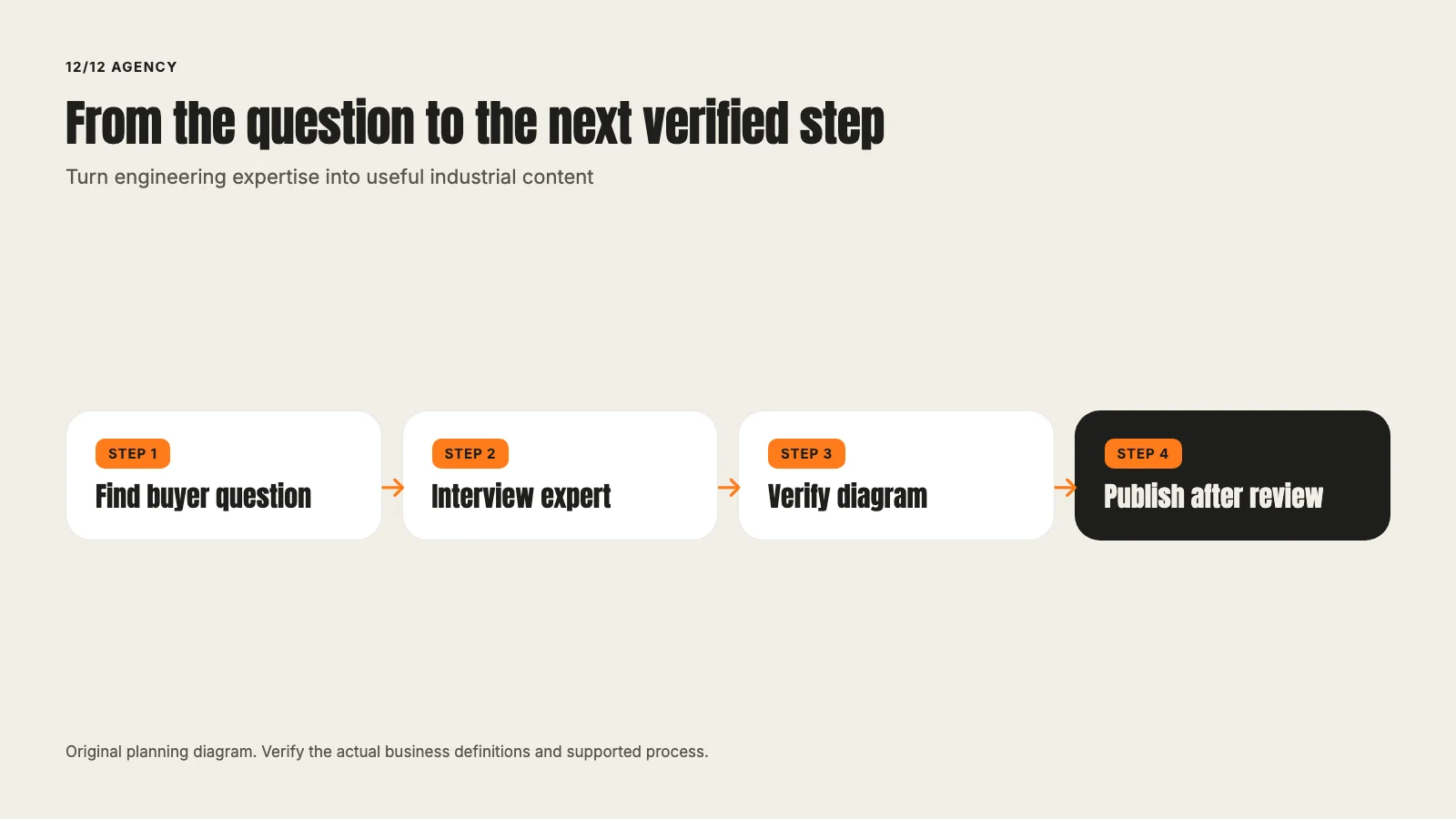
Ask the expert to walk through the actual process. What happens first? Which inputs change the decision? What can the company verify publicly? Which edge cases require another specialist?
Then ask what the draft could accidentally imply. A process description may sound universal even when it applies only to one material, production range or facility. Record those limits while the expert is available.
Do not assume that an internal presentation is approved for public reuse. Customer names, drawings, commercial terms and unpublished methods may need separate permission. The content plan should identify an approved source, not merely a file someone can open.
Choose a format that makes the decision easier
A process diagram can explain stages and responsibilities. A comparison table can show criteria without claiming a universal winner. An application article can explain the questions a buyer should bring to a technical review. An empty intake template can help the receiving team prepare.
Use the simplest format that carries the explanation. A diagram should not add unsupported arrows, tolerances or process steps because they look convincing. A photograph shows what is visible, not every capability the caption might imply.
A fictional component supplier could publish a guide to preparing an application inquiry. The diagram might show requirement, initial fit review, further specification and quote decision. It would not calculate feasibility or promise a delivery date.
Build a claim register
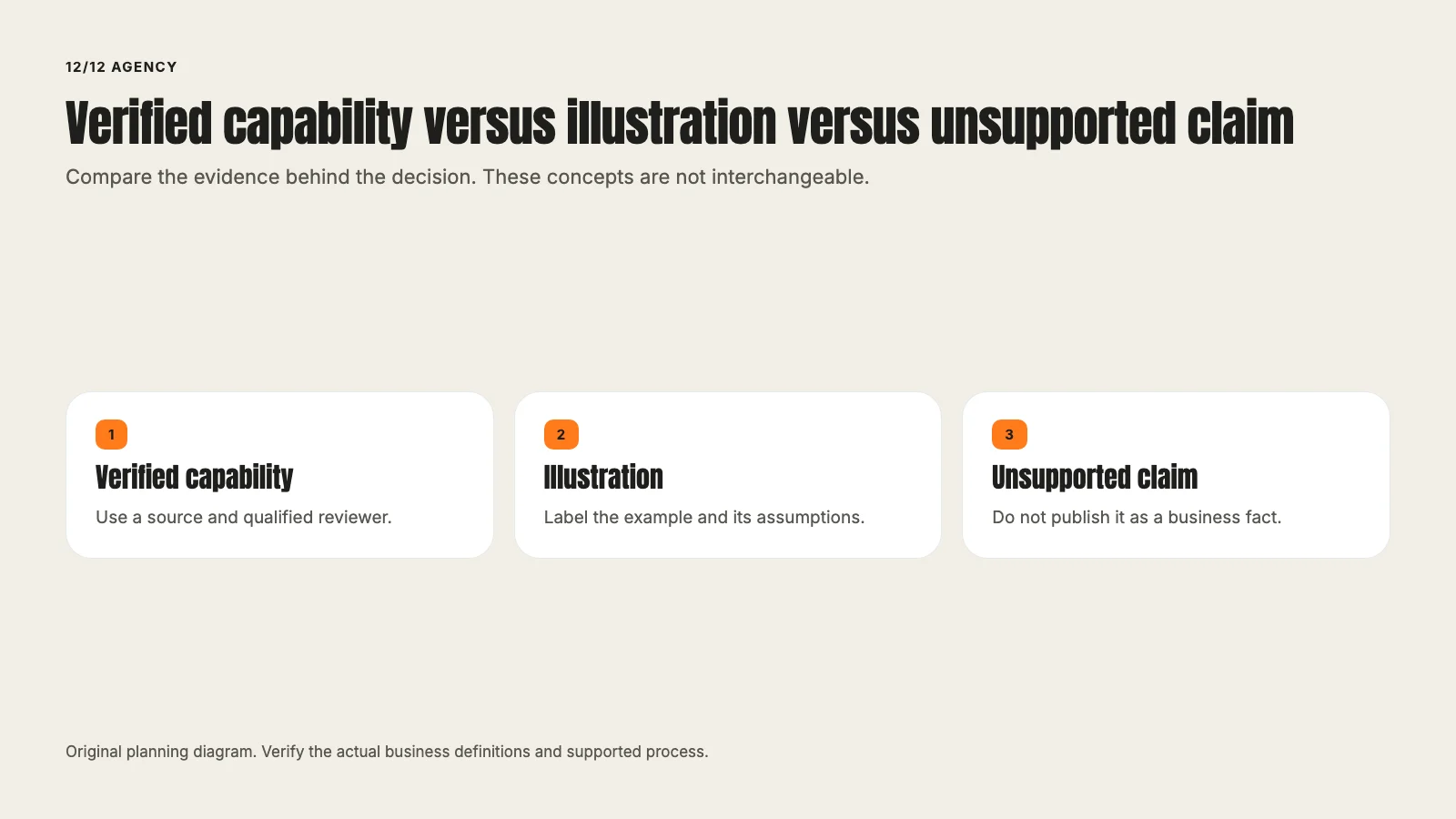
For each important statement, record its source, applicable scope, reviewer and revision trigger. A claim about a certification should identify which organization, facility or product it covers. A claim about a material or tolerance should use the approved technical wording.
Keep original observations distinct from external references and illustrative examples. If a number is hypothetical, label it in the text and any figure. If the content lacks a verified result, use a useful explanation rather than inventing a case study.
Google's helpful-content guidance provides a broad quality test: the answer should add original, useful value. The company's accurate expertise is the source of that value. A longer generic article is not a substitute.
Review while the explanation can still change
Give the technical reviewer a concrete question: is this statement accurate for the supported capability, and what would a buyer reasonably infer? A final spelling check is too narrow if the underlying explanation is wrong.
Ask commercial and privacy reviewers to handle their own areas. Technical approval does not automatically authorize a customer quote, confidential drawing or pricing statement. Keep those responsibilities visible.
Record unresolved points precisely. Unsupported claim about process temperature needs a different next step from image cropping. A broad review pending label should not obscure which source or decision is actually missing.
Make the page discoverable without distorting it
Map the article to one useful search family and the relevant existing pages. Close variants can share a single answer. If a topic already has a strong explanation, improve or link to it rather than adding a near-duplicate URL.
Google's technical search requirements describe eligibility, not a ranking guarantee. The public page needs accessible content and appropriate controls, but that does not establish that Google indexed it or that buyers will find it.
Use descriptive links to the relevant B2B industrial, equipment or industrial services context when they help the reader continue. Do not force every article to promote every offering.
Plan distribution around the buying role
A technical evaluator may need a detailed process explanation. A procurement colleague may need scope, documentation and commercial next steps. A sales engineer may use the article after a specific question arises. Adapt the surrounding message to that task.
A short social explanation can demonstrate one idea and lead to the complete resource. A sales follow-up can use it when it answers the person's actual question. Publishing an article does not authorize cold outreach or automatic email enrollment.
Keep the same accurate claims across formats. A short post should not turn a conditional capability into an absolute promise merely because there is less space.
Measure usefulness through evidence
Review discovery and engagement alongside the questions the content helps resolve. Did suitable buyers understand the requirement better? Did inquiries include more useful context? Did sales still need to correct the same misunderstanding?
These qualitative observations can guide the next edit. They do not prove that the article caused a contract. The conversion-tracking guide explains why recorded touchpoints and business outcomes remain separate measures.
A download is a download unless the business verifies a later inquiry. A quote is a quote unless the won outcome is recorded. Use accurate stage labels in public and internal reporting.
Maintain the source as the business changes
Assign a review trigger to technical information. A changed product, process range, certification or documentation set can make an old article inaccurate. Refresh the substance when needed and record the actual update.
Do not change the publication date merely to imply freshness. An unchanged claim still needs to be true. If a page must be merged or removed, prepare the specific content and route plan for approval rather than deleting it quietly.
Use a technical source card during editing
A source card can contain the precise claim, applicable product or process, approved evidence, named reviewer and change trigger. Keep the source separate from the polished sentence so the team can see whether editing altered the meaning.
For a fictional application guide, the expert might approve the sequence of questions but reject a diagram that implies automatic feasibility. The writer can then revise the visual while preserving the useful preparation advice. That is a substantive review outcome even if the final article contains no performance number.
Ask the reviewer to identify which statement would become inaccurate after a product or process change. That answer becomes a maintenance trigger. It is more useful than assigning an arbitrary refresh date to every paragraph.
The card also makes reuse safer. A short social explanation or sales resource can carry the approved claim and its limits into a new format. It should not expand the statement to make the shorter version more dramatic. Accurate reuse depends on preserving meaning, not just keeping the same citation at the bottom.
Bring one recurring technical question and the expert who can answer it to a content review.
Frequently asked questions
Want this run for your business?
Tell us where to send it and we'll follow up with the strategies that fit your market.