
Manufacturing leads start with a usable RFQ
David A · Founder, 1212 Agency
Published November 16, 2026

Define the inquiry a manufacturing sales team can assess. Connect capability evidence, specifications, routing and quote outcomes without exposing confidential work.
A manufacturing inquiry is useful when the receiving team can decide what happens next. A name and email address may not say enough about the application, capability, quantity or specification to begin that decision.
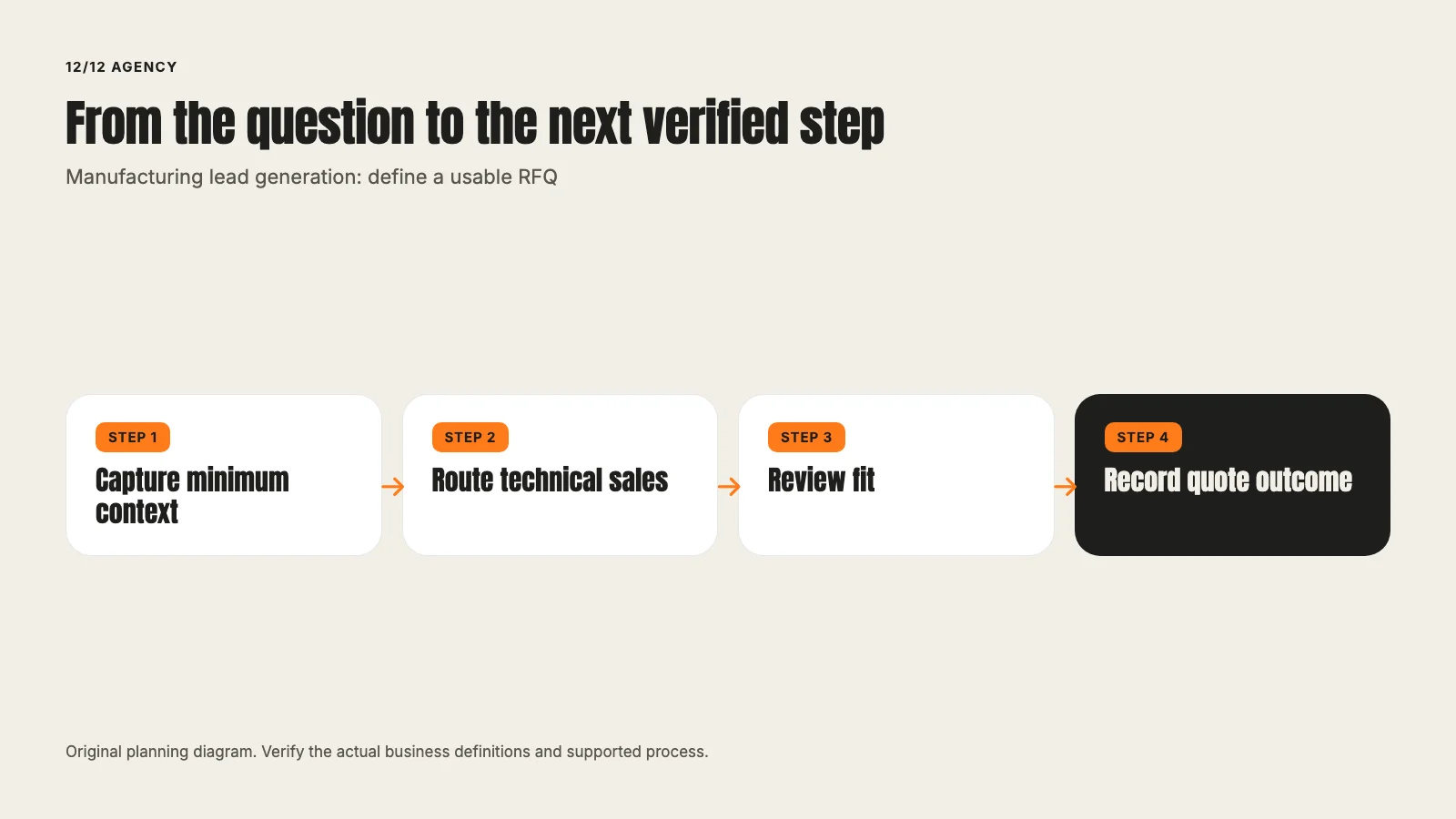
Lead generation should therefore connect the source to a usable request for quotation, or RFQ. The goal is not to collect every technical detail in a marketing form. It is to obtain the minimum appropriate context, route it correctly and preserve the evidence behind later outcomes.
Define what the business is willing to assess
Start with actual capabilities and commercial boundaries. Which materials, processes, applications, quantities and geographies can the company support? Which inquiries belong with a distributor, service partner or a different team?
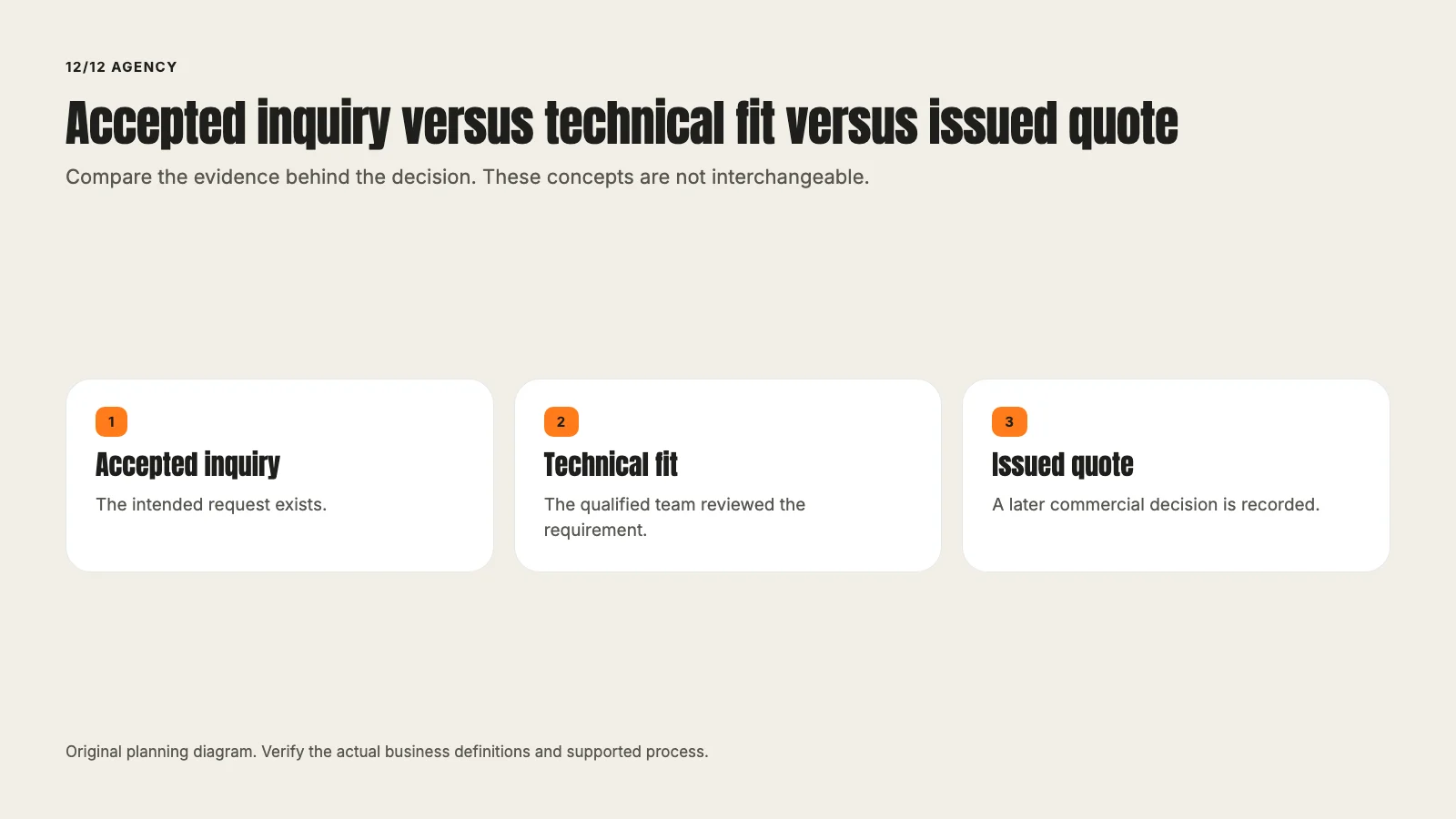
Ask technical sales to distinguish a qualified inquiry from a feasible project and an approved quote. Those stages require different evidence. A form containing a requested tolerance does not prove that the supplier can achieve it.
The manufacturing service page should explain the commercial fit. The broader industrial overview can connect the buyer journey. This guide focuses specifically on the inquiry and handoff rather than repeating the full strategy.
Identify the question behind the source
A buyer searching a process, part, application or supplier category may be at a different stage. A technical article can help someone research a requirement. A capability page can help evaluate supplier fit. A commercial comparison may require verified criteria and current evidence.
Map those sources to the explanation they need. Do not send every query to a generic contact page and assume the form will repair the mismatch. A B2B industrial page may need to explain buying roles, while an equipment page needs an accurate product and application boundary.
Read the actual search and page context before proposing more traffic. An inquiry can be unsuitable because the campaign attracted the wrong job or because the destination implied a capability the business does not offer.
Build a minimum useful intake
Ask the receiving team which fields change routing or initial preparation. Application, capability sought, material family, quantity range, general geography and planning stage may be relevant. The right set depends on the business.
Explain that early intake is not a technical approval. A buyer may not yet have a complete specification. Give the team a way to request the appropriate next information through a reviewed process rather than making every document mandatory at the first step.
Do not collect confidential drawings, export-controlled material or sensitive project details through an unreviewed marketing form. If the business needs attachments, security, legal and technical reviewers should define the handling and access before implementation.
Show the capability evidence near the request
A useful capability page answers what the company actually does and where its limits are. Use verified process descriptions, current documentation and approved examples. A generic factory photograph is not proof of a tolerance, certification or production scale.
Confirm every technical claim with the responsible expert. Record which product line, facility or process it applies to. A certificate's existence does not mean it covers every offering or every site.
Google's helpful-content guidance supports original useful explanations. The practical differentiator is the business's accurate knowledge, not a longer list of manufacturing keywords.
Agree the routing contract
Document who receives each inquiry category, which system stores it and what happens when the primary team is unavailable. A distributor question may need a different route from a direct production RFQ. A request for service on installed equipment may not belong in new-business sales.
Specify the evidence of successful delivery. A form's success message, a notification and a CRM record prove different parts of the path. Our conversion-tracking guide explains those distinctions in a wider acquisition context.
If a labeled live test is required, agree on the exact consequence before submission. Do not create repeated technical inquiries or quote requests merely to refresh a marketing dashboard. Keep the test identity visible and excluded from commercial reporting.
Review a defined inquiry cohort
Follow inquiries received in one entry period through a consistent outcome window. Separate accepted request, technical fit reviewed, sales-qualified opportunity, quote issued and won outcome. Preserve missing evidence and still-open records.
A fictional cohort might contain 40 accepted inquiries, 18 reviewed as potentially suitable, eight quotes and two won projects. Those figures illustrate the stage map. They do not establish manufacturing benchmarks or imply that all suitable inquiries should receive a quote.
If the included acquisition cost is a fictional $6,000, cost per accepted inquiry is $150 and cost per issued quote is $750. Cost per won project is $3,000 under that narrow cost definition. None of those amounts represents project profit or collected revenue.
Make rejection reasons useful
Ask technical sales to use a short, agreed set of reasons when an inquiry cannot progress. Unsupported process, quantity mismatch, outside geography, incomplete specification, distributor route and duplicate are different observations.
Do not force a conclusion where the evidence is missing. Unknown is better than labeling every unanswered request unqualified. Review whether a missing field, unclear capability page or operational delay caused the uncertainty.
These reasons can guide the next marketing change. A capability mismatch may need clearer copy. Repeated incomplete specifications may need an explanation or template. An unanswered notification may need a routing repair rather than another campaign.
Keep attribution narrower than business proof
An ad platform may credit a request under its attribution rules. The CRM may hold a later opportunity or quote. The finance system may record cash at a different time. Those totals need not match because they answer different questions.
Do not add platform-attributed values together when the same project can be claimed by more than one system. Preserve the actual outcome definition and source. A quoted value is not automatically won revenue.
For Microsoft Advertising, its UET overview distinguishes recorded website behavior from selected conversion goals. The broader lesson is to verify what the system is told to count rather than infer the business outcome from a tag name.
Choose the next complete work item
A useful first slice can include one capability explanation, a minimum intake, a verified route and a cohort review. The business can judge that complete path before multiplying campaigns or forms.
The next work item should name the observation, proposed change and acceptance check. Keep technical feasibility, commercial approval and marketing performance as separate responsibilities. Budget and account changes still require the appropriate approval.
Keep the RFQ template free of hidden assumptions
An empty template can ask for application, capability sought, material family, quantity range, specification status and the role needed for review. It should explain why the information helps the first assessment and what can wait for a secure later process.
Do not prefill a supported value merely because it appears in an illustrative example. A buyer's requested material does not prove supplier compatibility. A quantity range does not establish production capacity. The actual technical team decides what can be assessed or quoted.
Review the template with the people who receive it. If they cannot explain how a field changes routing or preparation, reconsider whether it belongs in initial marketing intake. The goal is useful context with appropriate handling, not a longer form that appears more technically sophisticated than the process behind it.
Bring the capability boundaries and the receiving team's questions to a review. Start with an inquiry the team can use.
Frequently asked questions
Want this run for your business?
Tell us where to send it and we'll follow up with the strategies that fit your market.