
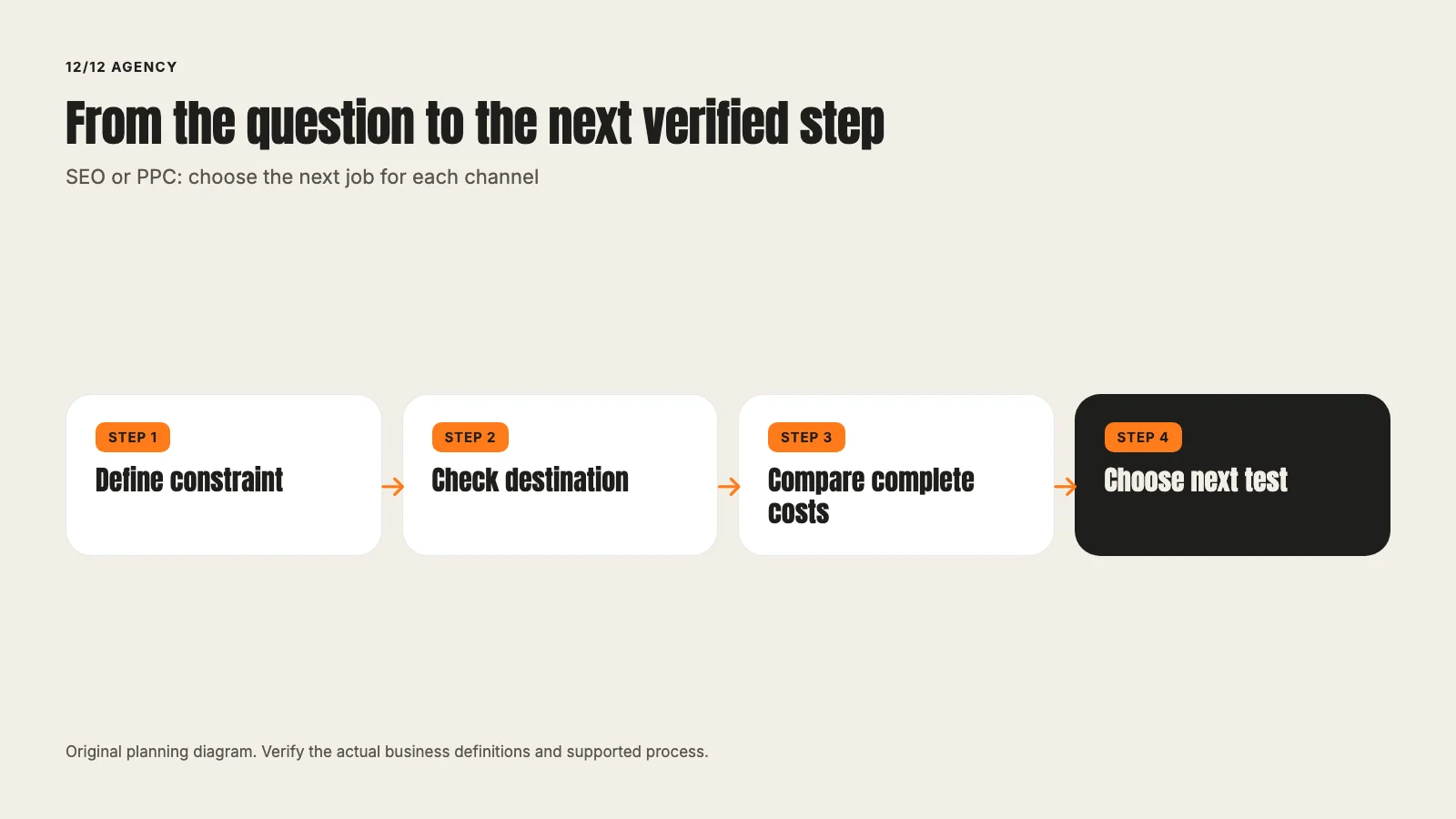
SEO or PPC: choose the next job for each channel
David A · Founder, 1212 Agency
Published November 16, 2026

Compare SEO and PPC using buyer demand, timing, page readiness and useful outcomes. Build a practical work sequence without a universal budget split.
The SEO-versus-PPC question often arrives before the business has defined the problem. Does it need a way to reach existing demand? A useful explanation for buyers doing research? A reliable form and sales handoff? More suitable inquiries rather than more visits?
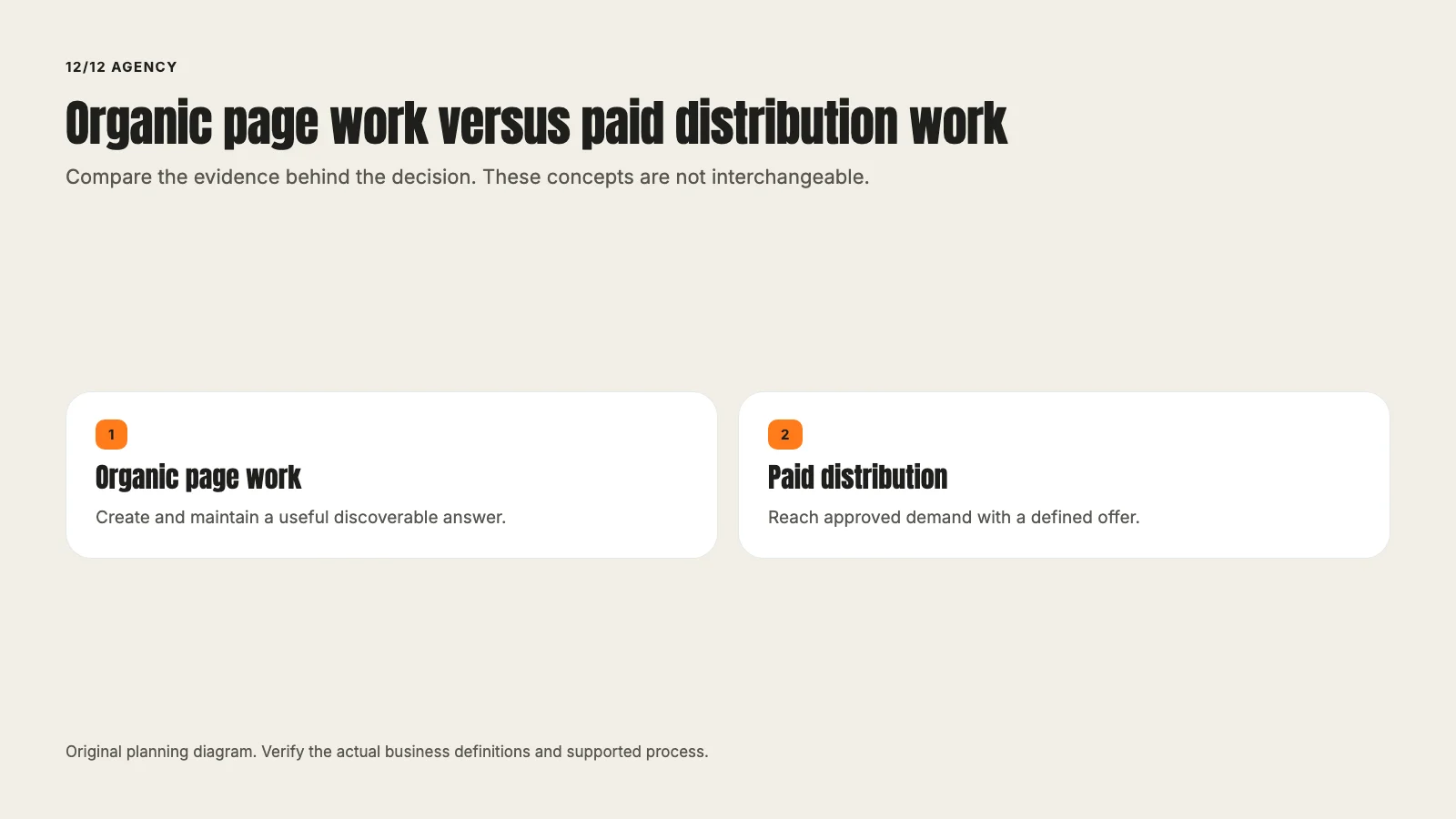
Search engine optimization and paid advertising can support different jobs in the same journey. Choosing the next job makes the channel decision more useful than comparing two generic lists of advantages.
This guide uses fictional situations, not client results or a universal allocation model. It does not recommend changing an existing account without reviewing the actual evidence and approvals.
Start with the demand the business can serve
Write down the buyer, offer and action. A contractor offering a specific service in a genuine operating area has a different demand problem from a software company introducing a new workflow.
Search advertising can reach eligible searches when the campaign enters the auction. Organic search depends on useful, discoverable content and how search systems evaluate it. Neither channel makes an unsupported offer relevant.
Look at the actual results for important terms. Are people comparing suppliers, learning a process, looking for a login or shopping for a product you do not provide? A high-volume phrase can still be the wrong demand for the business.
Google's keyword-list guidance is useful for understanding paid-search matching. Its helpful-content guidance offers a separate test for whether a page gives the reader a worthwhile answer.
Separate time sensitivity from a promise of fast sales
A time-sensitive offer may need a paid distribution plan. That does not mean advertising guarantees inquiries on a specific schedule. Campaign review, demand, eligibility, page quality and the sales path still matter.
SEO work can improve a lasting information asset, but organic visibility and business results are not guaranteed. A useful page may need technical fixes, better evidence or a different place in the site before it can serve readers well.
Ask what must happen by the date in question. Publishing an accurate event page is a controllable task. Selling a certain number of tickets is a business outcome affected by more factors. The plan should distinguish those commitments.
Review the destination both channels would use
If the page makes the wrong promise, changing the traffic source does not resolve the mismatch. Review the offer, fit requirements, proof and next step first.
A software buyer might need a use-case explanation before a demo form makes sense. A homeowner might need to know whether the contractor performs the requested job. An industrial buyer might need a capability limit or specification detail.
Our SaaS marketing overview, home-services overview and industrial overview show why the useful action differs by business. The channel plan should follow that journey rather than force every visitor into an identical form.
Use a job-based comparison
| Situation | Useful initial work | What to verify |
|---|---|---|
| Clear commercial demand, suitable offer, working page | Consider a bounded paid-search test | Search fit, accepted actions and later quality |
| Buyers repeatedly need a technical explanation | Build or improve an accurate relevant page | Expert evidence, discoverability and usefulness |
| Existing organic visits, poor handoff | Repair the page and accepted-action path | Form acceptance, confirmation and routing |
| Several pages answer the same question | Decide what each page answers | Which page best answers the question |
| New offer with uncertain positioning | Research the buyer and message | Whether the promise is clear and supportable |
These are starting decisions, not rules that every company must follow. The business's resources, current evidence and approval process determine what can be done well.
Compare full costs on a consistent basis
Paid-media cost is visible in the platform, but a complete acquisition view can also include management, creative, page work and sales follow-up. SEO requires research, technical implementation, expert input, content production and maintenance.
Do not call organic traffic free because there is no charge for each click. Do not compare a fully loaded SEO cost with a media-only paid number. Define the eligible costs and period before drawing a conclusion.
The existing budget resource can help structure the assumptions. Treat its outputs as scenarios rather than guaranteed leads. Record the inputs your team can support, then compare the complete costs of producing and measuring each channel's work.
Let the channels share useful evidence
Actual search terms can expose questions the website does not answer. Sales conversations can show why a relevant visit did not become a suitable inquiry. A product guide can provide a better destination for a campaign than the general homepage.
That does not mean every paid term needs an organic article. Check the current page, reader question and evidence before adding a URL. Likewise, a high-traffic educational page does not automatically deserve a paid campaign.
Use shared learning to improve the map. A clear question, an accurate page and an accepted action are useful across channels. Our conversion-tracking guide explains why the handoff needs checking even when the acquisition source changes.
Keep measurement from becoming a false competition
Someone may discover the business through one channel and return through another. Platforms can use different attribution rules and windows. A last recorded touch does not prove that the earlier work had no value.
Keep observable stages separate: relevant visibility, visits, accepted inquiries, qualified outcomes and collected revenue. Then explain the attribution basis for any channel comparison.
A controlled experiment can answer some causal questions when the design and sample support it. A before-and-after report with several simultaneous changes should not be described as proof that one channel caused the difference.
Work through two fictional examples
A local service company has accurate service pages and staff available for suitable estimate requests. It can review a small, clearly scoped paid-search test while improving the evidence on important service pages. The next review asks about job fit and accepted requests, not only click volume.
A technical software company has several articles but weak product and integration explanations. Its first useful SEO work may be improving those pages with the product team. Buying more category traffic before the page explains the product could leave the same buyer questions unanswered.
Neither example establishes a budget split. The important difference is the work required to make the next visitor useful.
Write a sequence the team can actually support
Choose the immediate problem, the owner and the acceptance check. Then identify the next dependent job. A technical repair might come before a new content cluster. A page rewrite might come before a campaign expansion. Sales-stage definitions might come before a cost comparison.
Allocate production capacity as well as money. A plan needing product interviews, design and engineering cannot be completed by assigning only a writer. The review process should include the people who can confirm the claims and release the changes.
Avoid treating publication volume as the goal. Complete useful work, observe what happens and use the evidence to choose the next step.
Keep the channel choice reversible and reviewable
Record the next test's scope, included costs and the evidence that would change the decision. A useful comparison can begin with one existing page or one query family rather than a permanent commitment to every channel.
The report should explain why the chosen work addresses the current constraint. A ranking observation, a click or a content publication is a step in that plan, not proof that the business problem is solved.
Bring the offer, current pages and next business problem to a strategy session. We can discuss paid media and the organic work needed around it.
Frequently asked questions
Want this run for your business?
Tell us where to send it and we'll follow up with the strategies that fit your market.