
Compare roofing leads by inspections and won jobs
David A · Founder, 1212 Agency
Published November 16, 2026

Compare roofing lead sources using contactability, project fit, inspections and won jobs. Build a full-cost cohort worksheet without treating every lead equally.
The cheapest roofing lead is not necessarily the least expensive path to a suitable job. A contact can be outside the service area, seeking unsupported work, duplicated, unreachable or still too early to book an inspection.
Compare sources using the same definitions and a complete outcome window. The goal is to learn which source produces work the company can serve at a cost it understands. This guide uses fictional arithmetic and makes no recommendation about a particular lead vendor.
Define the contact you are buying
A paid search request, a referral, an organic website inquiry and a third-party lead delivery have different origins. Some lead services may sell the same request to several businesses. Others may define a billable lead differently from your office's definition of a suitable project.
Read the actual terms before committing money. Check what is delivered, whether exclusivity is promised, which eligibility criteria apply and how disputes or credits work. Do not assume a vendor's word lead means a booked inspection or a customer.
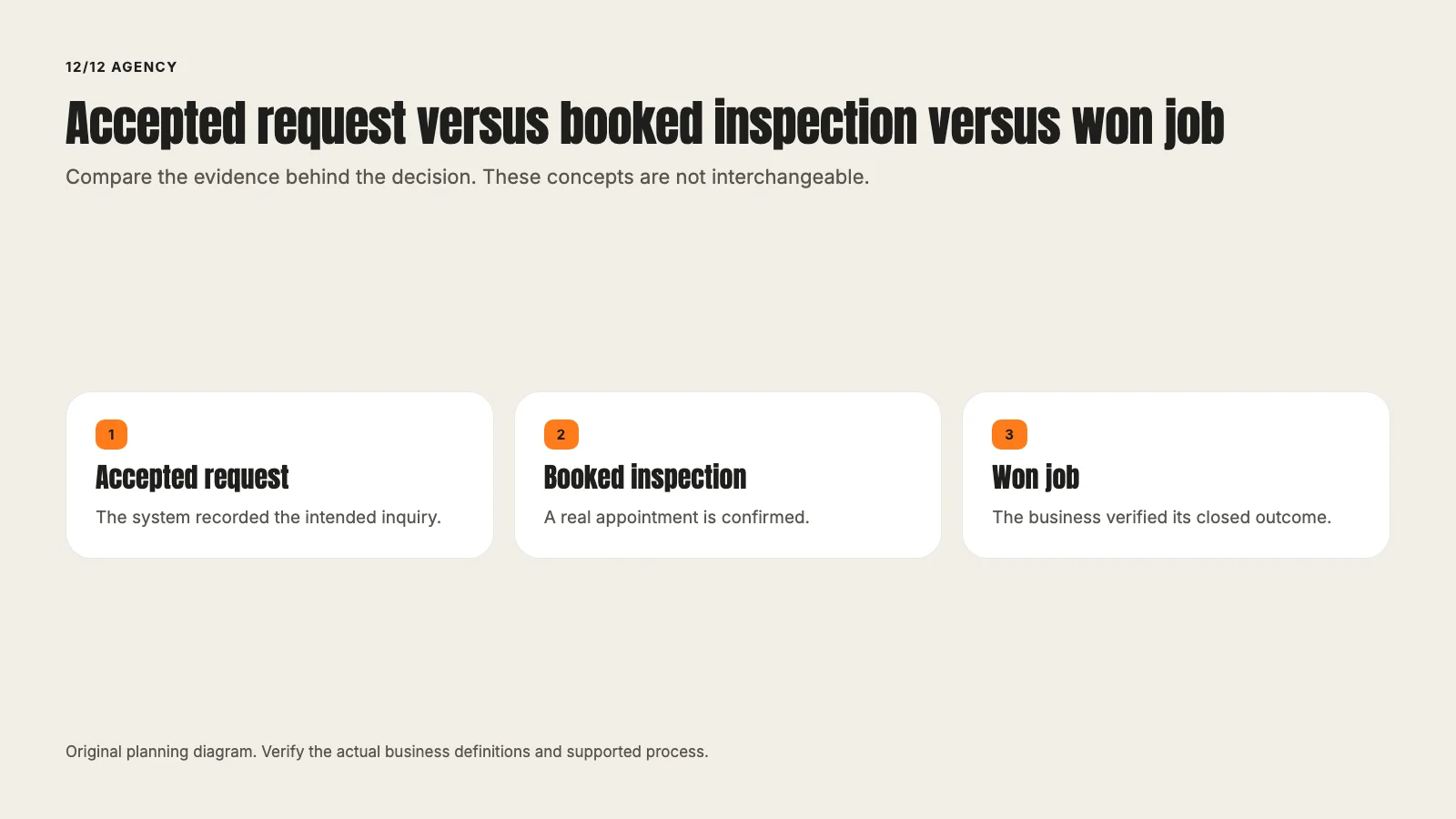
For the internal comparison, define accepted request, suitable project, contacted prospect, inspection booked, estimate issued and won job. Record duplicates and missing evidence separately. A contact that progressed through four stages is still one person or project.
Compare the complete cost
Include media or lead purchase cost and the relevant management, production and intake costs. Do not add the same expense twice if it is already included in a fee. Keep the period and acquisition cohort consistent.
In an illustrative scenario, source A costs $3,000 and produces 30 accepted requests. Source B costs $2,400 and produces 40. Their cost per accepted request is $100 and $60. That alone favors B.
After an equal outcome window, suppose A produces ten booked inspections and three won jobs, while B produces eight inspections and one won job. Cost per booked inspection is $300 for each source. Acquisition cost per won job is $1,000 for A and $2,400 for B, before costs excluded from this simplified model. Those results reverse the initial comparison without proving what another campaign will do.
Check whether the cohorts are comparable
A source focused on replacement projects should not be judged against emergency repair inquiries without considering the job mix. Geography, season, weather, staffing, project value and response process can all differ.
Write down those differences rather than forcing every source into one headline ranking. Compare matched groups where possible. If one source has only a few completed jobs, describe the result cautiously. A single additional job can materially change a small cohort's cost.
Also distinguish timing. Requests received late in the month may not have had time to produce an estimate or decision. Label still-open projects and review them again after the agreed window.
Inspect what happens after delivery
Ask the office to classify unsuitable requests with a short, consistent reason. Examples can include outside area, unsupported service, duplicate, incorrect contact information or unable to reach. Do not label every unanswered call bad lead without checking the contact process.
Review routing, operating hours and follow-up responsibilities. A request delivered while no one is available may have a different outcome from one answered promptly, but that does not establish a universal causal improvement from a particular response speed.
Use approved records and protect personal information. Public reports can show aggregated counts and definitions without screenshots of names, addresses or private project details.
Choose a next test rather than a permanent verdict
The useful decision might be to repair source tracking, narrow the supported project explanation, review a vendor's delivery terms or run a bounded channel comparison. A source should not be scaled merely because its accepted-request cost looks low.
Define what the next test must establish, what it costs and who approves changes. An agency review does not authorize a budget increase, cancellation or new vendor purchase. Those are business decisions with their own approval.
For owned acquisition, the roofing service page should explain supported work and the estimate path. The educational SEO and paid-search guides can address channel-specific decisions without becoming duplicate lead-vendor lists.
A usable comparison sheet
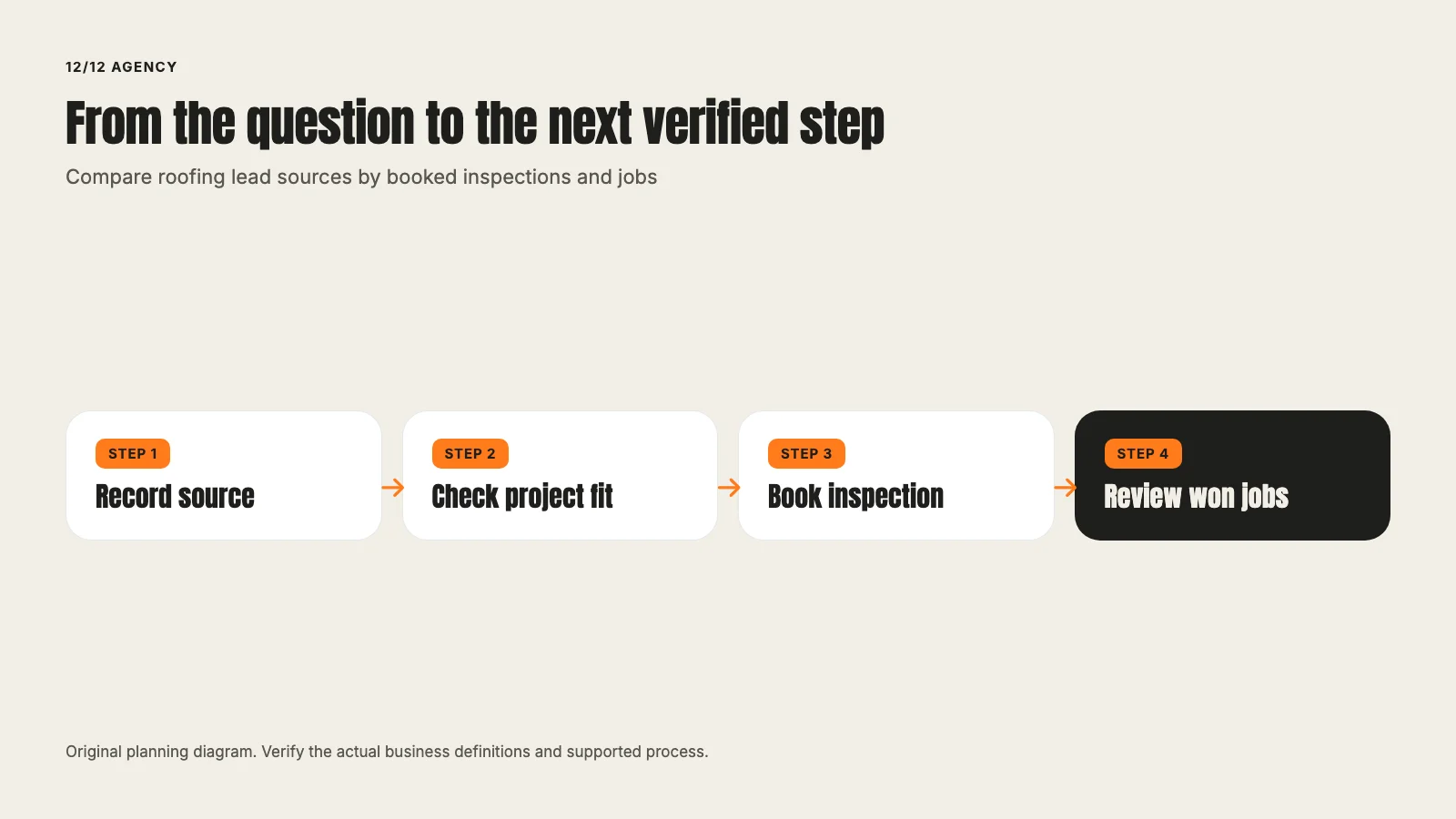
Use one row per source and cohort. Include entry dates, cost definition, accepted requests, suitable projects, contacted prospects, inspections, estimates, won jobs, still-open records and the main exclusion reasons. Keep business totals separate from labeled tests.
Do not sum attributed revenue across platforms that may both claim the same job. Record the business's verified closed outcome once and explain which attribution model is being compared.
Bring the source definitions and a completed cohort to a review. The first improvement may be the comparison itself.
Inspect the acquisition terms and operating effort
Before comparing a purchased source with owned marketing, write down the actual unit being supplied. Is the charge for a contact delivery, a related inquiry or a later stage? What evidence supports the vendor's eligibility description? Which duplicate or credit procedure applies to the agreement? Those questions require the actual terms, not a general assumption about lead marketplaces.
Owned acquisition has a different cost structure. The Google Ads and Meta service contexts can involve media, creative, pages and management. The home-services overview can connect those expenses to the office and estimate process. Neither path should be called free or guaranteed without a defined boundary.
The tracking guide helps identify the source record and accepted action. For a search comparison, Google's search-term documentation explains one source of query evidence. Its lead-generation guidance provides platform context for meaningful outcomes. Those references do not certify a roofing vendor or predict job quality.
Use a source review the estimator can maintain
Give the estimator a short set of questions: was the project supported, was contact made, was an inspection booked and what prevents the next step? Keep the definitions visible beside the fields. A busy team is more likely to maintain a few useful states than a long scoring rubric with unclear rules.
Review missing data as its own category. If nobody recorded the inspection result, the marketer should not guess that the lead was poor. Ask whether the source, form or operating process can preserve the needed evidence more reliably.
Also record the project mix. A repair inquiry and a replacement project can require different time and economics. A source that brings more of one type should not be compared with another solely on average lead cost. The business may prefer a particular mix, but that preference should be stated rather than hidden inside a quality label.
The resulting decision can be modest and concrete: clarify one project boundary, improve a routing field or collect a complete outcome window before changing acquisition. That is more useful than a permanent source ranking built from incomplete records. No contract cancellation, vendor purchase or campaign pause follows automatically from the worksheet.
Preserve the still-open projects
A roofing inquiry may remain legitimate while an inspection or decision is pending. Keep those projects visible in the source cohort instead of assigning them a final lost status for reporting convenience.
Write the review date and the amount of opportunity each record has had to progress. If source A's inquiries are older than source B's, a later-outcome comparison needs that qualification. Missing inspection evidence should remain missing until the responsible team verifies it.
The next report can revisit the same cohort without replaying contacts or creating new records. That produces a more useful history than replacing the dataset with whichever month currently looks best.
Frequently asked questions
Want this run for your business?
Tell us where to send it and we'll follow up with the strategies that fit your market.