
Restaurant marketing: choose the dining job
David A · Founder, 1212 Agency
Published November 16, 2026
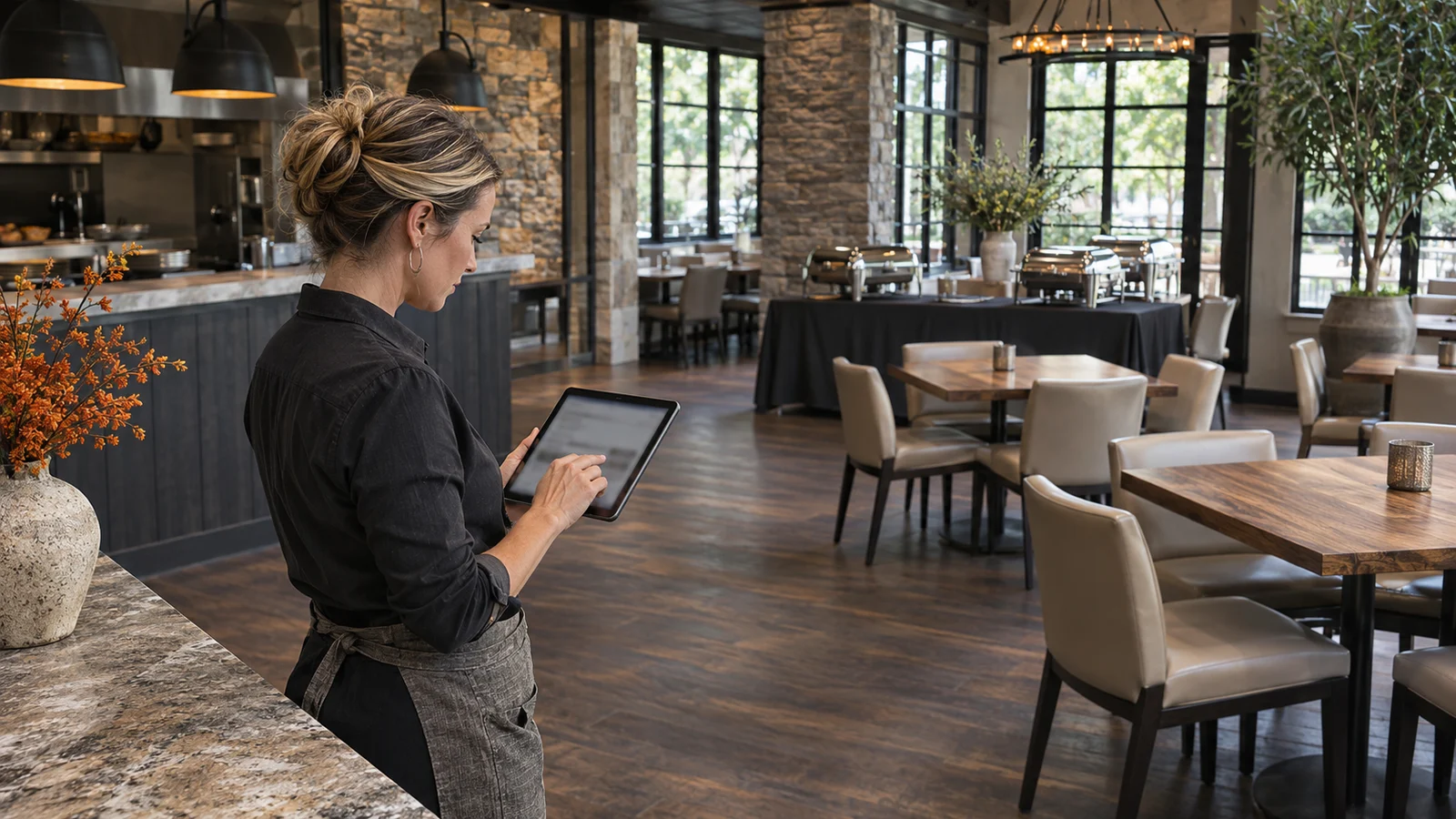
Plan restaurant marketing around reservations, visits, catering or private events. Match the offer to real capacity and a verified customer handoff.
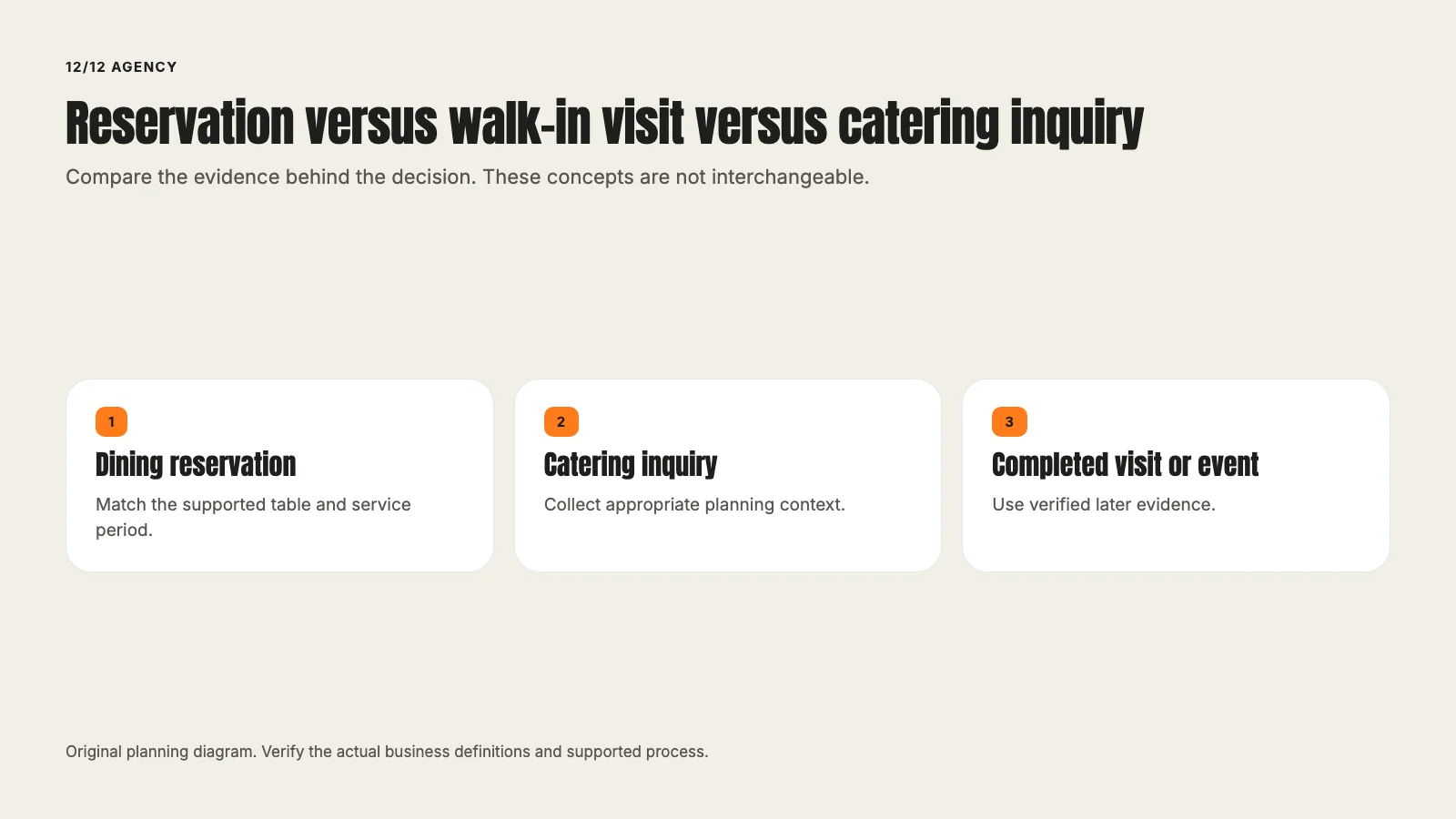
A reservation, a walk-in visit and a catering inquiry are different jobs. A restaurant marketing plan becomes difficult to judge when it sends them to the same generic page and counts every click as a customer.
Choose the business outcome first. Then align the offer, location information, destination and staff process. This guide uses fictional operating examples, not a promise about sales, table turns or a particular booking integration.
Separate the journeys the restaurant actually supports
Ask the restaurant team which work matters for the current plan. Dining reservations may depend on available tables and service periods. Catering may require lead time, location and a separate quote. Private events may need a capacity and consultation process.
The restaurant service page can explain those commercial contexts. The local-business overview can connect the wider engagement. Do not create several nearly identical agency pages to target every variation of restaurant marketing.
Define the accepted next action for each journey. A menu view is not a reservation. A catering form is not a confirmed event. An online order should only be offered if the actual system and fulfillment process support it.
Verify the public information people use
Check the current location, hours, contact details, menu source and approved imagery. Identify who maintains each fact. A promotion that remains visible after its service period can create confusion even if the campaign itself has ended.
Google's business representation rules support accurate real-world information. Use the actual location and operating model. Do not imply a separate branch or service that does not exist.
Google's local-ranking guidance also limits the promise an agency should make about map positions. A useful local plan improves accurate information and the customer path while acknowledging factors outside the business's control.
Match the message to available capacity
A campaign should promote a service the restaurant can fulfill. Ask which days, times, party sizes or event types the approved offer covers. The public explanation should make meaningful limits understandable before the request.
Do not invent a discount, minimum spend or availability claim. Those are commercial decisions. If a real offer exists, verify its current terms and the destination that communicates them.
A fictional catering campaign might invite a planning conversation for an office lunch rather than promise instant confirmation. A dining campaign might lead to the actual supported reservation route. The relevant page and next action should follow the job.
Use creative that represents the experience accurately
Approved food and venue images can help someone understand the restaurant. A stock image of a dish not served there creates the wrong expectation. A crowded dining-room photo should not imply current availability or a guaranteed atmosphere.
Ask the team which menu and venue facts can be verified. Food, allergy, dietary and safety statements require the appropriate responsible review. Marketing copy should not infer a medical suitability claim from an ingredient or image.
Short social explanations can introduce a dish, process or event context. The Meta service page can support a scoped paid discussion, while organic content should still have a clear audience and source rather than a posting quota alone.
Build the destination around the decision
A dining visitor needs current useful information and the reservation or visit path. A catering buyer needs enough context to prepare an appropriate inquiry. A private-event prospect needs a truthful explanation of the process and the information required for review.
Avoid placing every journey behind one vague contact button. Clear options can help routing when they reflect real operational differences. The website should not introduce a service merely because it makes a convenient landing-page category.
For paid search, the Google Ads service page can support the acquisition plan. A search campaign still needs a destination that matches the specific promise rather than a generic homepage by default.
Keep forms and booking expectations precise
Ask only the information the team uses at the initial stage. Date, general party or event size and requested service may be useful in a catering inquiry. A completed inquiry should not be called a confirmed booking unless the business actually accepts it at that point.
Inspect mobile controls, date entry, errors and the confirmation. If a third-party booking route is used, verify its actual behavior and permitted source handling. Do not promise an integration because the vendor has a general product page.
A labeled live test may create a real table hold or staff notification. Agree on that consequence beforehand. Do not make extra reservations or cancel existing ones merely to produce a marketing receipt.
Measure the outcome the campaign was given
Separate page visits, menu interactions, accepted inquiries, confirmed reservations, attended bookings and verified transactions. The conversion-tracking guide explains why those stages need their own evidence.
An advertising platform's attributed result is not necessarily the same as a reservation system's total or a point-of-sale record. Define the relevant period and stage before comparing them. Do not invent a POS connection or claim every walk-in can be attributed.
Use aggregated evidence where possible. A report can explain a reservation cohort without displaying customer names, phone numbers or private event details.
Compare economics with the right boundary
For a fictional catering test, suppose $1,500 of media and $500 of included production work produce ten accepted inquiries and two confirmed events after the agreed review window. Included cost per inquiry is $200 and per confirmed event is $1,000.
Those figures are illustrative arithmetic, not restaurant benchmarks. They do not show event profit. If the business wants a contribution comparison, it needs the actual revenue and eligible delivery costs under a clear accounting definition.
Do not compare a dining awareness campaign with a high-intent catering request campaign using one undifferentiated cost per click. Their jobs and outcome windows differ.
Make the next change useful
The review may reveal inaccurate hours, a confusing reservation handoff, an unsupported offer or a weak fit between the campaign and page. Fix a reproducible problem with an acceptance check. Test uncertain alternatives with an explicit question and review plan.
Budget, targeting, promotions and campaign status changes need approval. A report should name the proposed decision and its evidence, not treat an attractive cost metric as automatic permission.
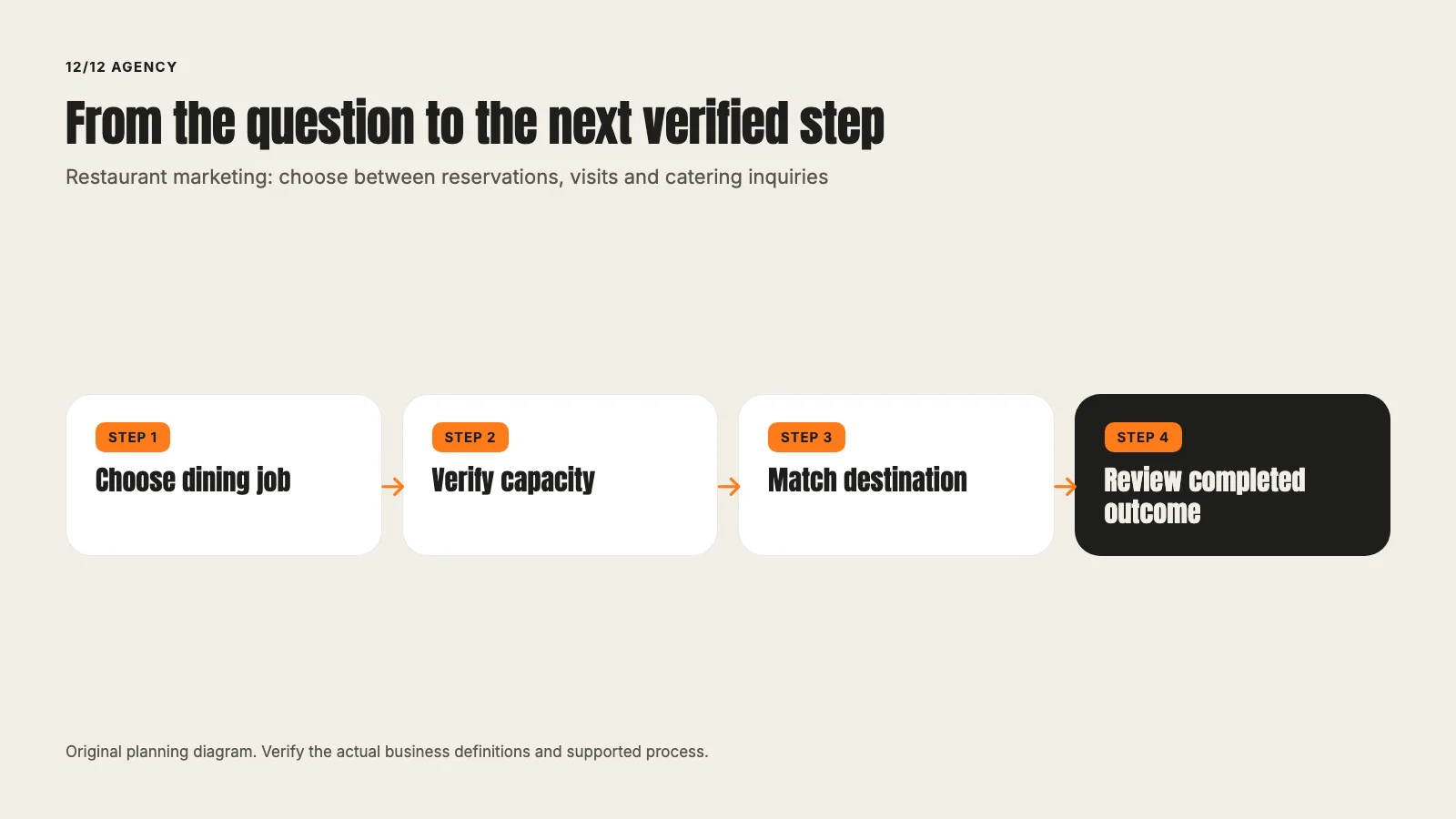
Build one service-period review card
Choose the dining or event job and record the relevant capacity, approved offer, destination, accepted action and receiving role. The card should make it clear whether the business is measuring a reservation, inquiry or completed visit.
For a fictional catering plan, the team may need a requested date, service context and an appropriate planning conversation. For a dining reservation, the useful evidence may be a confirmed booking in the supported system. Do not use the same denominator merely because both originated from an ad.
Review the actual final creative with the operations source. A beautiful dish image can still be wrong for the menu or service period. A table photograph can imply an event setup the restaurant is not currently offering. Those are factual review questions before they are creative preferences.
The card's next step should be concrete: verify the route, correct the offer, clarify the service or prepare a bounded comparison. No automatic discount, new reservation or campaign change is implied by the planning exercise.
Bring the dining job, capacity and current destination to a planning session.
Frequently asked questions
Want this run for your business?
Tell us where to send it and we'll follow up with the strategies that fit your market.