
Remodeling leads that fit the project you want to build
David A · Founder, 1212 Agency
Published November 16, 2026

Plan remodeling acquisition around project type, scope, readiness and consultation capacity. Review inquiries through estimates and signed projects.
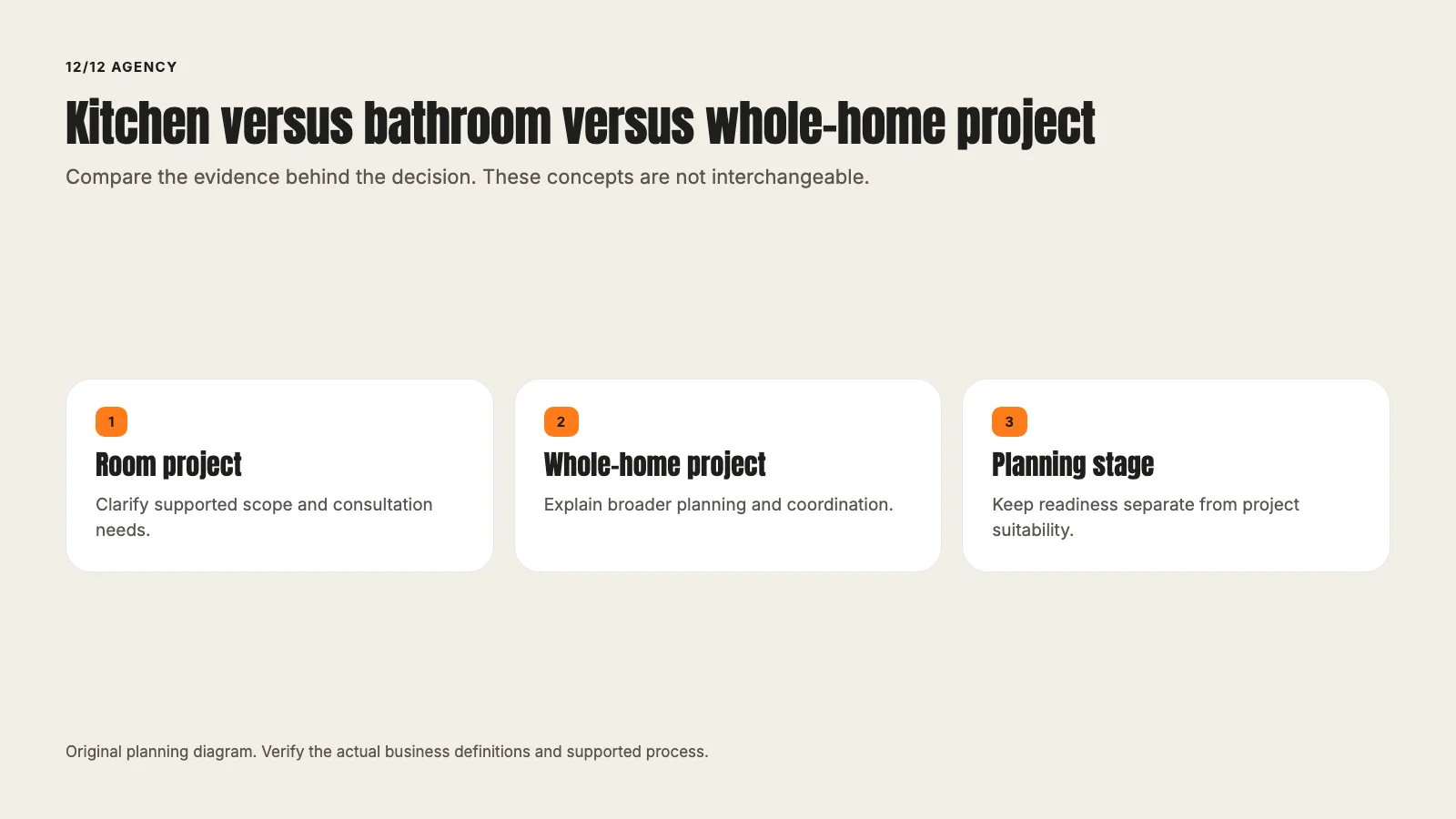
A kitchen refresh, a full addition and a whole-home renovation may all be called remodeling. They can require different expertise, timelines and consultation work. A lead report that treats them as the same opportunity leaves the sales team to reconstruct the difference.
Start with the project mix the business can support. Then connect the marketing promise to qualification, consultation and the later project decision. The examples below are fictional and contain no claim about a 1212 client's results.
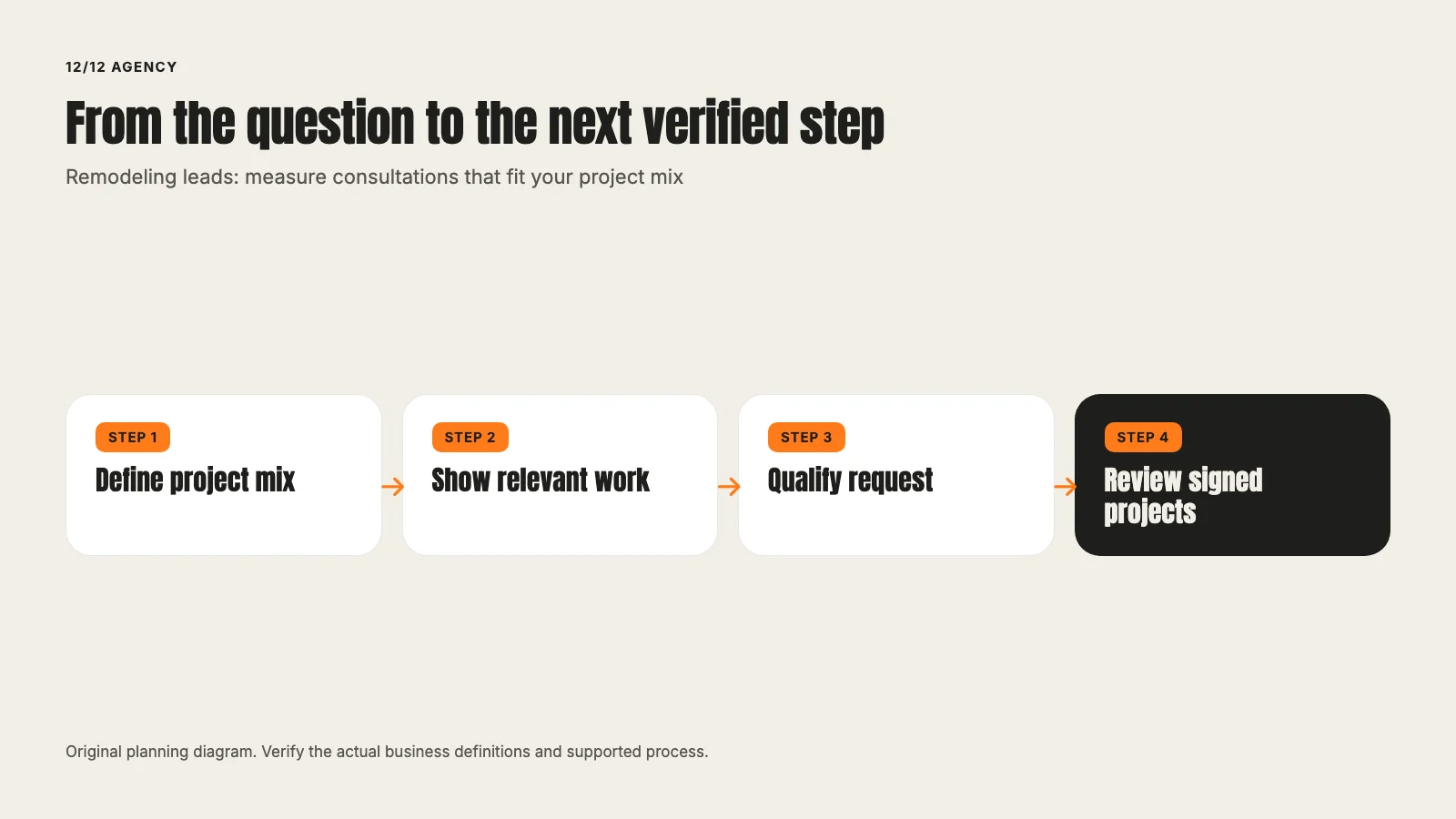
Define the supported project
Ask the business which jobs it wants and can deliver. Record scope, property type, service area and practical constraints. A company can accurately describe a specialization without claiming that every other project is unsuitable.
Use those facts to choose the page and message. A whole-home planning page may need process and coordination evidence. A bathroom project page may need a narrower scope explanation. Do not create separate pages solely to repeat the same promise under more keywords.
The existing remodeling service page remains the commercial destination. Educational content should help a buyer make a distinct planning decision.
Show relevant work with accurate context
A portfolio should help the reader evaluate the supported scope and process. Use approved images with truthful captions. If a photo shows only one room in a larger project, do not imply that it proves every service or design capability.
Ask the business to explain the decisions behind the work: the project objective, constraints that may be disclosed and the role the company actually performed. Avoid publishing a customer's address, plans or identifying details without permission.
Claims about permits, engineering, financing or costs need their own qualified review. An attractive image does not establish a typical price or guarantee that another property can achieve the same result.
Qualify for a useful first conversation
The initial form should ask for information the team will use. Project category, general location and planning stage can help routing. The right questions depend on the actual consultation process.
Avoid invented minimum budgets or arbitrary mandatory fields. If the business has a real threshold, the current wording should be approved. Explain the next step accurately: a request for consultation is not a confirmed appointment unless the system actually books it.
Give people room to explain uncertainty. A buyer may know the desired outcome without knowing the final scope. The form can support that conversation rather than demand a technical specification the visitor cannot reasonably provide.
Compare sources through the project stages
Use consistent labels for accepted inquiry, suitable project, consultation booked, consultation held, estimate issued and signed project. Preserve actual event dates and a clear project identifier where supported.
Do not add those stages together as a count of customers. An estimate value is not collected revenue, and a signed contract may have a different cash schedule. Separate acquisition reporting from accounting measures.
A fictional source produces 24 accepted requests, 12 suitable projects, six consultations and two signed projects after the agreed window. Those counts describe one cohort. They do not establish a remodeling benchmark or a promise for the next campaign.
Include the work outside the media account
Media spend is one acquisition cost. Management, creative, landing-page work and consultation time may also matter. Decide which costs belong in the comparison and avoid counting the same expense twice.
If the fictional cohort costs $4,000 in media and $1,000 in other included acquisition work, the total is $5,000. With two signed projects, the simple included acquisition cost per signed project is $2,500. It does not represent project profit or include unentered costs.
Review whether the consultation team can support additional volume. More requests can be harmful if they crowd out suitable projects or create misleading response promises.
Inspect the journey before buying more demand
Open the page from the actual campaign route. Check that the offer, project examples and form match. Follow the accepted request into the approved business process and inspect what the team receives.
A broken form or missing project category needs a repair with an acceptance check. An uncertain message choice needs a test plan. Those are different jobs. Do not repeat real submissions or create extra appointments without approval.
Our existing tracking guide supplies the broader event and CRM distinctions. The remodeling review should focus on project fit and the consultation process.
Choose the next decision
The next useful change might clarify the supported scope, improve portfolio context, change a form field or propose a bounded source comparison. Record why it is expected to help and what evidence will be reviewed.
Bring a supported project type and the current consultation path to a review.
Use a consultation-preparation card
For one supported project type, list the buyer's starting question, approved portfolio evidence, initial information needed and the actual consultation process. A whole-home inquiry may need a different explanation from a smaller room project. The card should make that difference clear without inventing a minimum price or technical recommendation.
The home-services overview can connect the service mix. A Google Ads plan may reach an existing project search, while a Meta plan may introduce an approved project explanation. Those channels still need the same accurate scope and receiving process.
Google's search-term guidance can support the paid-search review. Its lead-generation guidance supplies primary platform context for meaningful outcomes. The sources do not establish a remodeling benchmark or verify a contractor's project claims.
Review what the consultation actually taught the team
Ask whether the inquiry matched the supported project, whether the person understood the next step and what information was still missing. Separate a project that is unsuitable from one that is suitable but not ready or outside current capacity. Those differences can guide the next page or intake improvement.
A useful cohort review includes still-open consultations and estimates. Do not treat every recent request as a lost opportunity merely because it has not yet produced a signed project. Preserve stage dates and review an equivalent outcome window.
The same discipline applies to portfolio copy. A new project may provide useful evidence, but permission, technical facts and the company's actual role must be verified before publication. Do not reuse one room image across several service pages in a way that implies unrelated work.
Finish with a concrete next decision: clarify a project boundary, explain the consultation, repair a field or prepare a bounded acquisition test. Each action should identify the evidence that will show whether it was implemented correctly. More demand is useful only when the business can support the promise and interpret what happens afterward. A marketing report should make those responsibilities visible rather than hide them inside one cost-per-lead number.
Keep planning stage separate from suitability
A homeowner researching a supported project may be early rather than unsuitable. Record the distinction in the consultation process. The appropriate next step may be an approved preparation guide or a later conversation, depending on the business's actual scope.
Do not create an automatic long-term message sequence merely because the person is not ready now. Permission, relevance and suppression still need a reviewed plan. The marketing analysis can identify the question without authorizing new customer communication.
This distinction helps the team evaluate acquisition honestly. A source reaching early planners may need a different offer or window from a source seeking immediate consultations, rather than being labeled uniformly poor quality.
Frequently asked questions
Want this run for your business?
Tell us where to send it and we'll follow up with the strategies that fit your market.