
Local Services Ads or Search ads: compare the path
David A · Founder, 1212 Agency
Published November 16, 2026

Compare Local Services Ads and Google Search ads by eligibility, charging model, customer path and won work. Verify current rules before choosing a test.
Local Services Ads and Search ads can both reach people looking for a service, but they do not create the same customer journey. One comparison begins with the profile and lead-delivery model; the other may begin with a search ad and a website page.
Choose between them by the work the business can support, the rules it must meet and the evidence it can review. A lower headline lead cost is not a complete answer. This guide compares the planning decisions without recommending a launch or promising a result.
Check current eligibility first
Google's US Local Services introduction describes supported service categories, direct inquiries and the current Google Verified badge. Availability and badge conditions vary; do not assume an old Guaranteed or Screened description is current for every business.
The screening guidance explains that requirements depend on category and location. Verify the actual business's current process instead of copying a checklist from another trade or country.
This eligibility check is a real first dependency. It is not a reason to invent a new business location, change the service description or imply a license the business does not hold. The responsible business person supplies and approves the required facts.
Compare where the buyer makes the next decision
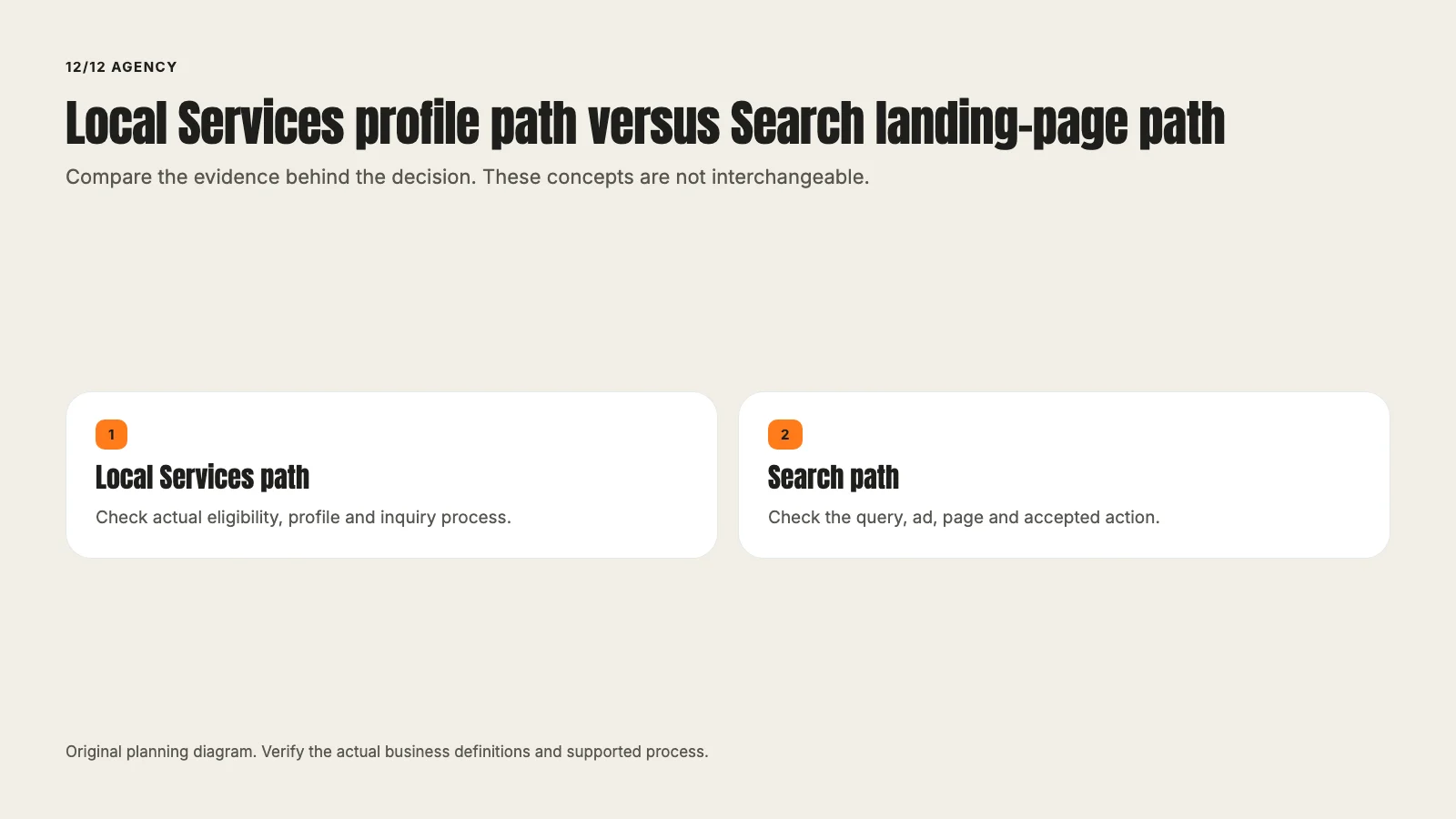
A Local Services prospect can evaluate the supported profile and contact options. A Search ad can lead to a page that explains a specific service, project or offer. Each route needs accurate information and a team ready to handle the inquiry.
For a fictional HVAC company, an urgent repair inquiry may require a different handoff from a planned replacement consultation. For a fictional roofer, a repair assessment and a commercial replacement project may need different evidence. The HVAC and roofing service contexts should guide the promise.
Do not label a channel better merely because its form is shorter. A simpler request can create more contacts while leaving the office with less context. A longer page can explain fit but may also contain avoidable friction. Review the actual journey.
Understand what is being charged
The current Local Services documentation describes payment for leads related to the business's offered services. Search campaign costs depend on the actual campaign and auction setup. Neither charging label establishes the cost of a won job.
Read the current account terms and reporting definitions. For Local Services, review the applicable lead assessment or credit process rather than assuming every unwanted inquiry can be disputed under an old workflow. For Search, distinguish click cost from accepted-request cost and later business outcomes.
Management, creative, landing-page work and intake costs can also belong in a full acquisition comparison. The paid media overview and Google Ads service page describe the engagement context without making either source's cost universal.
Build the same outcome ladder
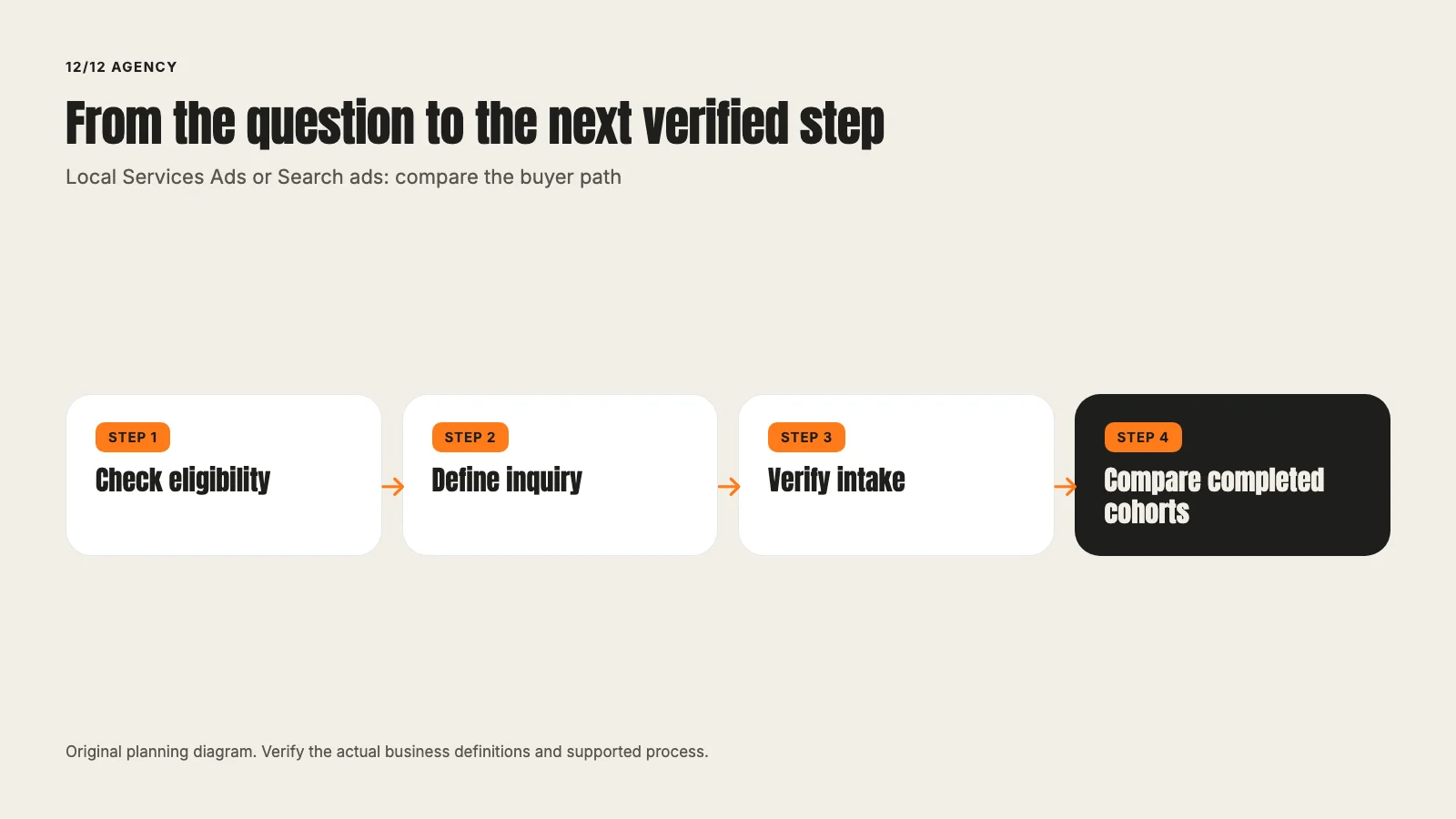
Define accepted inquiry, suitable service request, contacted prospect, appointment, completed visit and won job. Use the same business definitions across the comparison where possible. If a platform's lead total differs from the office's accepted-request count, explain why.
A contact that progresses through several stages is still one project. Do not count the inquiry, appointment and won job as three customers. Keep duplicate and test identities separate.
The conversion-tracking guide supplies the broader system distinctions. Some source information may be available, while other offline outcomes require a reviewed connection or manual cohort analysis. Do not promise perfect attribution for every call.
Work through an illustrative comparison
Suppose source A costs a fictional $2,000 and delivers 20 recorded inquiries. Source B costs $2,400 and produces 40 accepted requests. Their early-stage costs are $100 and $60 respectively, although the inquiry definitions must still be reconciled.
After the same outcome window, assume A has eight booked visits and four won jobs, while B has eight booked visits and two won jobs. The simple included cost per booked visit is $250 for A and $300 for B. Cost per won job is $500 and $1,200.
These invented counts demonstrate the worksheet. They are not Local Services or Search benchmarks. Different project mix, geography, availability and source definitions could change the interpretation. A small number of jobs should not support a permanent channel verdict.
Review operational readiness
Check who receives calls and messages, during which hours, and what happens when the primary person is unavailable. An inquiry route can be technically working while the business cannot fulfill its promise.
Inspect the profile or landing-page information against current service availability. Do not advertise emergency response, instant booking or a service area without verification. A campaign cannot create the necessary staffing, license or project capacity.
For Search, verify the actual page, form or calendar path. For Local Services, review the supported lead route and account requirements. Any real test that creates an inquiry or booking needs an approved labeled plan. Avoid repeated notifications to a working intake team.
Design a comparison the business can interpret
A matched test needs a defined job, operating area, period and cost boundary. Channels may reach different demand, so perfect equivalence is not always possible. Record the differences and preserve them in the result review.
Avoid changing several major variables while claiming to isolate the channel. If service availability, page copy and budget all change together, the result is a combined operational test. That can still be useful if described honestly.
Budget, bid, status and targeting changes remain approvals. This article supplies a decision framework, not authority to launch, pause or increase spending.
Choose the next useful step
If the business is ineligible for Local Services, improve the supported acquisition path rather than inventing a workaround. If the intake is broken, repair it before buying more contacts. If the definitions differ, reconcile the comparison before selecting a winner.
The home-services overview can help connect the source decision to the broader customer journey. A channel is one part of that system.
Bring the service, coverage and outcome definitions to a strategy session.
Build the comparison before the first paid result
Create an empty sheet with source, actual charge definition, included non-media costs, accepted inquiry, suitable request, booked visit, completed visit and won outcome. Add the entry period, review window and main exclusion reasons. The sheet should be usable by the office before it contains an attractive result.
For Local Services, attach the actual current eligibility and lead-assessment evidence relevant to the account. For Search, attach the approved campaign job, destination and goal definition. These are different prerequisites, so a missing item in one path should not be hidden by a complete item in the other.
Agree how shared demand will be handled. A person may contact the business more than once or arrive through several recorded interactions. The business needs a project identity and duplicate rule that reflects reality, not one that simply makes platform totals add neatly.
Also record operational changes during the comparison. If one source runs while the office is staffed and another reaches people during unavailable hours, the result includes that difference. It may still inform a practical decision, but it does not isolate the channel alone.
At review, show the counts and cost definition together. If the data is immature, state the next date or evidence needed. If the handoff is broken, propose a repair. A useful comparison does not require declaring a winner before the business has enough verified outcomes to support the claim.
Frequently asked questions
Want this run for your business?
Tell us where to send it and we'll follow up with the strategies that fit your market.