
Event marketing: connect the offer to attendance
David A · Founder, 1212 Agency
Published November 16, 2026

Plan event marketing around the real offer, registration process and venue capacity. Keep applications, payments, registrations and attendance separate.
An event campaign can produce a long list of interested people without showing who registered, paid or attended. The marketing plan needs to preserve those stages and the capacity constraints behind the offer.
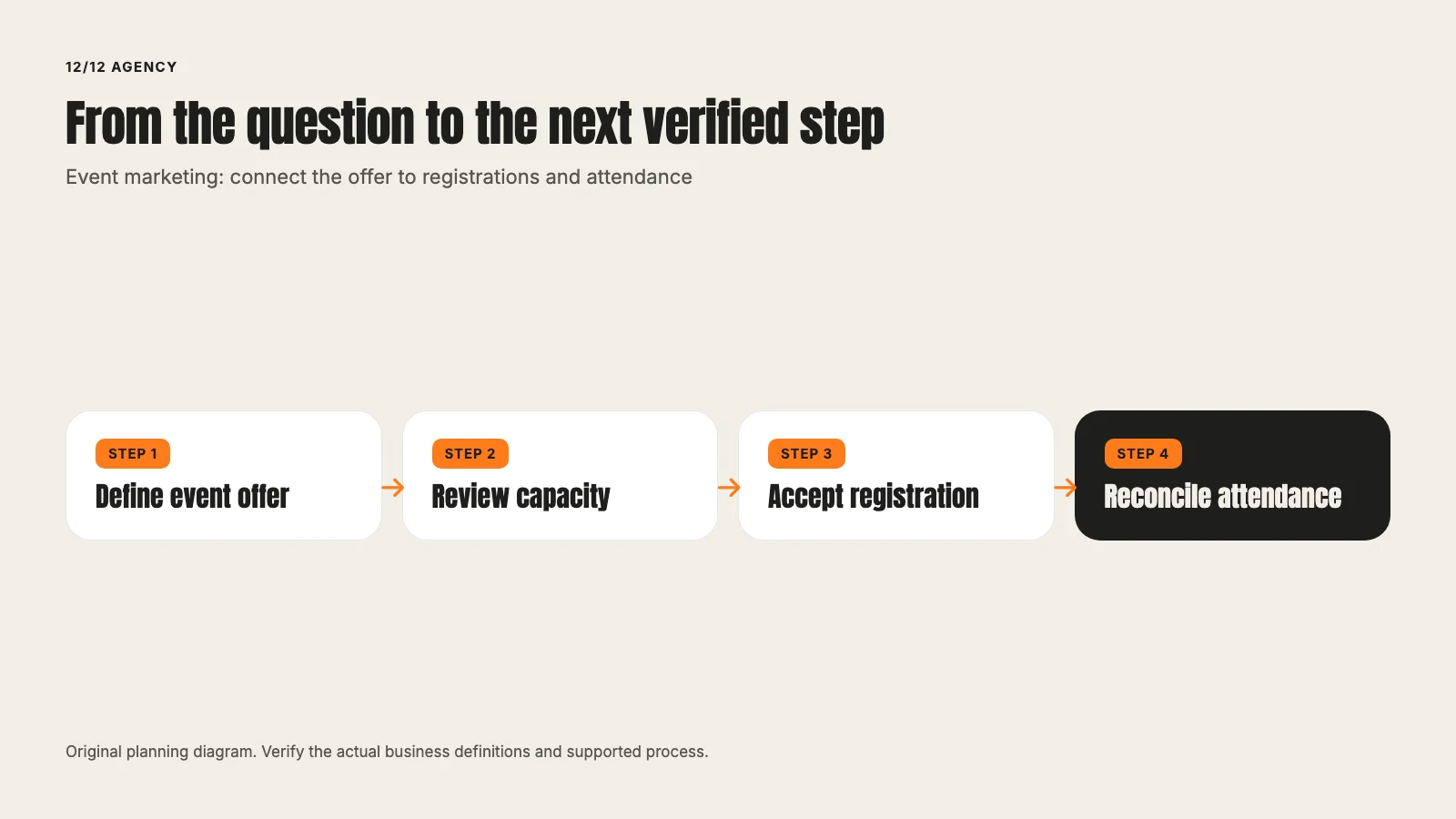
Start with the event's actual purpose and the next action the team can fulfill. Then connect the campaign, destination, registration and on-site evidence. The examples in this guide are fictional planning scenarios, not event results or ticketing-platform claims.
Define the event and the participation decision
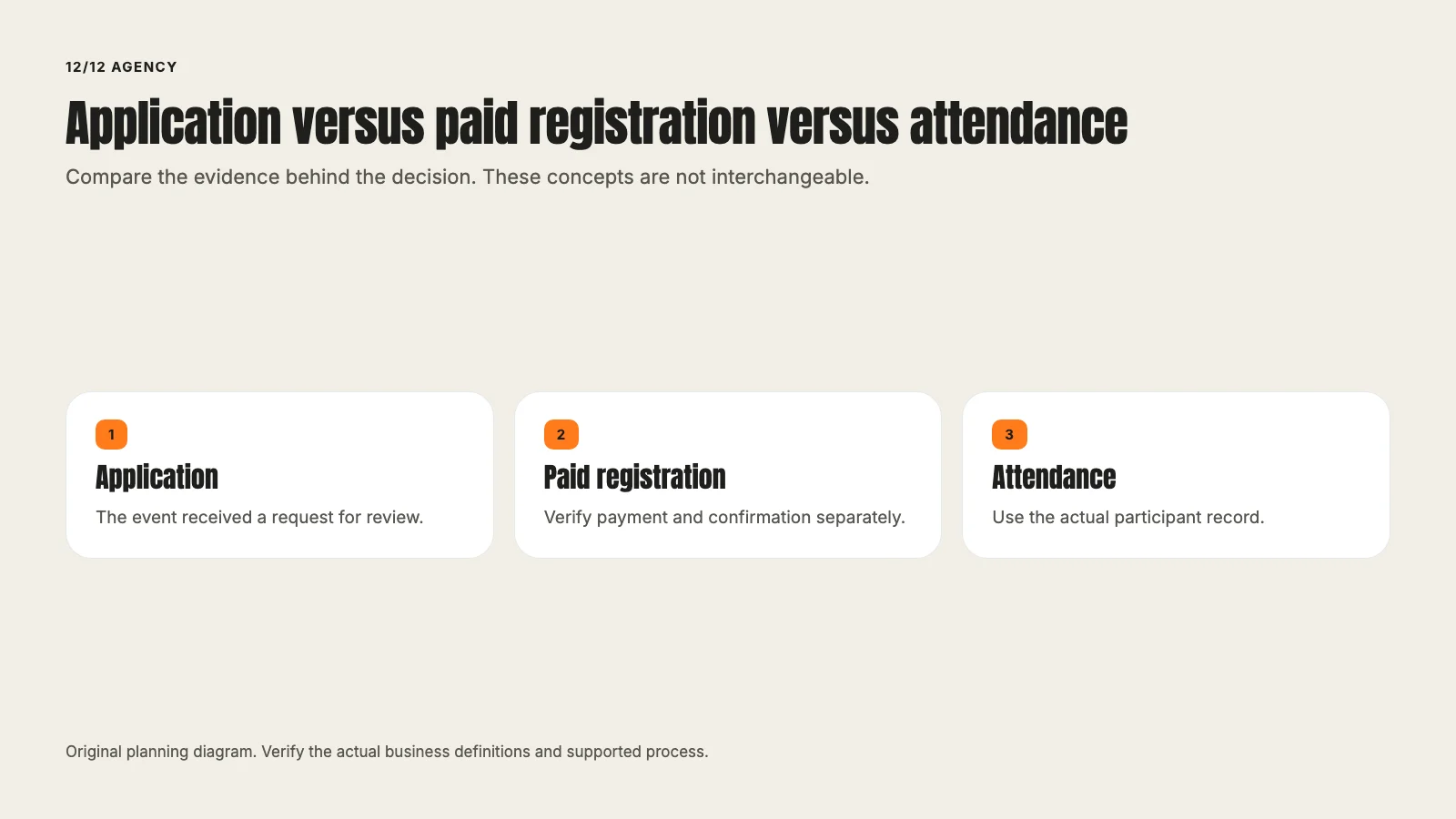
A public ticketed event, a qualified application and a private consultation have different entry paths. A free expression of interest is not a paid registration. An approved application may still require a separate payment or confirmation step.
The experiential overview can explain the commercial engagement, while the luxury-event page should retain its distinct context. Do not create another broad agency page merely because a keyword tool returns a close phrase.
Write the actual participation promise in one sentence. Identify what the person receives, what is required and what confirms their place. If the team cannot answer those questions, acquisition should not fill the gap with vague exclusivity or urgency.
Verify the offer and capacity
Confirm date, location, eligible audience, capacity, included experience and approved terms. Pricing, deadlines, refund or transfer terms and availability need the responsible business review. Do not invent them to make the page more persuasive.
A capacity claim should come from the actual event plan. If places are allocated after an application, say so rather than implying immediate booking. If a waitlist is offered, the system and follow-up process must actually exist.
Keep public information current. A changed venue or schedule affects the destination, confirmations and campaign creative. Identify who maintains the source of truth and how an approved change is checked across the journey.
Match the campaign to the right level of commitment
An awareness explanation may introduce the experience. A registration campaign asks for a specific action. A reminder to an eligible registered participant has another purpose. Those jobs should not be judged with the same click metric.
A Meta advertising plan may demonstrate the experience to relevant people. A Google Search plan may reach an existing event or category query. A LinkedIn plan may be relevant for a professional audience. The actual fit depends on the event, offer and approved targeting.
Use accurate creative. Images from another event should not imply they document this year's venue, attendance or exact experience. Label representative context where needed and use cleared assets.
Design the registration explanation
The page should make the commitment understandable before collecting information or payment. Explain whether the action is an application, reservation, purchase or request for more information.
Collect only the fields the reviewed process needs at that stage. An event application should not ask for private details merely to appear selective. Any necessary sensitive information needs an appropriate handling process and qualified review.
Inspect mobile controls, errors, payment return where applicable and the confirmation. Do not assume a ticketing integration works because the vendor lists it as a feature. Verify the actual implementation and its limitations.
Preserve campaign context through the route
An event journey may cross a marketing page, application, payment provider and confirmation system. Source information can be lost at an intermediate link even when the first page shows it correctly.
Map the supported parameters and identifiers with the technical team. Preserve existing destination settings and follow the approved consent behavior. Do not force tracking permission or place personal details in campaign URLs.
The conversion-tracking guide explains why a tag receipt, accepted registration and paid-attributed result are different evidence. A successful technical request alone does not establish a paid registration or attendance.
Define a stage contract
A practical ladder can include accepted interest, application received, application approved, registration confirmed, payment verified and attendance recorded. Not every event needs every stage. The labels should reflect its actual process.
Record timestamps and stable identifiers where the system supports them. Repeated updates should not create extra participants. A participant who applies, pays and attends is still one person, not three customers.
Keep test and duplicate identities separate. If a QA transaction automatically creates a deal or ticket record, label it as QA and exclude it from commercial counts. Do not quietly delete it or cancel a place without approval.
Model contribution with explicit assumptions
Suppose a fictional event has 100 available places and the plan assumes 80 confirmed registrations with 75% attendance. The scenario models 60 attendees. Those are assumptions, not observed turnout or a promise about another event.
If the included acquisition cost is $6,000, modeled cost per registration is $75 and per attendee is $100. Those amounts say nothing about event profit. Venue, delivery, staffing and other costs remain outside the model unless entered.
A contribution worksheet needs actual or explicitly assumed revenue and eligible costs. Do not call registration value collected revenue before payment is verified. Do not treat an application as a sale because it has an estimated value in a CRM.
Plan follow-up as part of the experience
Approved reminders can explain logistics and the next required action to eligible participants. Marketing nurture to interested people is a different message class. The actual permission, sender and suppression process need review.
The FTC's commercial-email guidance is a relevant primary source for covered US email. It does not make every event-related message transactional. The responsible team should classify the actual message and applicable requirements.
Google's personalized-advertising policy may also matter depending on the event and audience. Review the concrete offer instead of assuming ordinary retail targeting fits every experience.
Review the event through a complete window
Before the event, inspect accepted registrations, capacity and the working handoff. Afterward, reconcile attendance and verified commercial outcomes with the entry cohort. Note changes in schedule, offer, weather or operating conditions that affect interpretation.
The next decision may be a clearer application explanation, a broken confirmation repair, a different creative hypothesis or a revised distribution plan. A retrospective should record what was observed and what remains uncertain, rather than attribute every attendance difference to one ad.
Keep capacity and confirmation in one record
For each acquisition path, identify what confirms a place and which source controls remaining capacity. An accepted application, payment receipt and attendance check can occur in different systems. The event team should agree how those records are reconciled without duplicating participants.
A fictional review may find that a confirmation email is sent before the application is approved. The copy should then describe the narrower received state, or the process needs an approved correction. Calling it a confirmed place would create the wrong expectation.
The same principle applies to scarcity language. A limited-capacity claim needs a current verified source and an update responsibility. It should not remain in a creative template after the underlying allocation changes.
At review, show the exact offer, acceptance evidence and next operational step together. That lets the team distinguish a registration-system issue from a campaign message issue. It also protects the participant experience: a marketing test should not reserve a real place, charge a card or cancel a booking unless that specific consequence has been approved.
Bring the event offer, capacity and registration path to a planning session.
Frequently asked questions
Want this run for your business?
Tell us where to send it and we'll follow up with the strategies that fit your market.